
"Dr. Ou, I saw so many Ellanse disaster stories on Dcard, and it can't be dissolved. Is Ellanse really safe?" This is the question patients ask me most often in the clinic.
Ellanse itself is a very good product: firm, long-lasting and not prone to migration, with many advantages hyaluronic acid does not have. But it is also very demanding on the doctor's technique.
That is why I only started recommending Ellanse after injecting thousands of syringes of hyaluronic acid, when I was confident of a 0% failure rate in the area. Ellanse allows success only, not failure.
Ellanse (Ellansé, also called the "girl needle" in Taiwan) is a collagen stimulator made of 30% PCL microspheres and 70% CMC gel, and it fills on the day of treatment. Its biggest advantage is that it does not deform or migrate; its biggest risk is that it cannot be dissolved, because there is no antidote. So most "Ellanse disasters" are not product problems but too much volume or the wrong layer.
In this article I share my experience injecting Ellanse: which areas it suits, its pros and cons, and how it differs from hyaluronic acid and other collagen stimulators, so you can better judge whether Ellanse is right for you.
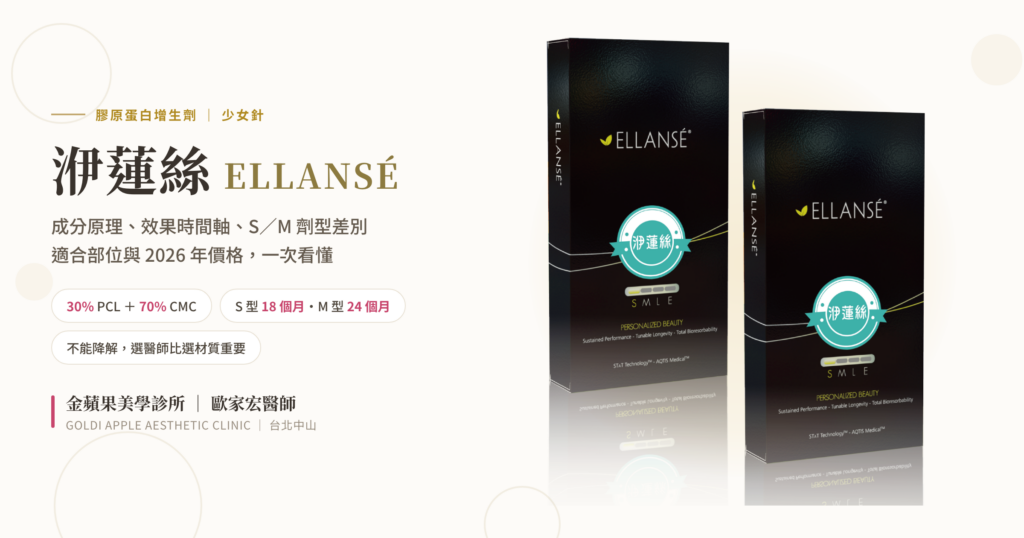
Ellanse at a glance
| Other names | Ellanse = girl needle = Ellansé, the same product |
|---|---|
| Product type | Collagen stimulator (not hyaluronic acid) |
| Ingredients | 30% PCL microspheres + 70% CMC gel |
| How it works | CMC fills immediately on the day, then PCL keeps stimulating your own collagen |
| Duration | S type 18+ months, M type 24+ months (manufacturer's figures) |
| Biggest advantage | Immediate filling, resists migration, long-lasting |
| Biggest risk | Cannot be dissolved, no antidote |
| Best areas | Forehead, temples, nasolabial folds (nasal base), apple cheeks |
| Not recommended areas | Superficial periocular area (superficial tear trough), lips, nasal root |
| Reference price | S type 1cc about NT$20,000–25,000; M type 1cc about NT$25,000–32,000 (2026 market range) |
1. What is Ellanse? The girl needle and Ellansé are the same product
Every clinic consultation throws these names at you and it is easy to get confused. Ellanse = girl needle = Ellansé are all the same thing. It is a collagen stimulator, not hyaluronic acid.
Ellanse ingredients: 30% PCL microspheres + 70% CMC gel
"Dr. Ou, does Ellanse work right after the injection?" Yes. Ellanse contains 70% CMC gel, which fills right away, so it has both "immediate filling" and "long-term collagen stimulation".
- PCL (polycaprolactone) microspheres, about 30%: the real star, responsible for stimulating collagen production
- CMC (carboxymethylcellulose) gel carrier, about 70%: provides the filling effect during the transition, holding the volume before collagen has grown, and is gradually metabolized after about 2–3 months
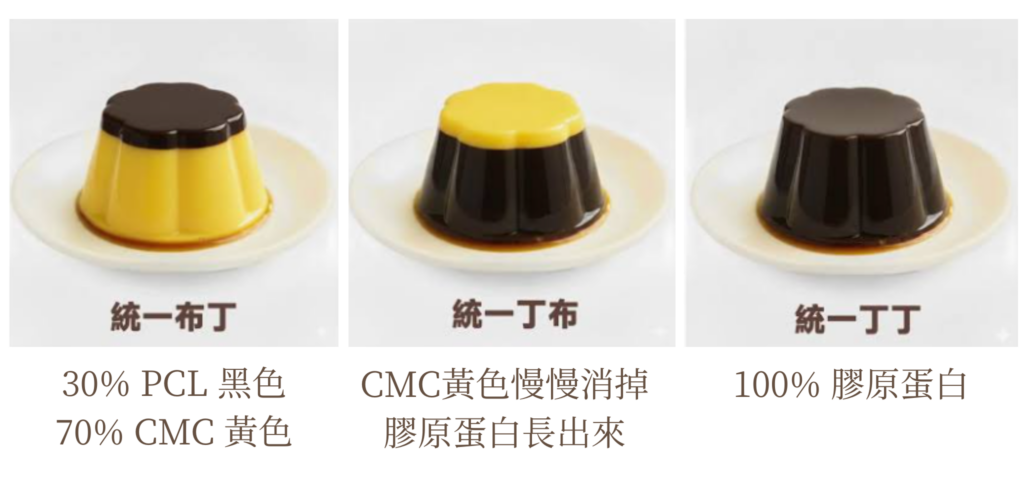
Let me explain with a pudding analogy: the CMC gel is like the yellow custard and the PCL microspheres are the black caramel. After injection the custard gradually shrinks while the collagen grown around the caramel slowly replaces it, until the CMC gel is completely gone and only your own grown collagen remains.
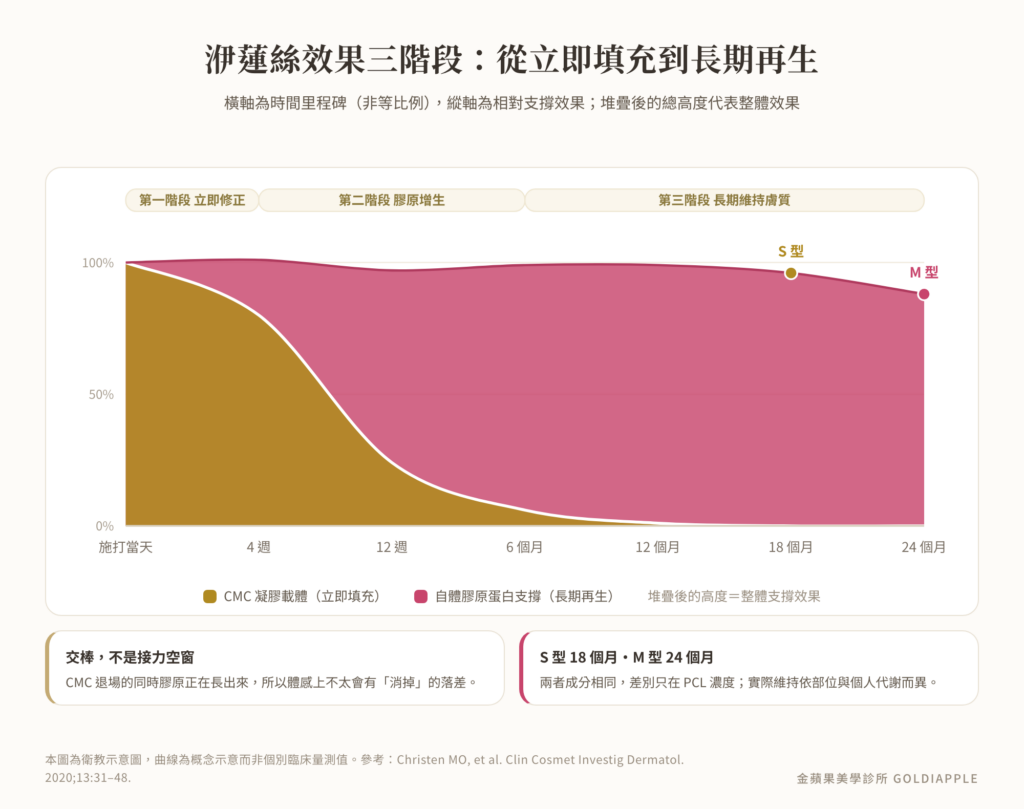
Ellanse results: what you see right after is the final look
From start to finish, the total volume stays the same. So patients often ask me, "Will Ellanse over-grow?" The answer: the volume you have right after injection is the volume you will have later. "Over-growth" simply means too much was injected at the start. Many people are talked into injecting a dozen syringes at once by clinics, and of course they end up puffy. The main cause of puffy faces after Ellanse is dose, not the product.
Ellanse looks plump immediately after injection. Some people feel it shrinks a bit after a month and want to top up in a hurry. I tell them to wait: that is just the CMC stand-in actor getting ready to leave the stage.
That is when the star comes on. From 1–3 months, the PCL microspheres keep stimulating collagen growth, and the collagen volume that grows is what lasts longest, for a total of 18–24 months.
| Stage | Time | Main player | What you notice |
|---|---|---|---|
| Stage 1: immediate correction | Same day | CMC gel | Hollows are filled right after injection |
| Stage 2: collagen growth | 1–3 months | PCL microspheres | CMC is slowly absorbed while PCL stimulates collagen growth |
| Stage 3: long-term skin improvement | 3 months to 2 years | Your own collagen | Continued collagen renewal improves skin texture |
How Ellanse works: how PCL makes collagen grow
Why are the PCL microspheres the star of Ellanse? After injection they release stimulating signals. The immune system detects a foreign body and sends collagen fibers to surround the microspheres.
The key way Ellanse beats hyaluronic acid: hyaluronic acid is gradually broken down, needs repeated top-ups, and can only prop up volume in hollows. Ellanse grows new tissue whose texture is closer to truly young skin, improving skin density, firmness and elasticity at the same time.
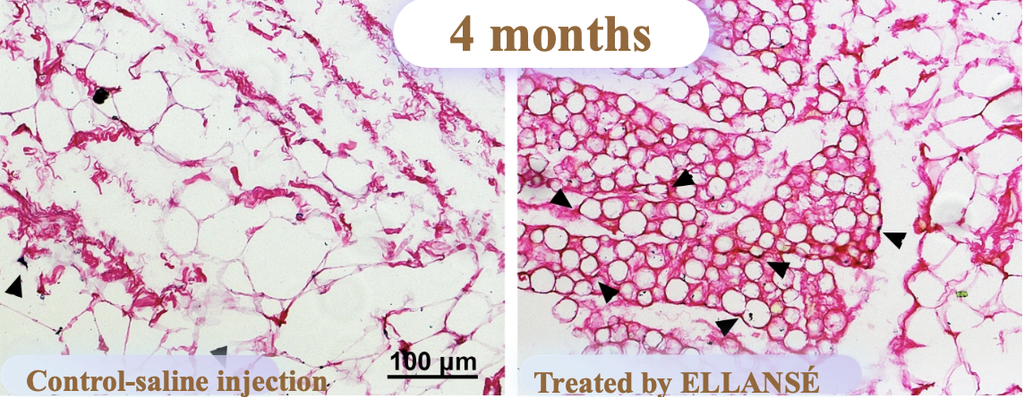
The images below are real changes under the microscope. Four months after injection, stimulated by PCL, collagen has clearly grown in the tissue and the skin has become firmer.
2. Pros and cons of Ellanse: no deformation, no migration
Why does Ellanse resist migration?
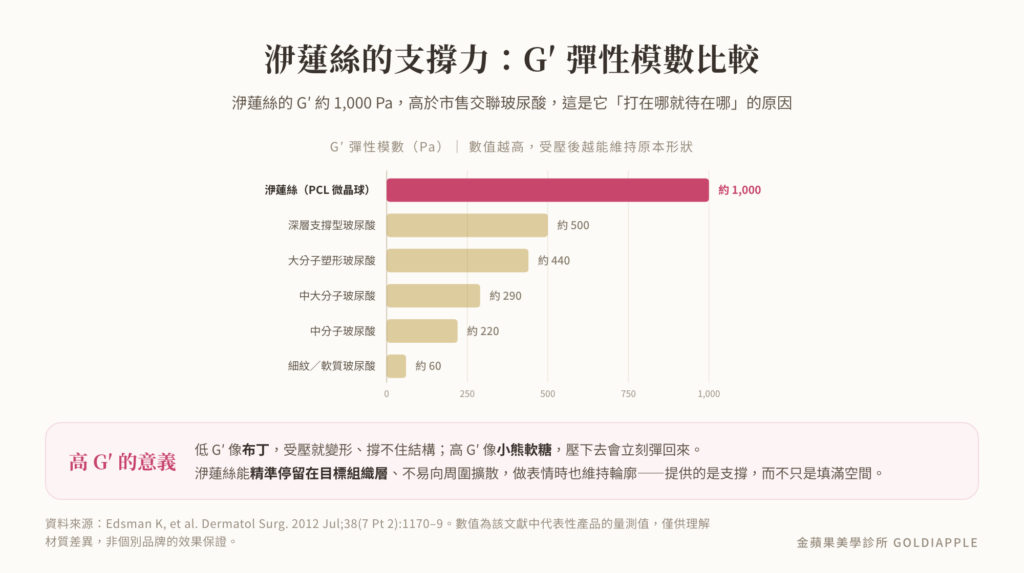
Resistance to migration and deformation is what I like most about Ellanse. Its elastic modulus (G′) is about 1,000 Pa, far higher than common cross-linked hyaluronic acid, which is why it "stays where it is injected".
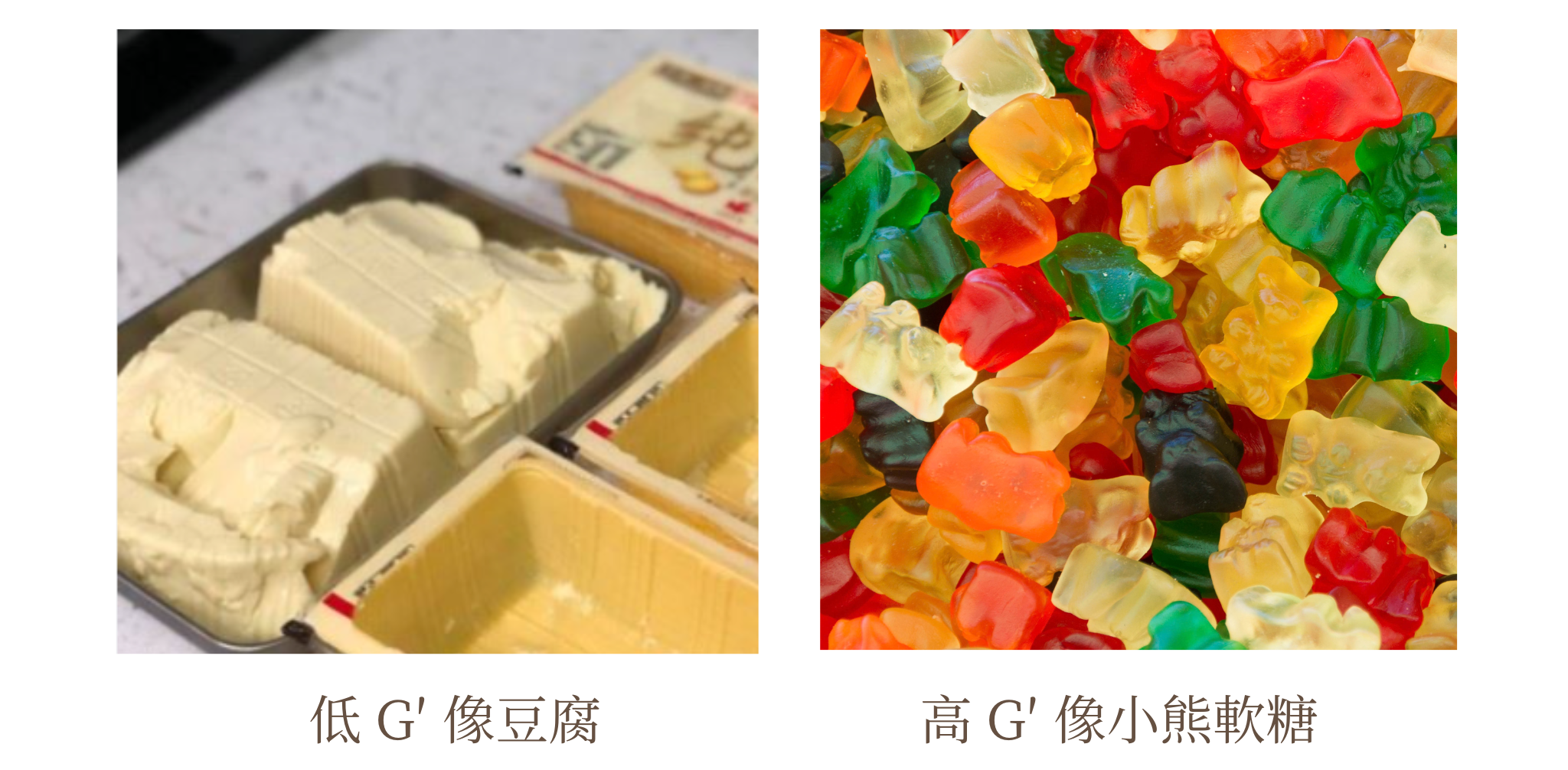
- Low G′ is like tofu: it deforms under pressure and cannot hold structure
- High G′ is like a gummy bear: it springs back immediately when pressed
Ellanse has a G′ of about 1,000 Pa. Supportive hyaluronic acid (such as Restylane SubQ) at about 500 Pa is already at the top of the hyaluronic acid range, and ordinary small and medium molecule hyaluronic acids mostly fall between 60 and 450 Pa.
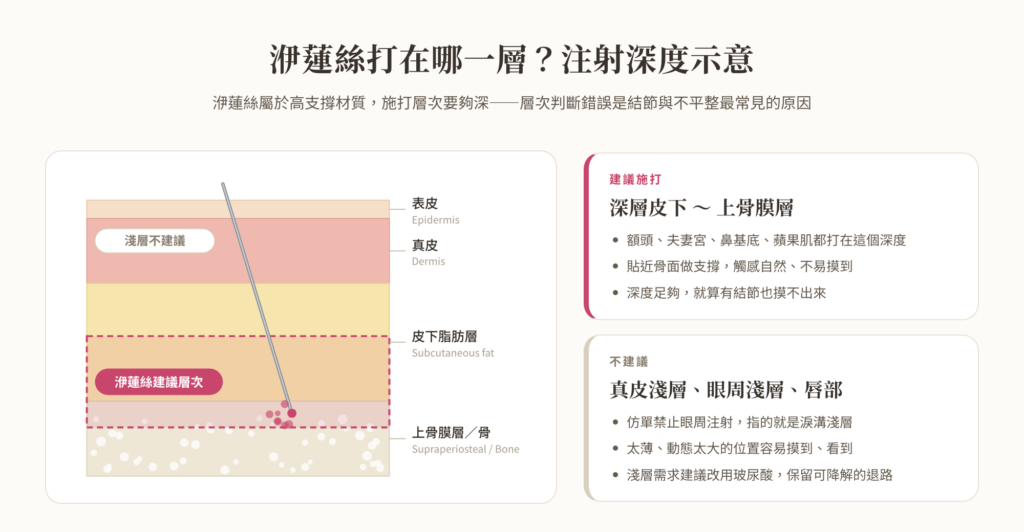
Ellanse stays precisely in the target tissue layer and does not easily spread to surrounding areas, keeping the contour even during facial expressions. In other words, it provides "stable support", not just filling space. This is why the forehead, temples and nasal base, which need a sense of bone structure, are where Ellanse is chosen first.
Conversely, this is also why it does not suit the superficial periocular area, the nasal root and the lips: a material this firm placed in a thin, shallow spot is easy to feel and see.
Pros of Ellanse
- Immediate results plus long-term regeneration, with no gap in effect
- Long-lasting: S type 18+ months, M type 24+ months, without the frequent top-ups hyaluronic acid needs
- Firm and resistant to migration: G′ of about 1,000 Pa suits areas that need support (forehead, temples, nasal base) and it is less likely to be pushed around by expression muscles than hyaluronic acid
- No "memory pillow" effect: hyaluronic acid in the forehead often leaves a dent when pressed, while the collagen grown after Ellanse feels closer to real tissue
Cons of Ellanse
After the pros, the cons need to be stated even more clearly. These are not signs of a bad product but its characteristics, and you must be able to accept them.
- It cannot be dissolved, the most important point: there is no antidote, so choosing the right doctor is crucial. If the dose or layer is wrong, it is much harder to deal with than hyaluronic acid; currently the only options are steroid injections or surgical removal
- Not suitable for very thin, superficial areas: the superficial periocular area, lips and nasal root are not suitable for Ellanse
- Not suitable for very fine sculpting: for delicate line adjustments hyaluronic acid is still more flexible, and reversible
3. Who is Ellanse suitable for? What can it improve?
Who Ellanse suits
More suitable:
- People with significant bone loss who need a "firmer" material for support, such as a sunken forehead
- People who have had hyaluronic acid but feel it is metabolized too fast and do not want to redo it every year
- People who want improvement on the day of treatment and also long-term collagen rebuilding
- People troubled by the memory pillow effect in the forehead
Less suitable:
- People who want to keep the option of "dissolving it if I regret it": please think this through carefully
- People who only want to treat superficial fine lines around the eyes or the lips
- People who are already clearly puffy or can feel lumps: existing filler must be dealt with first
Which areas suit Ellanse best?
The four best areas for Ellanse are the forehead, temples, nasal base (nasolabial folds) and apple cheeks. All of them need a firm material for support, and if budget allows I recommend going straight to Ellanse.
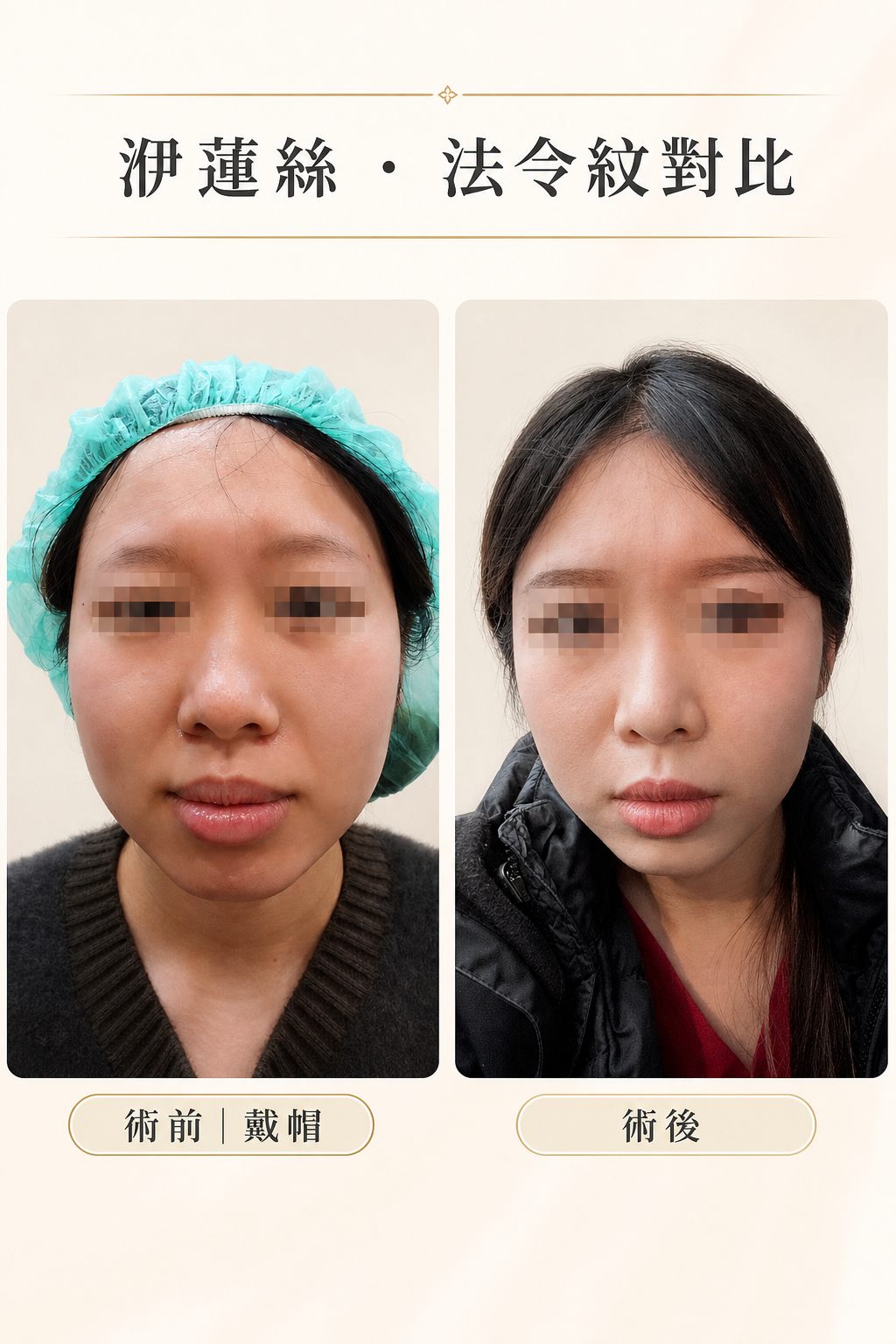
Ellanse for nasolabial folds (nasal base)
The labeled indication of Ellanse is the nasolabial fold. The product was designed to treat sunken nasolabial folds, and compared with hyaluronic acid it migrates less and lasts longer. I suggest starting with 1cc and adding more after 2–3 months if needed.
For details, read: Does Ellanse work for nasolabial folds?
Ellanse for the forehead
Hyaluronic acid in the forehead easily causes the memory pillow effect. The collagen from Ellanse feels closer to a real forehead, and since the forehead metabolizes slowly, my patients report it lasting over 3 years. Forehead hollows usually cover a wide area, so I suggest 2–3cc.
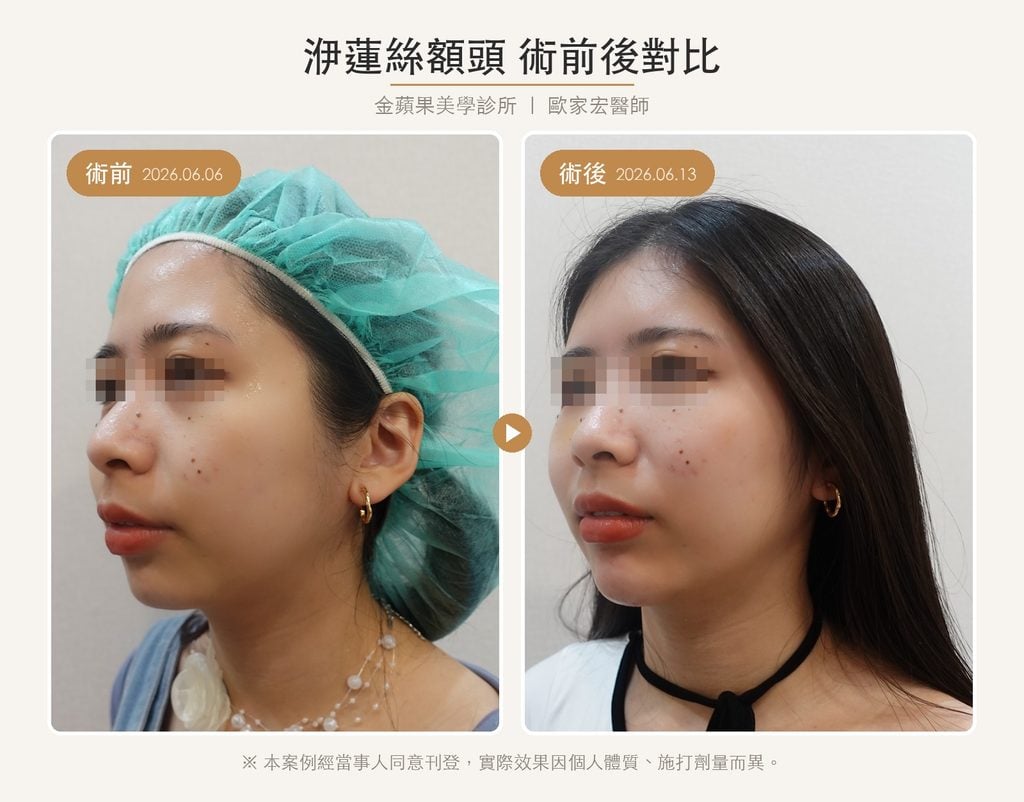
For a detailed comparison, read: Best fix for a sunken forehead: pros and cons of Ellanse forehead
Apple cheeks / deep tear trough
This area is the most debated, so I want to be precise: the label prohibits injection around the eyes, which means the superficial tear trough must not be injected, otherwise it becomes tear-trough "caterpillars" that cannot be treated. What is commonly called "Ellanse tear trough" is actually injection in the deep layer to support bone loss in the apple cheeks, which improves the tear trough indirectly. So it can be done, but only in the deep layer; for the superficial 1cc I recommend hyaluronic acid, which is safer.
For details, read: Can Ellanse be used for the tear trough? Why deep is fine, superficial is not, and prices
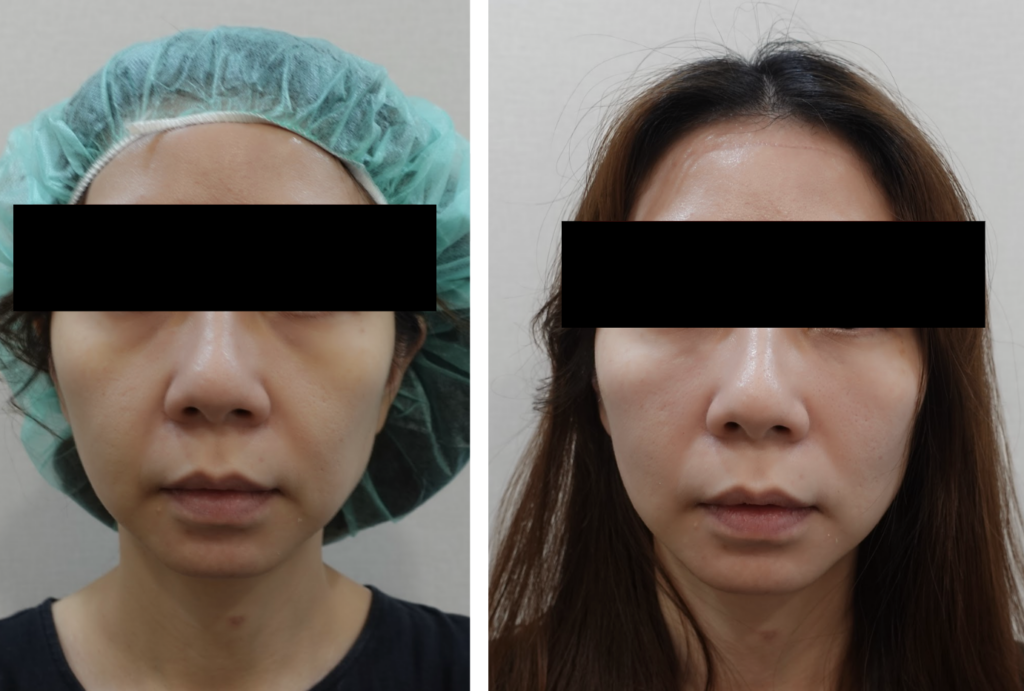
Ellanse for the temples
This is the safest of all areas. The temple is deep, so even if a nodule formed you could not feel it; and the temple metabolizes quickly, so plain hyaluronic acid usually needs topping up soon, which makes Ellanse better value. I suggest 2cc.
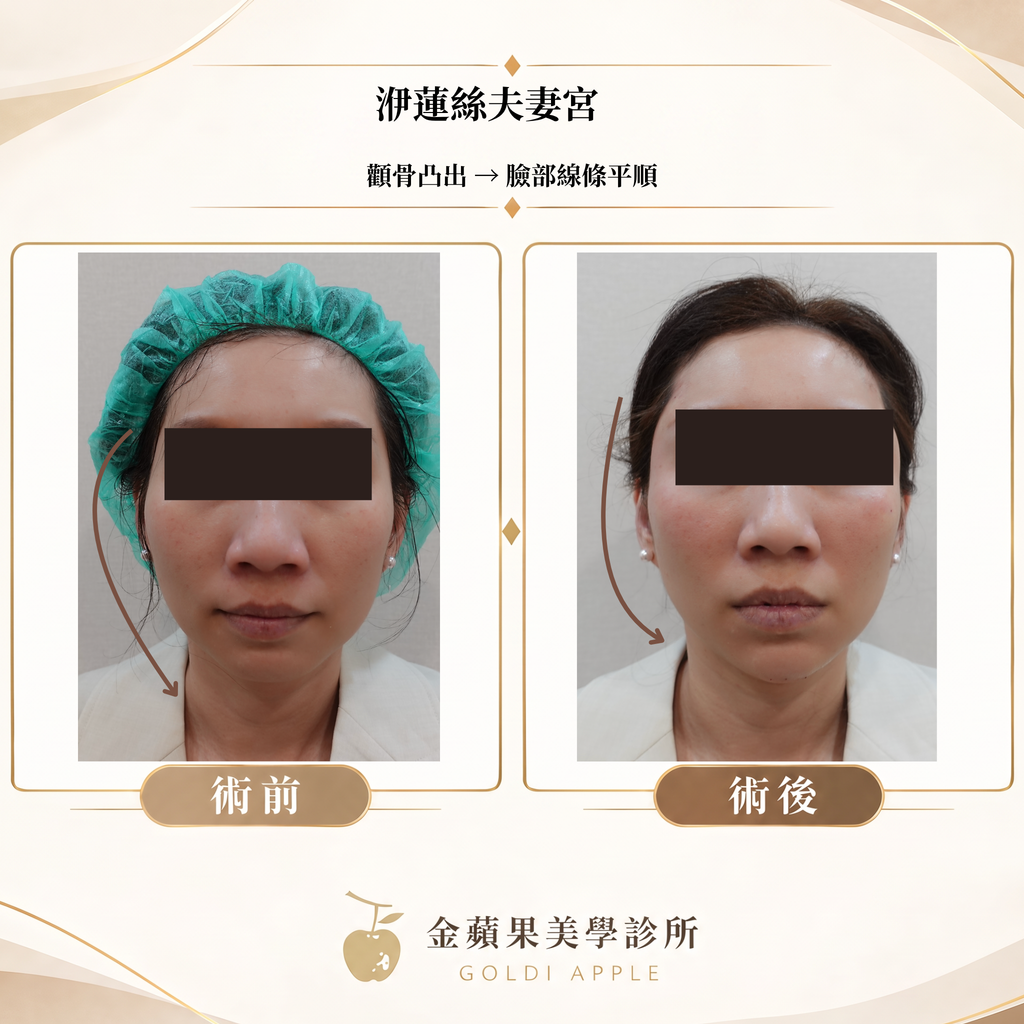
For details, read: Who is Ellanse for the temples suitable for? Treatment, results and precautions
4. What is the difference between Ellanse S type and M type?
In one sentence: the ingredients are exactly the same and the only difference is the concentration of PCL microspheres. M type has a higher concentration and is labeled by the manufacturer to last 24+ months; S type 18+ months.
| Ellanse S type | Ellanse M type | |
|---|---|---|
| Ingredients | PCL microspheres + CMC gel | PCL microspheres + CMC gel (same) |
| PCL concentration | Lower | Higher |
| Duration labeled by manufacturer | 18+ months (about 1.5 years) | 24+ months (about 2 years) |
| Price per 1cc (NT$) | 20,000–25,000 | 25,000–32,000 |
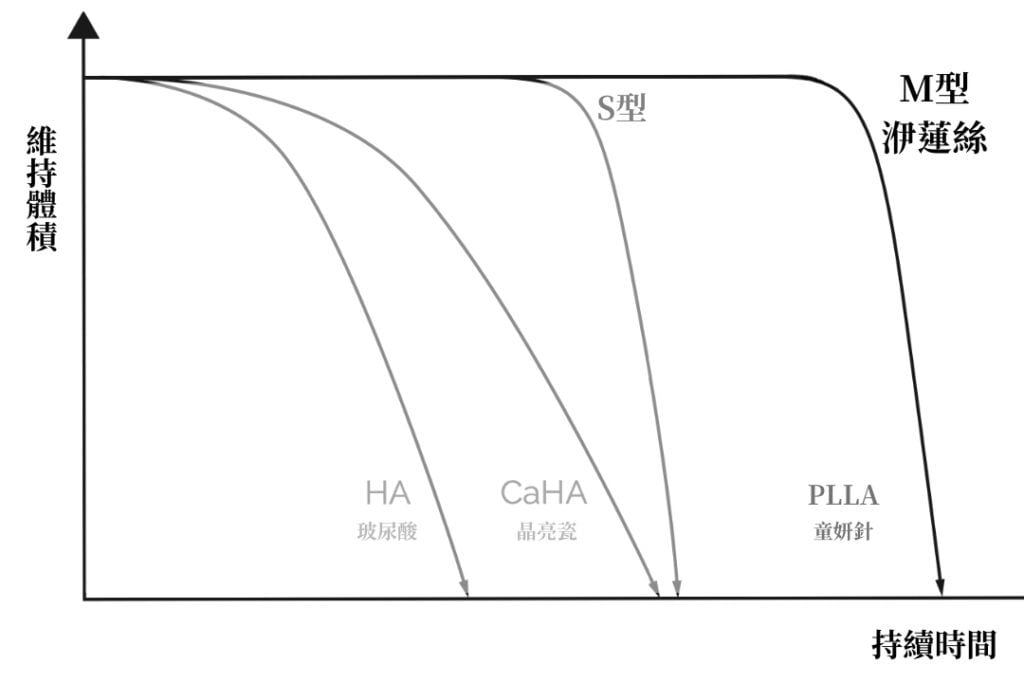
The manufacturer's clinical data show that both S and M types maintain stable satisfaction 2 years after treatment.
Which should you choose? Neither S nor M can be dissolved. S type lasts about as long as large-molecule hyaluronic acid, so hyaluronic acid would do. If you have decided on Ellanse, the longer-lasting M type is better value. Golden Apple Aesthetic Clinic mainly uses M type Ellanse.
5. How does Ellanse differ from other treatments?
Ellanse vs. hyaluronic acid
Hyaluronic acid "plumps up as soon as it is injected" but is gradually absorbed by the body and needs repeated top-ups. Ellanse first holds the volume with gel, then your own collagen takes over, so the effect evolves over time and lasts longer.
The two are not competitors. In practice a common approach is Ellanse for deep support and hyaluronic acid for the superficial layer and fine adjustments. The tear trough is the classic example (Ellanse in the deep apple cheeks, hyaluronic acid in the superficial layer).
| Hyaluronic acid | Ellanse | |
|---|---|---|
| Main ingredient | Hyaluronic acid | 30% PCL microspheres + 70% CMC gel |
| How it works | Injected to fill and take up space | Initial filling + stimulates your own collagen |
| How results appear | Immediate, then gradually broken down | Improvement on the day, then collagen growth later |
| G′ support (firmness) | About 60–500 Pa | About 1,000 Pa |
| Duration | About 6–12 months | S type 18 months, M type 24+ months |
| Pros | Can be dissolved with hyaluronidase, allows fine sculpting | Long-lasting, resists migration, no memory pillow effect |
| Cons | Short duration, absorbs water | Cannot be dissolved |
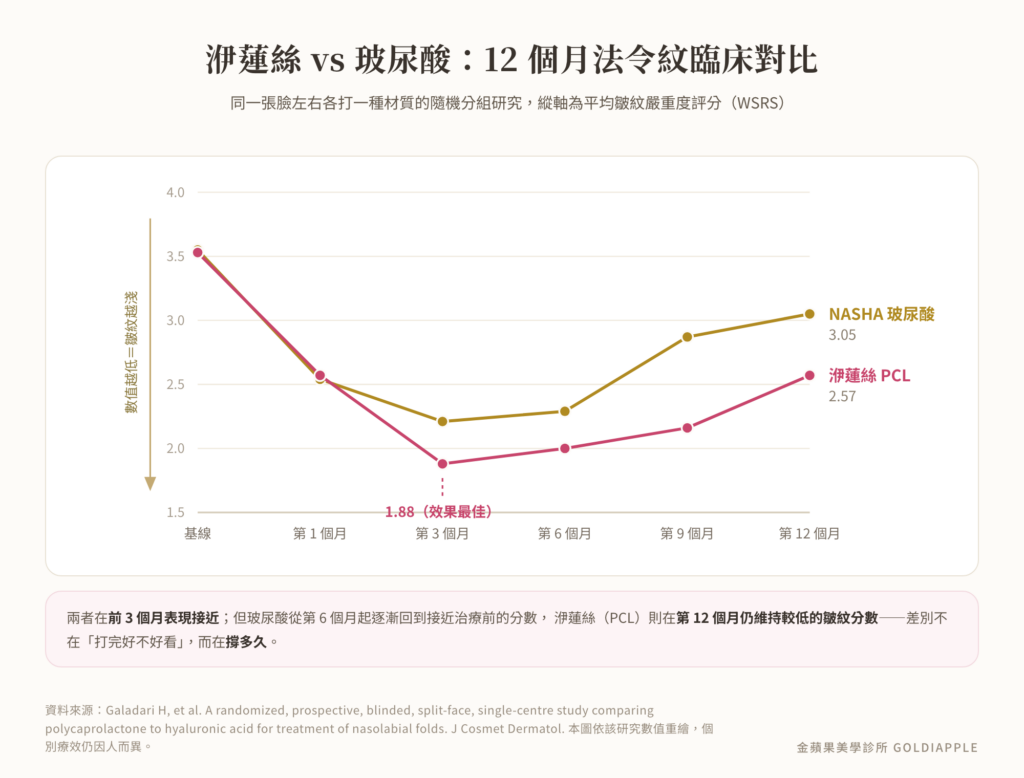
Ellanse vs. other collagen stimulators
The girl needle, Sculptra, Aesthefill, Radiesse and Vivacy are all collagen stimulators. Their stars are different collagen-stimulating ingredients, but the ultimate goal is the same: to stimulate your own collagen to grow. Each hires a stand-in actor (CMC gel or hyaluronic acid) to imitate the filling effect.
Besides immediate filling, these stand-ins have another important job: helping the stimulator spread evenly in the tissue, lowering the chance of nodules.
The collagen grown by each stimulator has a different softness. Rather than compare specifications, I will tell you directly which areas each suits:
| Material | Main ingredient | Suitable areas |
|---|---|---|
| Ellanse (girl needle) | PCL + CMC | Forehead, temples, nasal base, apple cheeks |
| Radiesse | CaHA + CMC | Forehead, temples, cheek hollows, brow bone, chin, nasal base |
| Sculptra | PLLA (no immediate filling effect) | Cheek hollows, temples, nasal base |
| Aesthefill | PDLLA + CMC | Cheek hollows, temples, nasal base |
| Vivacy / Juvelook-type products | PDLLA + HA | Cheek hollows, temples, nasal base, apple cheeks |
The biggest difference between Ellanse and Sculptra is how it feels: with Ellanse, what you see right after injection is how it will look later; with Sculptra there is almost no difference on the day, and you wait 2–3 months for the collagen to grow before seeing a change.
For full specifications and costs of the six stimulators, read: How to choose a collagen stimulator? Comparing Ellanse, Aesthefill, Sculptra, Vivacy, Nevre and Radiesse.
6. Before and after care for Ellanse. Are there side effects?
The biggest side effect: failure cannot be dissolved
The biggest difference between Ellanse and hyaluronic acid is that it cannot be dissolved, cannot be dissolved, cannot be dissolved. It is so important that I say it three times.
I often see patients asking me in tears: what do I do about nodules in my cheek hollows after Sculptra, or what do I do about tear-trough caterpillars after Ellanse. On Dcard you also see all kinds of Ellanse complications, which makes many people both love and fear this kind of product.
The advantage of this product is that it lasts, but the disadvantage is that it allows no failure at all. So let me be blunt: with collagen stimulators, the most important thing is not choosing the material, it is choosing the doctor. If Ellanse fails, even a god can hardly save you.
The key to reducing risk is the correct injection layer: the lower dermis or deep subcutaneous tissue, with the doctor judging the depth before injecting, which clearly reduces the risk of abnormal nodules and lumps. If you already feel a lump, read: What to do when Sculptra, Aesthefill or Ellanse fails?; if you are already puffy, read: What to do about a puffy face? 2 ways to treat it.
Before and after treatment
Before treatment
- Stop anticoagulants and blood-activating supplements (aspirin, fish oil, etc.) 1 week before treatment to lower the chance of bruising
- Pregnant women, people prone to keloids and people with autoimmune diseases should tell the doctor
- Tell the doctor if the area has had surgery or an implant, or if you recently had other injection treatments
After treatment
- Avoid vigorous massage of the injection sites within 24 hours
- Avoid deep facial massage for 1 month
- Avoid makeup on the day of treatment to lower infection risk; normal makeup is fine the next day
- If you feel the dose is not enough, wait 2–3 months after treatment until the collagen has stabilized before returning to decide whether to top up
7. Ellanse prices (2026)
The direct answer: Ellanse S type 1cc is about NT$20,000–25,000, and M type 1cc is about NT$25,000–32,000. They differ in PCL concentration: S type lasts 18+ months, M type 24+ months.
Recommended dose and cost range for each area (actual cost depends on the in-person assessment):
| Area | Recommended dose | Cost range (NT$) |
|---|---|---|
| Temples | 2cc | 40,000–50,000 |
| Forehead | 2–3cc | 45,000–65,000 |
| Nasolabial folds (nasal base) | 1–2cc | 25,000–45,000 |
| Apple cheeks (deep tear trough) | 1–2cc | 25,000–45,000 |
The cost difference comes mainly from three things: the type (S/M), the total cc, and whether hyaluronic acid is needed for the superficial layer. When evaluating, compare the total price of the whole plan, not just the price per syringe. Golden Apple Aesthetic Clinic Ellanse: 1cc NT$23,000 / 2cc NT$44,000 (latest prices: Golden Apple treatment prices).
Ellanse FAQ
What is Ellanse? How is it different from the girl needle and Ellansé?
They are the same thing. Ellanse is the Chinese product name, Ellansé is the manufacturer's brand name, and "girl needle" is the popular nickname. It is a collagen stimulator made of 30% PCL microspheres and 70% CMC gel, not hyaluronic acid.
How soon does Ellanse work, and how long does it last?
You see improvement on the day because of the CMC gel carrier. Over about 4–12 weeks the CMC is gradually metabolized while PCL starts stimulating new collagen, and the two hand over to each other, so you rarely notice a "drop-off". The manufacturer labels S type at 18+ months and M type at 24+ months; actual results vary with the individual and the area.
Does Ellanse ligament lifting work well?
I strongly advise against using Ellanse for ligament lifting. I have seen many disasters caused by it. Ellanse ligament lifting places Ellanse at different points on the outer contour, lifts the sagging tissue, and uses the Ellanse like a thumbtack to pin it in place for a lifting effect.
The problem is that right after injection it does lift, which looks great, but two or three months later the Ellanse grows in, and some people feel their cheekbones look wider and their face looks puffier. The best solutions for lifting are thread lifting or ultrasound; do not use collagen stimulators to lift.
Is Ellanse prone to nodules?
No product has a 0% chance of nodules. Ellanse has been on the market for a long time, and its perfectly round, smooth microspheres keep the inflammatory reaction as controlled as possible, minimizing nodule risk.
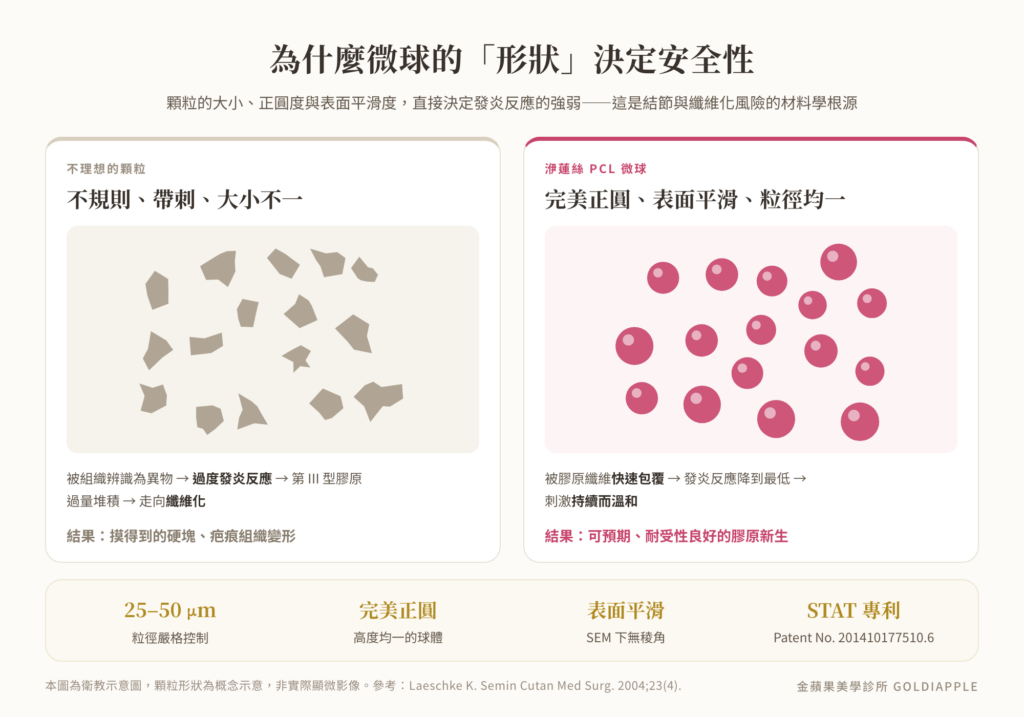
PCL microsphere patent: perfectly round spheres of 25–50 μm lower the nodule risk.
The biggest worry with collagen stimulators is nodules. The chance of nodules with Ellanse is actually low, and since Ellanse is injected only deep, even a nodule would hardly affect appearance.
A mild, controlled inflammatory reaction grows just enough collagen to fill the hollow, while excessive inflammation produces so-called nodules, which feel hard.
To lower the chance of nodules, the key is the particle size, shape and surface smoothness of the microspheres. The closer to a perfect sphere, the smoother the surface and the more suitable the size, the less likely they are to trigger excessive inflammation.
The PCL microspheres of Ellanse are made with the manufacturer's patented STAT technology, with three key specifications:
- Perfectly round with a smooth, even surface: almost no edges are visible under the electron microscope, giving complete tissue coverage that fully stimulates collagen without over-stimulating and producing unwanted connective tissue
- Particle size strictly controlled at 25–50 μm: if too small, they are swallowed by macrophages and the injection is wasted; if too large, nodules are more likely. This range is the safest and most appropriate size
- High predictability (the manufacturer calls it "1-to-1 precise correction"): inject 1cc and grow 1cc of collagen
The size, roundness and surface smoothness of the microspheres directly decide the strength of the inflammatory reaction, which is the material-science root of nodule and fibrosis risk.
Does Ellanse migrate or deform?
Not easily. Ellanse has a G′ (elastic modulus) of about 1,000 Pa, higher than commercial cross-linked hyaluronic acid (about 60–500 Pa), so it stays precisely in the target layer and does not easily spread, keeping the contour even during expressions.
What is the difference between Ellanse S type and M type? Which should I choose?
The ingredients are exactly the same; the only difference is the concentration of PCL microspheres. M type has a higher concentration and lasts 24+ months, S type 18+ months. People who choose Ellanse usually want results that last longer than hyaluronic acid, so M type is better value. Golden Apple Aesthetic Clinic mainly uses M type Ellanse.
Can Ellanse be dissolved? What if it fails?
No. Ellanse has no antidote like hyaluronidase for hyaluronic acid, which is its most critical difference from hyaluronic acid. PCL breaks down naturally over time, but the collagen that has grown cannot be actively removed, and failure can only be handled by surgical scraping.
Can Ellanse over-grow and make the face puffy?
The look right after Ellanse injection should be the final look. It does not grow without limit. The "over-growth" people worry about is mostly the accumulated result of too much dose at the start. So it is better to go in stages and inject a little less; if the effect is not enough, top up after 2–3 months.
Can Ellanse be used for the tear trough?
Yes, but only in the deep layer. The label's prohibition of injection around the eyes refers to the superficial tear trough, where injecting would cause tear-trough caterpillars that are hard to treat. In practice it is injected deep to support the bone loss of the apple cheeks, which improves the tear trough indirectly; for the superficial layer, hyaluronic acid is safer.
How is Ellanse different from Sculptra and Radiesse?
The main ingredient and feel are different. Ellanse (PCL) looks on the day as it will later, with both immediate filling and long-term growth; Sculptra (PLLA) shows almost no difference on the day and you wait 2–3 months; Radiesse (CaHA) is firm and its strength is deep structural support.
Which areas is Ellanse suitable for?
It suits the forehead, temples, nasolabial folds (nasal base) and apple cheeks best, all of which need a firmer material for support. The superficial periocular area, lips and nasal root are not recommended.
How much does Ellanse cost?
S type 1cc is about NT$20,000–25,000, and M type 1cc about NT$25,000–32,000 (2026 market range). The actual cost depends on the type, total cc and whether hyaluronic acid is added for the superficial layer; please rely on the quote for the whole plan after an in-person assessment.
Can I wear makeup after Ellanse? Is there downtime?
I recommend avoiding makeup on the day of treatment to lower infection risk; normal makeup is fine the next day. Most people have no obvious downtime, and there may be slight swelling, redness or bruising that fades within a few days. Avoid hot compresses and vigorous massage within 24 hours, and deep facial massage for 1 month.
Does Ellanse stay in the face?
PCL microspheres eventually hydrolyze into small molecules, are metabolized into carbon dioxide and water and leave the body, so they do not remain. But the collagen that grows stays, and this is often confused.
What does not remain is the stimulator that was injected, but the collagen your own body grew is another matter. "Cannot be dissolved" means there is no antidote like hyaluronidase. So if Ellanse is placed wrongly and fails, unless it is surgically debrided it stays on the face for a very long time (in my observation, about five years or more).
The three stages of PCL hydrolysis: in the early stage the microsphere keeps its volume and shape, and eventually it is metabolized into carbon dioxide and water and leaves the body.

Conclusion
Ellanse is a great filler, but nothing changes the premise that it cannot be dissolved. It is better to inject in stages and a little less, and a little deeper rather than shallower. The forehead, temples, nasal base and deep apple cheeks are its home turf; leave the superficial periocular area and lips to hyaluronic acid. With collagen stimulators, the most important thing was never choosing the material, it is choosing the doctor.
Am I suitable for Ellanse? Consult Dr. Ou of Golden Apple now!

All Ellanse used at Golden Apple Aesthetic Clinic is genuine manufacturer product (certified clinic lookup).
Not sure whether your hollows need Ellanse or hyaluronic acid? Add us on LINE and send one front and one side photo for Dr. Ou's initial assessment: @goldiapple (remember to include the @)
References
- Christen MO, et al. Polycaprolactone: How a Well-Known and Futuristic Polymer Has Become an Innovative Collagen-Stimulator in Esthetics. Clin Cosmet Investig Dermatol. 2020;13:31–48.
- Edsman K, et al. Gel Properties of Hyaluronic Acid Dermal Fillers. Dermatol Surg. 2012 Jul;38(7 Pt 2):1170–9.
- Laeschke K. Biocompatibility of Microparticles into Soft Tissue Fillers. Semin Cutan Med Surg. 2004;23(4).
- ELLANSÉ Expert Consensus Working Group. Material characteristics of ELLANSÉ and expert consensus on its use for nasolabial fold augmentation. China Medical Cosmetology. 2022;12(3):1–7.
- Moers-Carpi M, et al. Long-term follow-up data (2013, 2021).
- Gao F, Lin H, Wang H, et al. Enhancement of Fat Grafts: Polycaprolactone (PCL) Microspheres Boost Collagen Production in Subcutaneous Adipose Tissue. Aesthetic Surgery Journal. 2025.
- Sinclair Pharma / AQTIS Medical manufacturer technical data (ELLANSÉ product introduction, 2026).
Written and updated by Dr. Ou Chia-Hung (founder and director of Golden Apple Aesthetic Clinic) | Last updated: September 28, 2026. This article is health education information and is not a diagnosis or individual treatment advice; the actual treatment and dose depend on an in-person assessment.