
Juvelook (Vivabella) at a Glance: 2026 Price and Key Points
First, the names: Juvelook (喬雅露), Vivabella (薇貝拉) and Juvelook are the same product. It comes from the same Korean manufacturer with the same formula. Taiwan simply has two distributors, so two Chinese names appeared on the market. The "Juvelook" and "Vivabella" you hear at different clinics are the same bottle, and you do not need to compare them separately.
| Item | Details |
|---|---|
| Also known as | Juvelook = Vivabella = Juvelook: the same product from different distributors |
| Product type | Collagen stimulator (not hyaluronic acid) |
| Ingredients | PDLLA microspheres + non-cross-linked hyaluronic acid carrier, ratio 85:15. Black vial 200 mg = PDLLA 170 mg + HA 30 mg | White vial 50 mg = PDLLA 42.5 mg + HA 7.5 mg |
| Microsphere size | Black vial 40–80 μm (subcutaneous tissue) | White vial 20–40 μm (dermis) |
| Types | Black vial (VIVABELLA 200) for deep layers, white vial (VIVABELLA 50) for the dermis |
| License number | Wei-Bu Yi-Qi Shu-Zi No. 036506 (approved by Taiwan's TFDA in 2023) |
| Manufacturer | VAIM Co., Ltd. (Korea) |
| Recommended course | First course is 3 sessions: 4 weeks apart for the black vial, 3–4 weeks apart for the white vial |
| Shelf life after mixing | 96 hours (AestheFill about 2 hours, Sculptra about 72 hours) |
| Timeline of results | The carrier is metabolized within a month; collagen grows gradually and peaks at about 6 months |
| Longevity | Black vial 18–24 months; white vial 12–16 months |
| Reference price | About NT$23,000–28,000 per vial |
| Biggest advantage | Relatively low nodule rate; the white vial is the only collagen stimulator approved in Taiwan for the dermis |
| Biggest risk | Cannot be dissolved; the superficial layer around the eyes is contraindicated → Vivabella tear trough |
| How side effects are handled | For nodule management, see Juvelook side effects: what are they and what to do if it fails? |
Updated August 18, 2026 | Written and updated by Dr. Chia-Hung Ou
The publicly listed Vivabella reference price in this article is about NT$23,000–28,000 per vial. The actual total cost varies with the type, treatment area, number of vials needed, the doctor's assessment and current promotions. At your consultation, confirm the product type, the number of vials and what the fee includes.
- Don't compare only the price per vial: first confirm whether you are trying to solve deep hollowness, superficial lines or something else, and then discuss the type and amount.
- Approved use has limits: the Vivabella soft tissue implant approved by Taiwan's TFDA (license no. Wei-Bu Yi-Qi Shu-Zi No. 036506) is labeled for "intradermal and subcutaneous filling of nasolabial folds in adults aged 19 and over, to increase soft tissue volume and correct tissue asymmetry." Other areas or layers mentioned in this article are outside the approved use and must be evaluated carefully by a doctor according to the product's approved information and each person's conditions.
- Not zero risk: redness, swelling, pain, bruising, infection, nodules or unevenness can still occur after injection.
1. What Is Juvelook? Juvelook = Vivabella = Juvelook
Patients often ask me, "Dr. Ou, does your clinic do Juvelook?" Vivabella is in fact the Korean Juvelook: the same manufacturer and the same ingredients. Taiwan just has two distributors, hence two names. Since my clinic mainly buys from the Vivabella distributor, this article uses the name Vivabella.
(1) What is Juvelook (Vivabella)?
Vivabella is a Korean-made collagen stimulator. If you have heard of AestheFill (the "elf needle"), Vivabella is its upgraded version, called the "second-generation AestheFill," because both of their collagen stimulators are PDLLA.
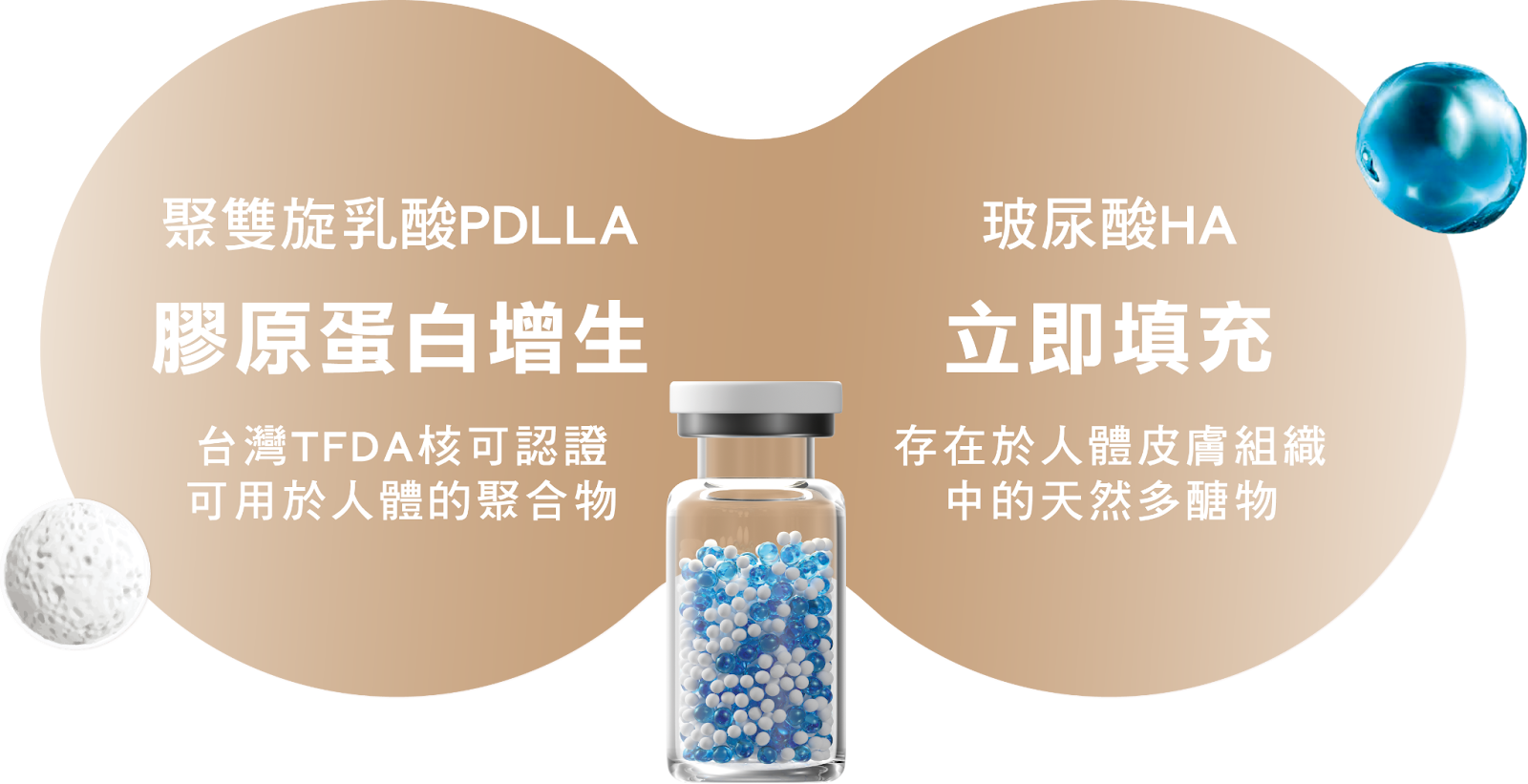
AestheFill's ingredients are PDLLA + CMC gel. Vivabella replaces the CMC gel with hyaluronic acid (HA), making it PDLLA + hyaluronic acid.
PDLLA is like coffee grounds, and CMC gel or hyaluronic acid is like milk or oat milk. You need that liquid to brew the PDLLA into a tasty latte.
AestheFill versus Vivabella is like walking into Starbucks and telling the barista you want oat milk instead of milk in your latte. The main coffee ingredient is unchanged; you simply prefer oat milk.
So when patients ask whether AestheFill or Vivabella is better, I can only say it depends on which you prefer, because their collagen-growing ability is about the same.
- PDLLA microspheres: stimulate your own collagen production, making skin plumper and firmer over time
- Non-cross-linked hyaluronic acid (HA): to be clear, the hyaluronic acid here is different from Juvederm or Restylane. Ordinary commercial hyaluronic acid contains a cross-linker so that it lasts a long time. The purpose of Vivabella's hyaluronic acid is to mix the PDLLA microspheres evenly, so within a month after injection it is metabolized (yes, it simply vanishes) and you suddenly look the way you did before. Many patients are thrilled with a plump face right after the injection, then complain a week later that it didn't work. In my experience, Vivabella's collagen grows gradually and peaks at about 6 months, so once the hyaluronic acid fades it behaves like Sculptra and takes time to grow in.
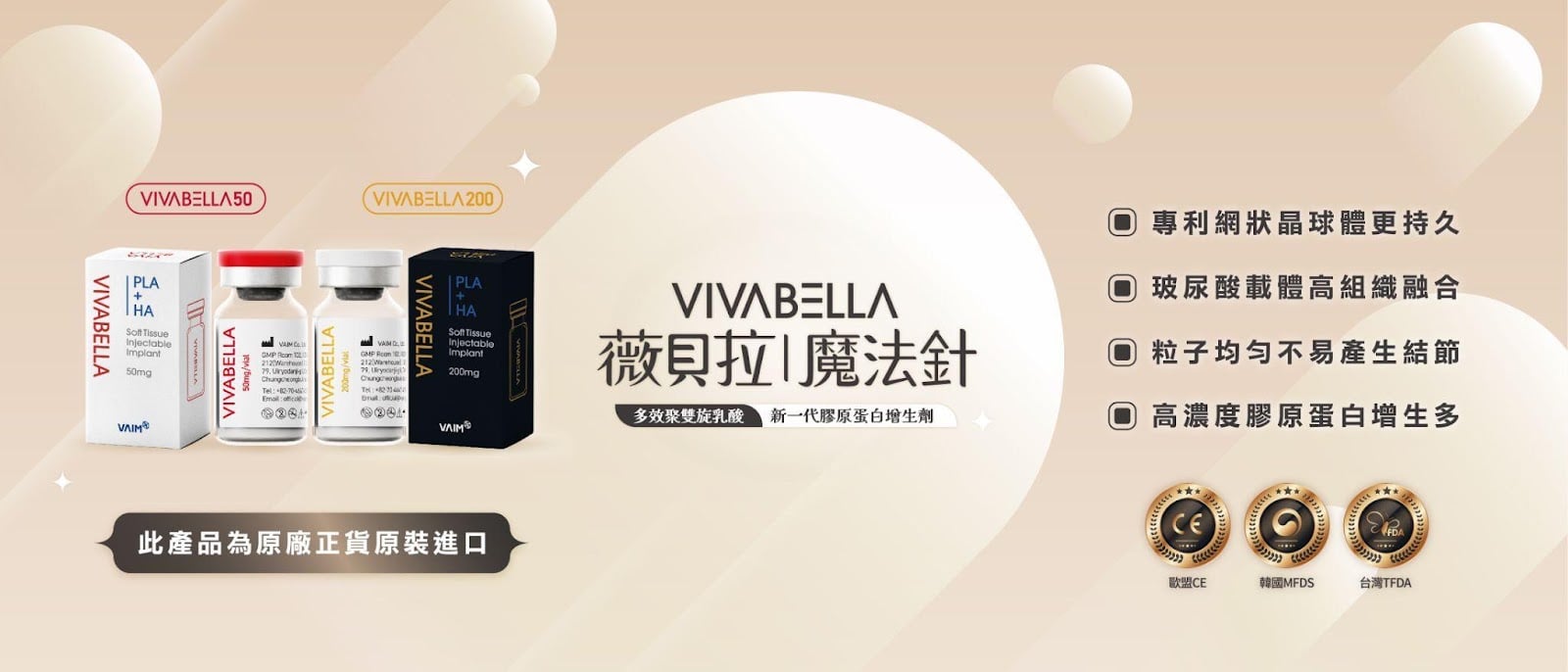
(2) 3 Key Features and Advantages of Vivabella
With so many collagen stimulators such as Vivabella, Sculptra and Ellanse, what exactly makes Vivabella strong?
- Nodule risk and handling: adding hyaluronic acid lets Vivabella blend the PDLLA powder very evenly. At Golden Apple Aesthetic Clinic we shake Vivabella vigorously with a shaker to make it extremely uniform. This mixing takes about 30 minutes, but it is worth the wait to get the material evenly mixed. The risk of lumps or nodules still cannot be completely ruled out.
- Two molecule sizes to choose from: most collagen stimulators, such as Sculptra and Ellanse, prohibit superficial injection. Vivabella comes in two types (commonly called the "white vial" and the "black vial"). Only the white vial (small Vivabella) is the only collagen stimulator approved in Taiwan for superficial injection, and it can refine superficial lines (neck lines, the superficial part of nasolabial folds), while the black vial suits deep support.
- Gradual skin improvement: the PDLLA ingredient stimulates new collagen, so the white vial combined with skin booster injections can firm the skin, an effect other skin boosters struggle to achieve.
2. Vivabella Collagen Stimulation: How Is It Different from AestheFill?
Since Vivabella is called the second-generation AestheFill, it must have something special. Its biggest advantage is that it uses non-cross-linked hyaluronic acid as the suspension carrier. The carrier is different, but the risks of swelling, inflammation and nodules remain.
As in the coffee analogy above, Vivabella's suspension uses non-cross-linked hyaluronic acid (non-crosslinked HA), which mainly serves as a suspension carrier to help distribute the PDLLA microspheres. Actual reactions after treatment and nodule risk are still affected by injection depth, dose, technique and individual response, so it cannot be considered risk-free.
By comparison, AestheFill uses CMC (carboxymethylcellulose) as its carrier. CMC also keeps PDLLA microspheres stably suspended, but it is essentially a more viscous polysaccharide and is more likely to cause swelling after injection.
Because Vivabella and AestheFill use the same collagen-stimulating ingredient and even the same developer, their collagen-growing ability is about equal, so I don't particularly recommend one over the other. Consumers have their own preferences, and the two suit the same areas. It comes down to which brand you like.
3. What Are the Disadvantages of Juvelook (Vivabella)? What If It Fails?
As I always say, no product in this world is perfect. Ellanse, Sculptra and hyaluronic acid all have their drawbacks.
Having covered the advantages, I still have to be honest. First, on Dcard, Threads and PTT I see comments that easily mislead the public, such as "Vivabella is super natural with no nodule risk" and "Juvelook can't cause embolism."
I have collected real cases of Juvelook nodules and the three-stage treatment in Juvelook side effects: what are they and what to do if it fails?.
No collagen stimulator has a zero chance of nodules. Such a thing does not exist on the market today. "Relatively low probability" does not mean it can never form nodules.
Also, many clinic websites say Vivabella can be used for the tear trough. I want to clarify that injecting Vivabella around the eyes is contraindicated, and I strongly advise against injecting it into the superficial layer around the eyes (better safe than sorry, because a nodule there is very hard to treat). Using the black vial in the deep apple cheek area to improve the tear trough is fine.
Like all collagen stimulators, Vivabella must succeed the first time. A large-molecule black vial injected too shallow will still cause tear trough caterpillars, so the best way to avoid a failed Vivabella is to find a doctor who specializes in subtle aesthetic work like me. Otherwise, a failed collagen stimulator is nearly impossible to fix.
4. Juvelook / Vivabella: Comparing the 2 Types, Black and White Vial
The black and white vials are like espresso and milk foam. The black vial has large molecules that sink to the bottom, and the white vial has small molecules that float on the surface, so they are injected into completely different areas.
The black vial fills deep hollows; the white vial refines superficial lines
(1) Black Vivabella
The black vial (VIVABELLA 200) is the larger-molecule filler. A 200 mg vial contains 170 mg of PDLLA microspheres + 30 mg of non-cross-linked hyaluronic acid (85:15), with a microsphere size of about 40–80 μm. That size means it goes into the subcutaneous tissue, not the dermis. This type is for deeper hollow areas. Suitable areas include: hollow cheeks, hollow temples, nasolabial folds and the deep tear trough.
(2) White Vivabella
The other type is the white vial (VIVABELLA 50), Vivabella's fine-molecule type. A 50 mg vial contains 42.5 mg of PDLLA microspheres + 7.5 mg of non-cross-linked hyaluronic acid (also 85:15), with a microsphere size of about 20–40 μm, only about half that of the black vial, which is why it can go into the dermis. Its molecules are finer and its texture softer, and it is one of the few collagen stimulators approved by Taiwan's health authority for use in the dermis. This type is especially suited to superficial fine lines, acne scar repair and overall skin brightness. Because the molecules are small and blend well with tissue, swelling, nodules or unevenness can still occur after treatment, so a doctor must evaluate according to the approved information and individual conditions.
| Item | Black vial VIVABELLA 200 | White vial VIVABELLA 50 |
|---|---|---|
| Molecule size | Large-molecule PDLLA microspheres | Small-molecule PDLLA microspheres |
| Total per vial | 200 mg | 50 mg |
| PDLLA content | 170 mg | 42.5 mg |
| Hyaluronic acid carrier | 30 mg | 7.5 mg |
| Microsphere size | About 40–80 μm | About 20–40 μm |
| Layer used | Subcutaneous tissue | Dermis |
| Main benefit | Improves deep hollowness | Improves superficial fine lines, skin brightness and acne scars |
| Suitable areas | Hollow cheeks, temples, nasolabial folds, deep tear trough | Acne scars, neck lines, fine lines at the mouth corners, skin quality |
| Nodule risk | Can still occur; related to depth, dose, technique and individual response | Can still occur; related to depth, dose, technique and individual response |
| Recommended course | First course 3 sessions, 4 weeks apart | First course 3 sessions, 3–4 weeks apart |
| Nickname | Black vial | White vial |
| Price | NT$23,000–28,000 per vial | NT$23,000–28,000 per vial |
5. Vivabella Compared with 4 Other Collagen Stimulators
The collagen stimulators commonly seen in Taiwan today are these five: Vivabella, Sculptra, Ellanse, AestheFill and Radiesse. All have good results for improving hollowness. The table below summarizes their differences and features.
| Item | Vivabella VIVABELLA | Sculptra | Ellanse | AestheFill | Radiesse |
|---|---|---|---|---|---|
| Origin | Korea | France | Netherlands | Korea | Germany |
| Main ingredient | PDLLA (poly-D,L-lactic acid) | PLLA (poly-L-lactic acid) | PCL microspheres | PDLLA (poly-D,L-lactic acid) | CaHA |
| Structure | HA hyaluronic acid | CMC gel | CMC gel | CMC gel | CMC gel |
| Filling effect | Gradual | Gradual | Immediate | Gradual | Immediate |
| Mixing time | 30 minutes | Mixed immediately | No mixing needed | 30 minutes waiting to dissolve | No mixing needed |
| Longevity | Black: 18–24 months; White: 12–16 months | 18–24 months | 18–24 months | 18–24 months | 18–24 months |
| Key strengths | Low nodule rate; the only one that can be injected into the dermis | Grows the most collagen | Immediate filling that changes contour, good for sculpting features | Natural, soft result | Very firm, good for building a defined contour |
| Types | Black vial, white vial | 1 type | 2 types, S and M | 1 type | 1 type |
| Areas used | Hollow cheeks, temples, nasolabial folds, apple cheeks | Hollow cheeks | Temples, forehead, nasal base | Apple cheeks, temples, hollow cheeks, nasolabial folds | Forehead, chin, nasal base, apple cheeks |
6. Vivabella Before and After Care
1. No massage is needed after Vivabella!
Because Vivabella has fine, rounded particles combined with a hyaluronic acid carrier, lumps or nodules still cannot be ruled out. If you knead or push the area afterward, it may shift the Vivabella and destroy the three-dimensional structure I originally designed, affecting the result.
2. Vivabella comes in two types that are injected in completely different places.
As mentioned above, the white and black vials are like Juvederm's large-molecule Voluma and small-molecule Volite: different molecules suit completely different areas.
If the white vial is injected into a deep base layer, it may not provide enough support. If the black vial is injected into the superficial layer of the skin, its larger particles may cause nodules, shifting or an unnatural look. Never mix them up!
3. Some volume disappears within a month after Vivabella, because the hyaluronic acid carrier is metabolized
Many people say in the first week after Vivabella, "Wait, where did the fullness I had right after the injection go?" This is actually normal and expected, so there is no need to worry.
The reason Vivabella gives an immediate plumping effect is that its formula contains non-cross-linked hyaluronic acid (non-crosslinked HA) as a suspension carrier. This hyaluronic acid absorbs water readily and fills quickly, but is also metabolized quickly. So in the first month after treatment, most of the "immediate volume" you see comes from the hyaluronic acid, and once your body naturally breaks it down and absorbs it, the fullness gradually fades.
But here is the real key: the star of Vivabella is not the hyaluronic acid but the PDLLA microspheres. These microspheres slowly stimulate your own collagen inside the skin, a gradual, steady and natural process that usually takes about 6 months to reach its peak.
So if you feel the volume has decreased after a week, don't rush to top up, and don't doubt that it works. This is exactly Vivabella's phased change of "temporary fading → steady rebound." Give your skin some time to grow its own collagen, and you will find the result is not only natural but longer lasting and better and better over time.
Juvelook (Vivabella) FAQ
How much is a vial of Vivabella?
The publicly listed reference price in this article (August 2026) is NT$23,000–28,000 per vial. The final quote should state the type, number of vials, the treating doctor and whether post-treatment follow-up visits are included. Don't compare only the lowest price per vial.
Is Vivabella the same as hyaluronic acid?
Not exactly. According to public data from Taiwan's TFDA, Vivabella is made of PLA (poly-D,L-lactic acid) and non-cross-linked hyaluronic acid crystals, and the hyaluronic acid serves as one of the carriers. Because it also contains PLA particles, follow-up handling cannot simply be treated like a pure hyaluronic acid filler, and should be evaluated by a doctor familiar with the product.
Can Vivabella cause nodules?
No injectable implant should claim it "never" does. The risk of nodules or unevenness relates to the product, dilution or mixing, injection depth, dose, technique and individual response. Before treatment, understand the approved use, possible risks and the plan for handling problems.
To compare other collagen stimulators, keep reading the complete Sculptra guide and Ellanse price and features. If your main problem is hollow cheeks, see Vivabella for hollow cheeks.
Are Juvelook and Vivabella the same thing?
Yes, exactly the same. Juvelook (喬雅露), Vivabella (薇貝拉) and Juvelook refer to the same product: the same Korean manufacturer and the same formula, with two distributors in Taiwan and so two Chinese names. Whichever name you see, you do not need to compare them separately. What matters is the doctor's skill and the mixing quality, not the name.
How much is a vial of Juvelook?
The current public reference price is about NT$23,000–28,000 per vial, the same for black and white vials. The actual cost varies with the type, treatment area, number of vials and the doctor's assessment. At your consultation, confirm the product type, the number of vials and what the fee includes.
Which areas can Juvelook be injected into?
The black vial (VIVABELLA 200) has large molecules and suits areas that need support, such as hollow cheeks, temples, nasolabial folds and the deep tear trough. The white vial (VIVABELLA 50) has small molecules, is approved for the dermis, and suits acne scars, neck lines, fine lines at the mouth corners and skin quality. The two must never be mixed up. The superficial layer around the eyes is contraindicated and not recommended.
My Juvelook faded quickly after injection. Did it fail?
No, this is normal. The hyaluronic acid in Juvelook is non-cross-linked and is only a carrier that disperses the PDLLA powder evenly. It is metabolized within a month, so you feel you are "back to how you were." The real result comes when PDLLA stimulates your own collagen to grow in, a gradual process that peaks at about 6 months.
Medical Review and Sources
Written and updated by: Dr. Chia-Hung Ou | Last updated: August 18, 2026. This article is for education and price reference. Actual suitability, type, dose and risks must be confirmed at an in-person consultation.
- Taiwan TFDA Unique Device Identification system: Vivabella soft tissue implant (class III device, ingredients and intended use)
- Taiwan TFDA medical device license search: Vivabella soft tissue implant, license no. Wei-Bu Yi-Qi Shu-Zi No. 036506 (manufacturer VAIM Co., Ltd., approved in 2023)
- VAIM Co., Ltd. manufacturer product technical data (ingredient ratio, microsphere size, mixing conditions and course recommendations)
- US FDA: Dermal Fillers (risks of injectable fillers and warning signs for seeking care)
- VIVABELLA Taiwan product information website