
Recently Merz brought in actress Moon Ga-young as an ambassador and made Radiesse, the "regeneration needle," famous. Many patients who saw the bus and TV ads asked me what a "regeneration needle" really is. Put simply, it is what used to be called Radiesse.
"Regeneration needle" is a new name used in the last few years. The name did not change to sound nicer; it changed because people's understanding of it changed, with the focus moving from "stimulation" to "regeneration." In this article I will call it Radiesse throughout.
"Where can Radiesse actually be injected?" Many patients have consulted several clinics: some say it is hard enough to build up a chin, while others say it is soft enough for neck lines and acne scars. Which is right? The answer is a bit cheeky: both.
Radiesse is like a sugar cube. As a solid it is as hard as a sugar cube and can serve as bone; add a little water and it melts into sugar water that can be injected into very superficial lines. The dilution determines the injection layer. In this article I will cover Radiesse's ingredients, how it works, who it suits, how it is injected and whether it has side effects.
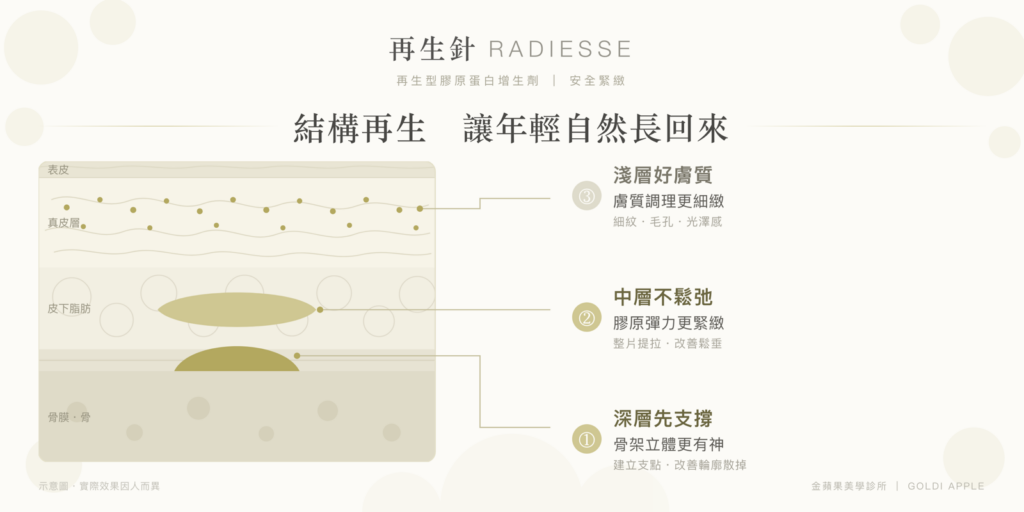
1. What Is Radiesse? What Is Structural Regeneration?
(1) Radiesse ingredients
Radiesse consists of 30% CaHA microspheres and 70% CMC gel. CaHA stands for calcium hydroxylapatite, a long name, but you only need to remember one thing: it is a component your bones and teeth already contain. It is not a foreign synthetic chemical and is highly compatible with the body.
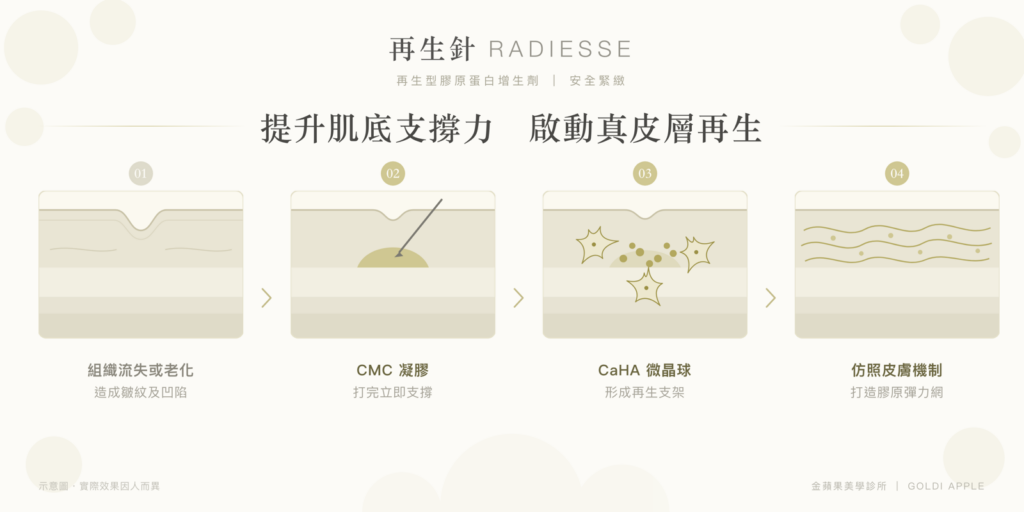
Think of it as a cup of bubble tea: countless tiny round calcium beads suspended in gel. At the moment of injection, it is the gel that provides volume. But the gel is slowly metabolized by the body, and what stays behind to do the work is the calcium beads. They stand in place like scaffolding, letting your own fibroblasts climb on and start producing new collagen.
This is what we call structural regeneration: instead of stuffing something in to take up space, it lets your own tissue grow back.
(2) How it works: why Radiesse rarely causes a puffy "steamed-bun" look
The mainstream collagen stimulator ingredients today include PDLLA (Juvelook, AestheFill), PCL (Ellanse) and PLLA (Sculptra). They sound complicated, but the principle is the same: once these microspheres are injected into tissue, your immune system treats them as invaders and triggers an inflammatory response. The stronger the reaction, the more collagen is stimulated.
It is like a cut on your arm, which also stimulates collagen to grow new skin. Collagen stimulators use a "mild and controlled" inflammatory response to stimulate tissue to produce new collagen.
The stronger the inflammation, the better the collagen production. Sculptra and Ellanse are currently observed to produce the most collagen, though the stronger the production, the more likely repeated filling of the apple cheeks or nasal base is to cause a puffy "steamed-bun" look.
Radiesse's CaHA stimulates relatively less collagen, but its advantage is that it rarely forms nodules, its collagen production is natural, and you don't need to worry about growing too much. This safety profile also earned it approval from the US FDA, the EU CE mark and Taiwan's TFDA, which back its safety and clinical effect.
Of course, puffiness is not any product's fault. Ultimately it is the result of injecting too much. Some clinics push fillers regardless of whether you are already full enough. Typical examples of overfilling are a bulging forehead, apple cheeks so full they push down the eyes, and a swollen nasal base.
This is a mindset I hope every aesthetic consumer has: don't obsess over filling every hollow and line. A face looks three-dimensional and attractive because of light, shadow and angles. Once everything is filled flat, those angles disappear and the person looks off, though you can't say what is wrong.
Further reading: Facial overfilled syndrome, How to handle Sculptra / AestheFill / Ellanse nodules
2. How Does Radiesse Work? What Are Its Pros and Cons?
(1) The 3 ways Radiesse works
The three concentrations of Radiesse work differently, and the key is dilution: the more it is diluted, the stronger the regeneration.
Before injecting, one key step greatly affects what Radiesse is used for: diluting it with saline and anesthetic. How much is added decides what this injection will do today.
You may wonder: doesn't dilution just make it thinner? Because dilution changes not the total amount but the distribution. In undiluted form, the calcium beads are clumped together and the cell surface they can touch is limited. After dilution, the beads are spread over a larger area and reach many more fibroblasts.
The larger the contact area, the stronger the regeneration reaction, but the weaker the ability to hold up volume. That is the trade-off: do you want bone-like "support" today, or collagen "growth"?
| Technique 1: undiluted | Technique 2: 1:1 dilution | Technique 3: super-diluted | |
|---|---|---|---|
| Your concern | Collapsed skeleton, lost contour | Laxity, sagging, loss of elasticity | Skin quality, fine lines, pores |
| Injection depth | Deepest, on the periosteum | Middle layer | Superficial layer |
| Main effect | Support, lifting | Half support, half regeneration | Almost pure regeneration |
| Immediate result | Obvious | Moderate | Almost invisible |
| Common areas | Temples, cheekbones, chin, jawline | Hollow cheeks | Acne scars, neck, back of hands |
(2) Pros of Radiesse
Resists deformation and builds a bone-like look
Compared with hyaluronic acid, Radiesse is less likely to deform or shift, and it better simulates the feel of bone. It is very suitable for areas that need skeletal support, such as the chin, forehead and hollow nasal base.
To fill a skeletal deficiency, you need something thick enough with enough supporting force. If you put something soft on bone, it will be squashed and slide away.
Radiesse performs at the top on three indicators:
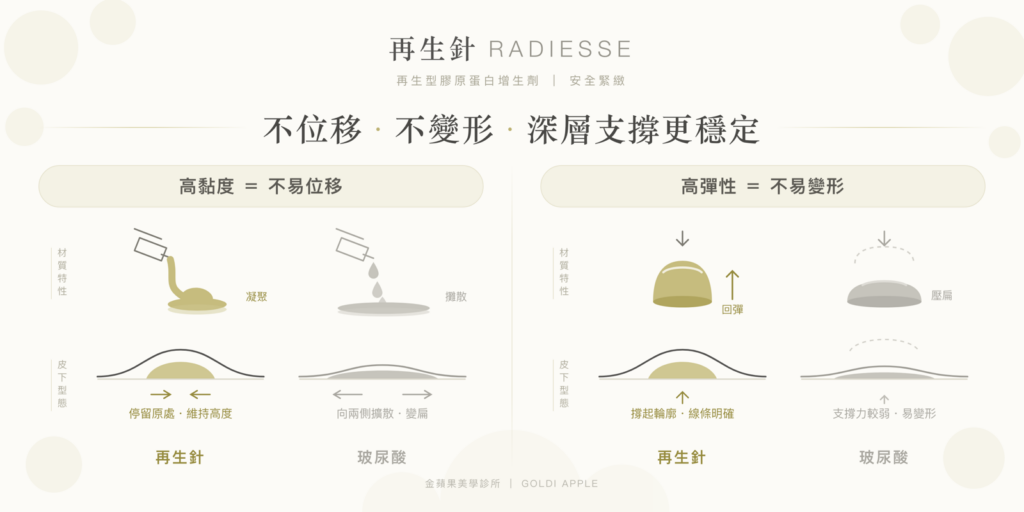
- High viscosity = resists shifting: it helps stay stably attached where injected, resists muscle movement and lowers the risk of shifting and spreading (the higher the viscosity, the more it stays where it is placed)
- High elasticity = resists deformation: it improves support and lifting, with a notable effect from a small amount (the higher the elastic modulus G′, the better it resists deformation and holds up the skeleton)
- High cohesivity = resists dispersing: the higher the cohesivity, the more tightly it bonds with surrounding tissue, which is harder for hyaluronic acid to do
By comparison, even the largest-molecule hyaluronic acid has a hardness G′ of only about half to two-thirds of Radiesse, and hyaluronic acid absorbs water, softens and flows, making it hard to keep a bone-like contour. So when it comes to skeletal support, Radiesse is my first choice.
Of course, none of this means hyaluronic acid is useless. Hyaluronic acid and Radiesse complement each other like a married couple, each with strengths the other lacks. Even Radiesse's manufacturer recommends mixing it with hyaluronic acid as the best way to use it. Juvederm's newly launched HArmonyCa this year is Radiesse + hyaluronic acid. Hyaluronic acid provides Radiesse with a volume effect and improves hollowness more noticeably.
Grows elastin and firms the skin
The biggest difference between Radiesse and Ellanse or Sculptra is that it grows elastin. Ellanse and Sculptra simply grow collagen, which is very "hard," so they suit bone-like support.
The elastin that Radiesse grows is elastic, and more importantly it has new blood vessels growing within it, like your native tissue, just like a regenerated gecko tail has blood vessels. That is why it is named a "regeneration needle."
Diluted Radiesse can spread CaHA microspheres evenly in the dermis, improving overall facial firmness and skin texture without adding volume.
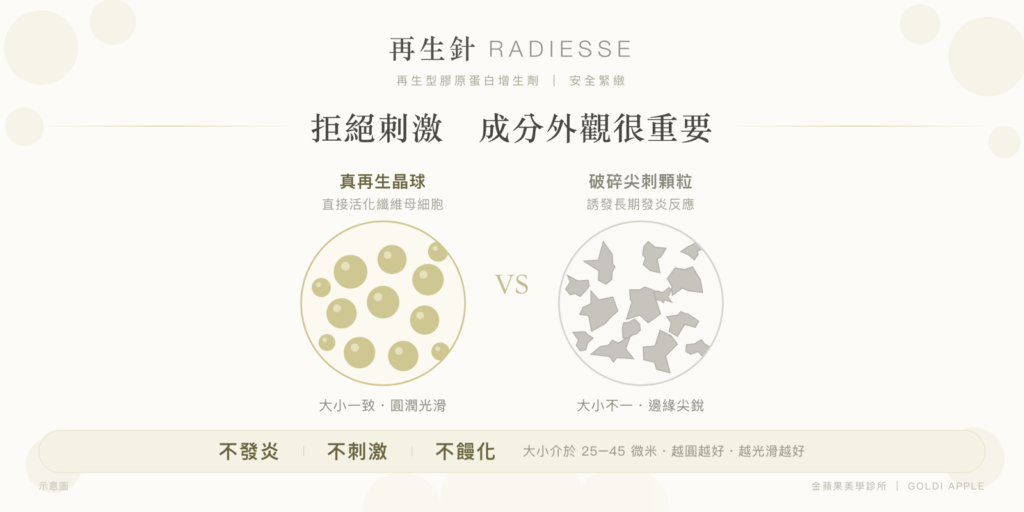
CaHA microspheres are the key to avoiding puffiness. They mimic the skin's own synthesis mechanism and directly activate fibroblasts, starting 5 key steps of skin regeneration and building a collagen-elastin network:
- Type I collagen: support
- Type III collagen: softness
- Elastin: elasticity
- Proteoglycans: hydration and glow
- New blood vessels: healthy skin tone
(3) Cons of Radiesse
"Doctor, the effect disappeared a month after my Radiesse and I'm not as plump anymore." This is normal.
Let me be clear about it first, because if the doctor doesn't tell you in advance, you will 100% misunderstand.
Right after Radiesse you see the result because the CMC gel is holding it up. After one or two weeks the gel is metabolized, and when you look in the mirror you think, "Huh? It seems to have gone down." Many people go back to the clinic to complain at exactly this point.
But this is exactly how the product is designed. After the gel leaves, the calcium beads left in place start working, letting your own fibroblasts climb on and grow something new. So Radiesse's result curve doesn't just decline; it drops a little and then slowly grows back: only after three to six months, when your own collagen takes over, does the result truly arrive.
To improve this drawback, I recommend adding a syringe of hyaluronic acid as a mixed (hybrid) combination:
- Fills the gap in results: for the week or two after the gel leaves and before collagen has grown, hyaluronic acid fills that gap
- Preserves volume and room for later adjustment: the most common early complaint about Radiesse is that "the area feels very tight afterward," making it hard to work on if you want to refine or adjust later. The reason is that the collagen it grows is too dense. Mixing in a little hyaluronic acid keeps Radiesse's firmness while leaving flexibility for later adjustments.
3. Who Is Radiesse Suitable For? What Can It Improve?
Radiesse suits different age groups, especially people with facial laxity, hollowness or an undefined contour. It is more suitable for those who want to improve aging structurally and boost firmness, rather than simply fill volume.
(1) Who Radiesse is for
If you compare 3D reconstructions of the same person's face at age 20, 50 and 80, you will find that bone is actually being resorbed all the time:
In particular, Asians' midline skeleton (nasal bones, cheekbones, mandible) is thinner than that of Westerners to begin with, so bone resorption with aging is more noticeable. This is why in Asia Radiesse is mostly used as a tool for skeletal support.
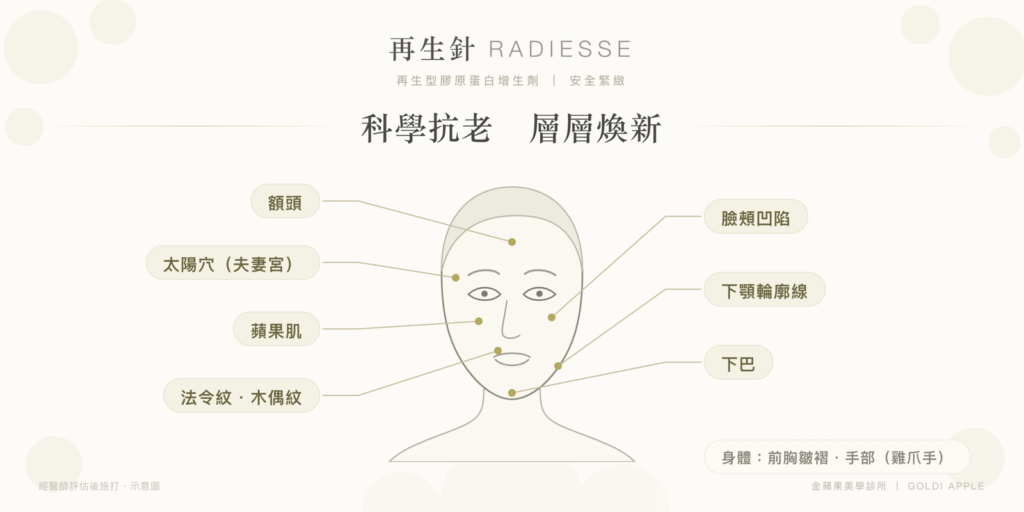
Radiesse can be used to improve the following aging concerns:
• Face: forehead, temples, hollow cheeks, nasolabial folds, apple cheeks, jawline, chin
• Body: turkey neck, hands (crepey, bony hands)
(2) Improving skeletal support: 6 key points
Given the skeletal features of Asians, support for the whole face can be summarized as 6 periosteal injection points:
- Brow bone — lifts the brow peak and opens up the eyes; patients often say they look "more radiant" and "more alert" afterward
- Forehead — a full forehead makes the upper face lines smoother and adds poise
- Temples and the area beside the ears — strengthen the outer contour
- Apple cheeks — improve under-eye hollowness and the tear trough.
- Nasal base — nasolabial folds naturally become shallower. Note that this is not about "filling in" the nasolabial fold but supporting the root at the nasal base, improving it from the source
- Chin — midline support, improves the jawline
Further reading: How Radiesse is injected into the chin, How Radiesse is injected into the forehead, A complete approach to nasolabial folds
4. Radiesse Case Sharing | Natural Firming Results
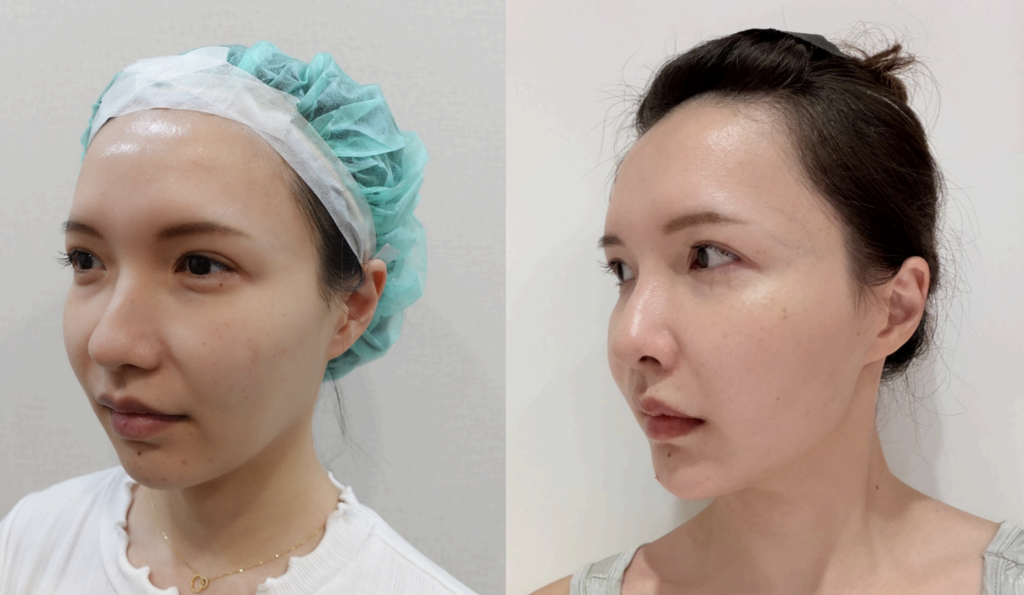
(1) Radiesse for the chin
One syringe of Radiesse improved a receding chin and made the facial contour more refined
More Radiesse chin cases: https://goldiapple.com/radiesse-chin/
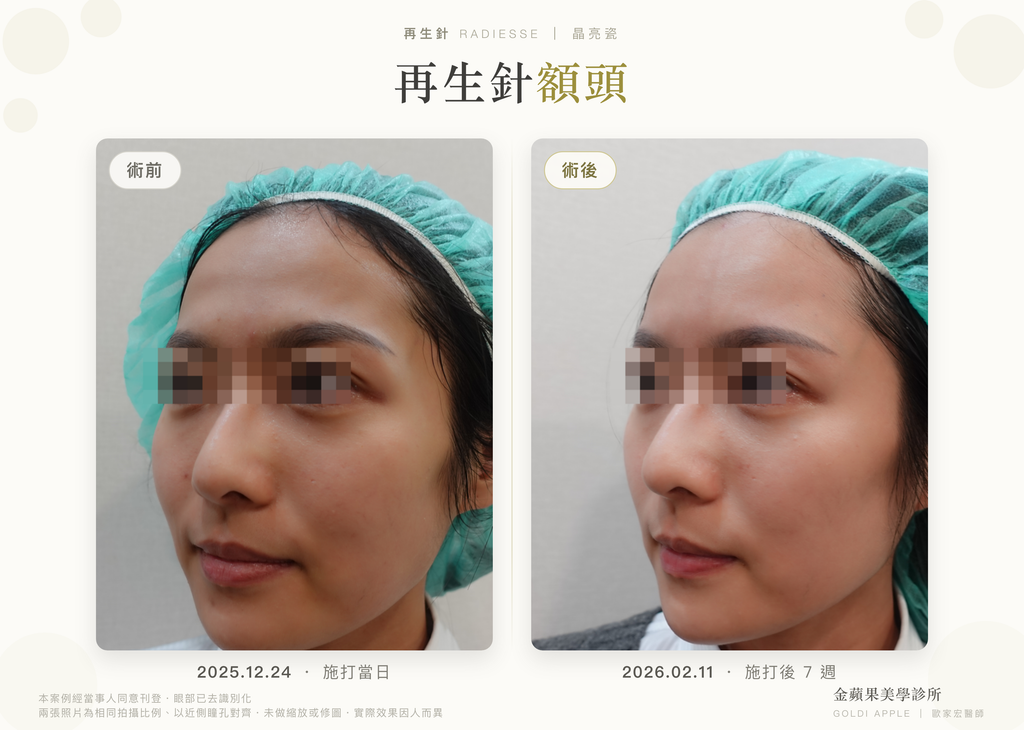
(2) Radiesse for the forehead
More Radiesse forehead augmentation cases: https://goldiapple.com/radiesse-forehead/
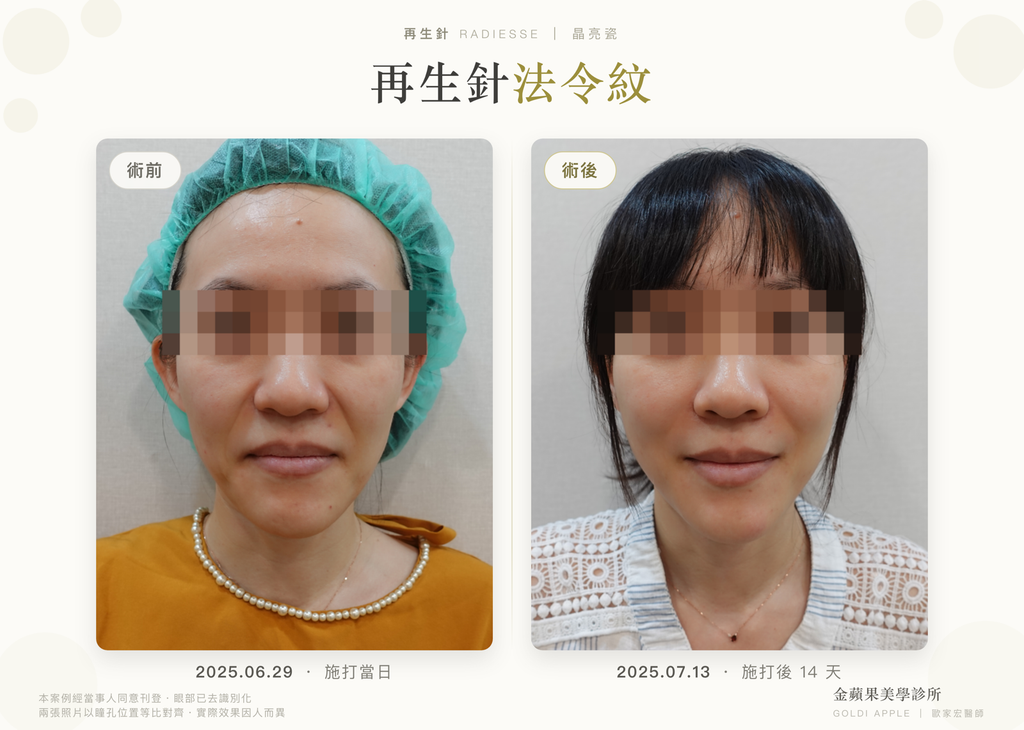
(3) Radiesse for nasolabial folds
Further reading: Does Radiesse work well for nasolabial folds?
5. How Does Radiesse Differ from Other Treatments?
(1) Radiesse vs. hyaluronic acid: one holds a place, the other leaves something behind
This is the most important difference, and I will put it in the plainest words.
Hyaluronic acid holds a place. Once injected it is a lump with volume sitting there, propping up the hollow. It shapes very well and can be sculpted finely, and if it goes wrong it can be dissolved with hyaluronidase, which is its biggest advantage. But all it does is hold a place; once the place is held, your skin tissue itself has not become more elastic.
Radiesse leaves something behind. At first it also holds a little space (thanks to the CMC gel), but its real value is what remains after the gel leaves: collagen, elastin and a whole supporting structure.
So the two are not really competitors. You don't need to pick a side, and often the right answer is to use both.
(2) Radiesse vs. other collagen stimulators
| Brand | Radiesse | Ellanse | Sculptra | AestheFill | Juvelook / Vivabella |
| Main effect | Support + firming | Support + filling | Filling | Filling | Black: filling; White: skin quality improvement |
| Main ingredient | CaHA + CMC | PCL + CMC | PLLA | PDLLA | PDLLA + HA |
| Form | Gel | Gel | Powder (needs mixing) | Powder (needs mixing) | Powder (needs mixing) |
| Origin | USA | Netherlands | Italy | Korea | Korea |
| Suitable areas | Chin, forehead | Temples, forehead, nasal base | Hollow cheeks, temples | Hollow cheeks, temples | Tear trough, hollow cheeks, temples |
| Immediate filling | Yes | Yes | Takes 3 months to grow | Takes 3 months to grow | Takes 3 months to grow |
Further reading: Comparison of 6 collagen stimulators
6. Radiesse Pre-Treatment Notes and Aftercare. Are There Side Effects?
Before treatment
- Stop anticoagulants or blood-activating supplements a week before treatment to reduce bruising, such as aspirin and fish oil
Aftercare
- Bruising, redness and swelling at the treated area are normal; you can apply ice within 48 hours to reduce swelling
- Avoid massaging, rubbing or pressing hard for two weeks
- Bruising, swelling, redness and hard lumps usually improve within a few hours to a week
7. Radiesse Cost
Radiesse and Ellanse both come in syringes. A Radiesse syringe is 1.5 cc and usually costs NT$20,000–25,000. The nasal base, apple cheeks and mild receding chins usually call for 1 syringe at a time, while the forehead and moderate receding chins usually need 2 syringes (3 cc). Whether you need to combine it with hyaluronic acid can be discussed with your doctor based on your actual situation.
8. Radiesse FAQ
What is Radiesse?
Radiesse is a regenerative collagen stimulator that improves underlying support through structural regeneration, creating three-dimensional features and a naturally firm facial contour. It consists mainly of 30% CaHA microspheres and 70% CMC gel, is highly compatible with the body, and does not irritate, inflame or cause puffiness, with stable and natural results.
Which areas is Radiesse used for?
After doctor evaluation, Radiesse can be used to correct moderate to severe facial wrinkles and folds, and to restore and correct fat loss and contour hollowness. Common treatment areas include:
• Face: forehead, temples, hollow cheeks, nasolabial folds, marionette lines, apple cheeks, jawline, chin
• Body: body creases (stretch marks), cellulite, hands (crepey, bony hands), turkey neck
What results can I expect from Radiesse?
Radiesse improves underlying support through structural regeneration: building support in the deep layer, improving laxity in the middle layer, and promoting new collagen in the superficial layer. It improves laxity and fine lines, creating three-dimensional features and a naturally firm facial contour.
How soon does Radiesse work, and how long does it last?
Results appear quickly after treatment and keep improving as new collagen forms, lasting 12–24 months, though actual results vary with each person's constitution and lifestyle. A follow-up evaluation within 6 months, or planning an annual regeneration treatment, is recommended to maintain results.
Is Radiesse safe?
Yes. Radiesse has been on the market for more than 20 years, is approved by the US FDA, EU CE mark and Taiwan's TFDA, and is supported by more than 250 international journal articles on its safety and clinical use. Choose a manufacturer-certified clinic and doctor to ensure quality and safety.
Does Radiesse remain in the body? Can it be broken down?
Radiesse is highly biocompatible and gradually breaks down in the body into calcium and phosphate, similar to components found in milk and cola, and is absorbed through natural metabolism. MRI observation shows it can be metabolized by the body in about 2.5 years, so there is no need to worry.
Will Radiesse make my face bigger or risk a puffy look?
Radiesse mainly improves support through structural regeneration rather than simply adding volume, so with the right dose and injection layer it is less likely to make the face look bigger or puffy. Radiesse's CaHA microspheres are the only true regenerative microspheres: smooth, round and uniform in size, giving stable, natural firming.
How is Radiesse different from other collagen stimulators on the market?
Compared with traditional collagen stimulators that rely mainly on stimulation, Radiesse follows skin science, improving support and aging through structural regeneration in a gentle process, so results are more stable, firmer and more natural.
Are the "regeneration needle" and Radiesse the same thing?
They are the same thing. "Radiesse" is the name used for many years, and "regeneration needle" is a new name from the past few years. The name changed because people's understanding of this needle changed, with the focus moving from "stimulation" to "regeneration."
Is it normal that the result is less obvious a month after Radiesse?
Normal, and this is exactly how Radiesse is designed. Right after injection the CMC gel holds the volume; after one or two weeks the gel is metabolized, and the CaHA microspheres left in place start working. So the result curve doesn't just decline: it drops a little and then slowly grows back with new collagen, and after three to six months your own collagen takes over.
What injection techniques does Radiesse have? Which one suits me?
There are 3, and the key is dilution: undiluted product goes onto the periosteum to fix a collapsed skeleton and lost contour; a 1:1 dilution goes into the middle layer to treat laxity, sagging and loss of elasticity; a super-dilution of 1:2 or more goes into the superficial layer to improve skin quality, fine lines and pores. The more it is diluted, the stronger the regeneration but the weaker the ability to hold up volume. The actual technique is decided by the doctor after evaluating your type of aging.
Can Radiesse be mixed with hyaluronic acid?
Yes. The two materials complement rather than replace each other. Hyaluronic acid can fill the gap in results after the gel leaves and before collagen has grown, and since too much hyaluronic acid tends to cause puffiness, Radiesse can firm up the area that is about to be oversaturated.
Is it safe to inject Radiesse onto the periosteum?
It is safe when injected at the correct anatomical layer with safe technique. The key move is aspiration: after advancing the needle and before pushing the product, pull back for 3–5 seconds to confirm you haven't entered a blood vessel. This is the only safety net in deep injection. At your consultation, you can ask the doctor whether they perform aspiration.
How long after Radiesse can I have other treatments?
If you want other treatments, especially structural ones such as the nose, I recommend waiting a full six months. The inflammatory, proliferative and remodeling phases of wound healing take time to complete, and working on the area before they finish gives unpredictable results.
Is Radiesse right for me? Consult Dr. Ou at Golden Apple now!
Online consultation