
"Dr. Ou, I really want a thread lift. Why won't you do one for me?" I don't accept every patient for facial thread lifting, because the results are not good for everyone. So who is actually a good candidate?
Facial thread lifting works best for loose skin and long, slim faces
Facial thread lifting places absorbable barbed threads (mostly PDO) into the fascia layer. The barbs hook the tissue and lift it upward, while collagen grows along the threads, like weaving a safety net inside the face to prevent collapse.
It is completely different from traditional Chinese medicine thread embedding: that is meant for weight loss, while aesthetic thread lifting is meant for lifting. Let me be honest first: facial thread lifting is not an elixir of youth. Its real value is delaying the cliff-like aging to come.
I get my wife threaded regularly too, hoping she stays young. The earlier you start, the better you can hold your current state. If marionette lines and nasolabial folds are already deep, threads can only take 2 to 3 years off and cannot turn things around dramatically.
| Item | Description |
|---|---|
| Treatment name | Facial thread lifting (thread lift applied to the face) |
| Threads | Mainly absorbable threads (PDO, etc.) with barbs |
| Placement layer | Fascia layer |
| Two effects | ① Physical lift from the barbs ② Collagen grows along the threads, tightening the whole area |
| Thread dissolving time | Gradually dissolve over about 3 to 6 months |
| Face shapes with the best results | Long, slim faces; loose skin |
| Face shapes with limited results | Baby-fat faces; wide cheekbones |
| Four treatment areas | Upper face (brow lift), midface (nasolabial folds), lower face (jowls and marionette lines), nose |
| Biggest advantage | No volume effect: no puffiness ("mantou face") and no nodules |
| Can it be repeated? | Yes. The threads are absorbed, and many patients have repeated it for over ten years |
| Golden Apple facial thread lift prices | Mid and lower face NT$42,000 / upper face NT$30,000 / nose NT$20,000 |
- First check whether your face shape is right. Long, slim faces and loose skin respond best; for baby-fat or wide-cheekbone faces the effect may be minimal, and I will ask those patients to consider other treatments.
- Do not use collagen stimulators for lifting. Threads lift along "lines and surfaces" with no volume effect; stimulators lift at "points" and eventually grow volume, which can widen the cheekbones.
- You do not need to pull hard. Threads pulled too tight break easily and give worse long-term results. Regularly reinforcing the safety net in the fascia layer is the real value of facial thread lifting.
- Side effects are almost always technique problems. When the threads are placed correctly in the fascia layer, eating and making expressions should feel natural, and you should not feel the threads.
Key topics
1. What is facial thread lifting? Aesthetic thread lifting vs. traditional Chinese medicine thread embedding
2. Facial thread lifting vs. collagen stimulator lifting: which is safer?
3. Which areas of the face can be threaded?
4. Who is facial thread lifting suitable for?
5. What are the side effects of facial thread lifting?
6. Facial thread lifting cost
7. Frequently asked questions about facial thread lifting
1. What is facial thread lifting? Aesthetic thread lifting vs. traditional Chinese medicine thread embedding
Many patients worry when they hear "thread embedding", because they first think of the traditional Chinese medicine version. The two are very different:
| Aesthetic facial thread lifting | Traditional Chinese medicine thread embedding | |
|---|---|---|
| Purpose | Improve facial sagging | Weight loss |
| Thread feature | Fishbone barbs that hook tissue and pull it up | No barbs |
| Placement | Facial fascia layer | Acupuncture points |
The key difference is the barbs. Aesthetic threads use fishbone-shaped barbs to hook tissue and lift it upward, which is why the market often calls it "scarless fascia lift".
How effective is aesthetic thread lifting?
As I said at the start, facial thread lifting is more like a safety-net project against collapse. Its goal is to prevent cliff-like aging in the future, not to rescue a structure that has already collapsed all at once.
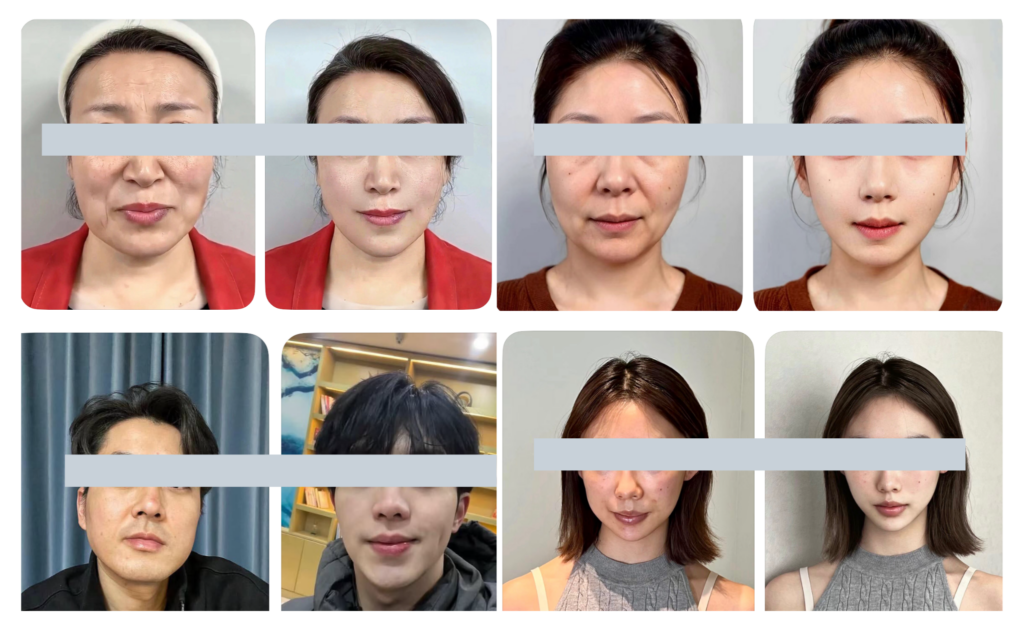
Too many posts on Xiaohongshu, Instagram and Threads heavily retouch thread lift results, which misleads the public into thinking they will look more than ten years younger afterward.
Thread lifting cannot reach the level shown in those images. Even a facelift cannot achieve that. It is not a scarless fascia lift, it is an AI lift. If you want that effect, you could just give your photo to ChatGPT to retouch, without enduring the pain of threads or a facelift.
The case photos in this article are not retouched and show the real results of thread lifting. If the results do not meet your standard, I suggest consulting a facelift surgeon directly.
How does facial thread lifting work? PDO threads tighten the tissue
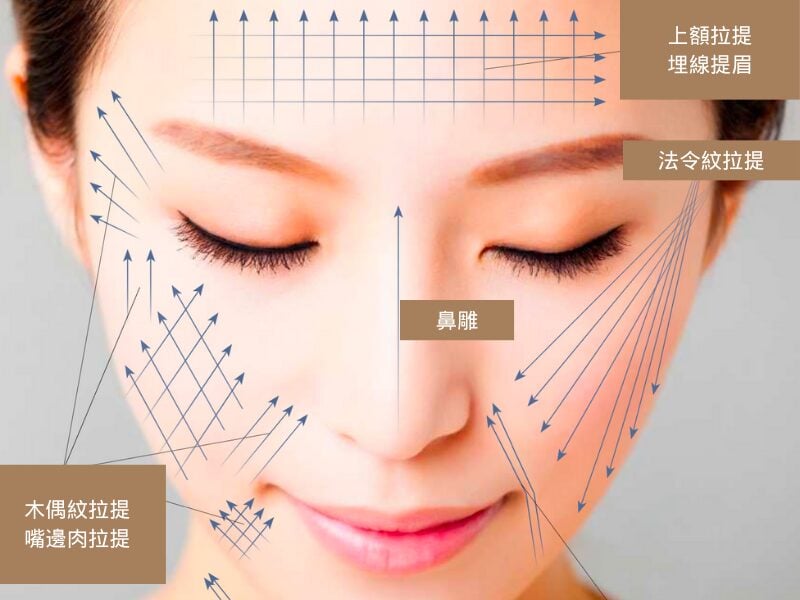
The threads we place in the face are generally PDO absorbable threads, placed in a mesh pattern in the fascia layer. This adds a safety net to the tissue and prevents the face from sagging.
The next part of the principle is very similar to collagen stimulators: whenever there is a foreign body in the tissue, the immune system sends collagen fibers to surround it. PDO threads in the fascia layer also stimulate collagen to grow around the thread, making the tissue firmer.
At the same time, the threads themselves slowly dissolve, usually being absorbed gradually over 3 to 6 months. The physical lifting effect will not be as obvious as right after placement, but the firmness from thread lifting can last about a year.
But remember one thing: the most important function of threads is not to keep hanging your flesh up, but to let the collagen that grows make the tissue firmer overall and slow the speed of facial sagging.
2. Facial thread lifting vs. collagen stimulator lifting: which is safer?
People often ask me: "Dr. Ou, since the ultimate goal is also to stimulate collagen growth, why not just use collagen stimulators to lift?"
There are many "Ellanse lift" and "Juvelook lift" approaches out there, and right after injection you can indeed see a lifting effect. But from my years of experience treating puffiness (mantou face), I strongly advise against using collagen stimulators to lift.
"Lines and surfaces" lifting vs. "points" lifting
This is the biggest difference between the two: threads lift along "lines and surfaces", while collagen stimulators only lift at "points".
Threads are very thin, and collagen grows evenly along the whole thread. When the threads are woven into a mesh, the effect rises from a line to firmness across the whole surface.
| Facial thread lifting | Collagen stimulator lifting | |
|---|---|---|
| Type of lift | Line to surface (mesh) | Point |
| How collagen grows | Evenly along the whole thread | Gathers around the injection point |
| Volume effect | None | Yes |
| Risk of puffiness | No | Yes |
| Risk of nodules | No nodules from inflammatory reaction | Yes |
| Original design purpose | Lifting | Improving hollows, not lifting |
Stimulators eventually grow volume, which can widen the cheekbones
Threads contain no collagen stimulator and have no "volume effect". This is very important, and it is the biggest advantage of threads.
Collagen stimulators were designed to improve hollows, not to lift. But because threads are hard to learn and injections are much easier, some doctors invented all kinds of filler-based lifting techniques with names such as "MD codes" and "XX contour fixation", trying to imitate with stimulators what threads can do.
Unfortunately, imitating makes it worse. When you inject a stimulator at a single point, there is indeed some lifting in the short term, like clay sticking down "a single point of sagging tissue". But these stimulators eventually grow volume. If the injected area was not hollow to begin with, once the volume grows your cheekbones can look wider.
Many victims who come to me to treat puffiness are people whose single-point collagen grew into volume and made their faces look fatter.
I wrote this section hoping that you will not choose a lifting method with more side effects just because you are afraid of threads. If you really do not dare to get threads, I suggest simply doing ultrasound (HIFU) or radiofrequency maintenance. Ultrasound lifts less than threads, but at least it has almost no side effects.
3. Which areas of the face can be threaded?
Facial thread lifting is mainly divided into four areas, and each area addresses different problems with a different thread layout:
| Area | Problem addressed | Details |
|---|---|---|
| Upper face | Drooping brows, brow-to-eye distance too narrow | Thread brow lift / upper forehead threads |
| Midface | Sagging-type nasolabial folds, drooping apple cheeks | Nasolabial fold threads |
| Lower face | Jowls, marionette lines | Jowls / marionette lines |
| Nose | Nose shape, bridge line | Thread nose lift / nose threads |
In practice I rarely thread only one area. I plan the whole face according to the degree of sagging in each area. A comparison of thread types, characteristics and costs is in my article What is thread lifting? 6 types of threads. This article focuses on the principle, suitable candidates and areas of facial thread lifting.
Mid and lower face threads: nasolabial folds and marionette lines
Many people see retouched ads on social media and think threads will remove nasolabial folds completely. They go in with very high expectations and then find the folds are still there.
I always tell patients that nasolabial folds are natural muscle lines everyone is born with and can never disappear completely, even with a very tight facelift. The main purpose of threads is to improve facial sagging and make the folds visually shallower, not to eliminate them entirely.
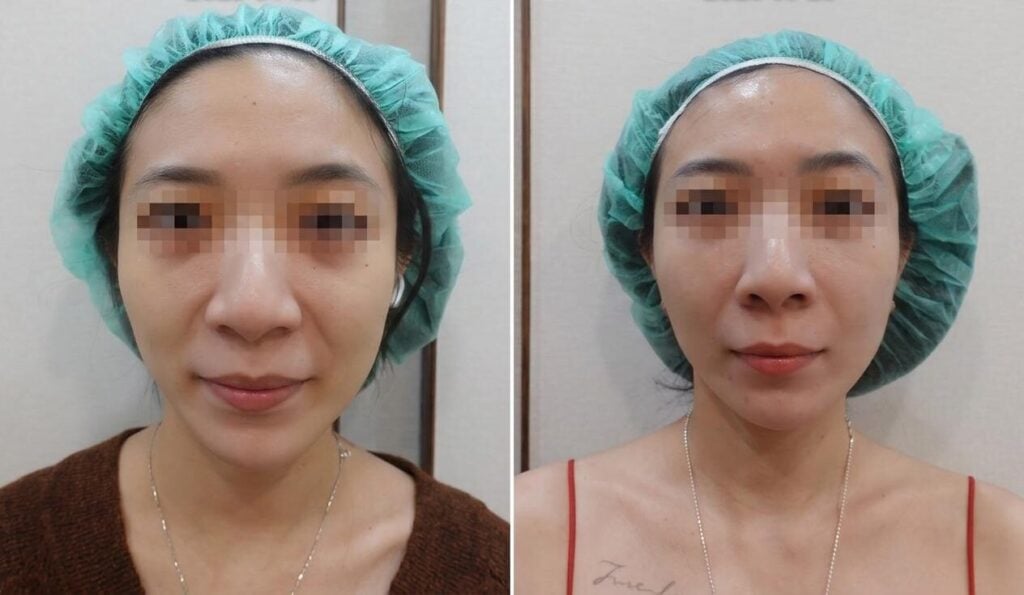
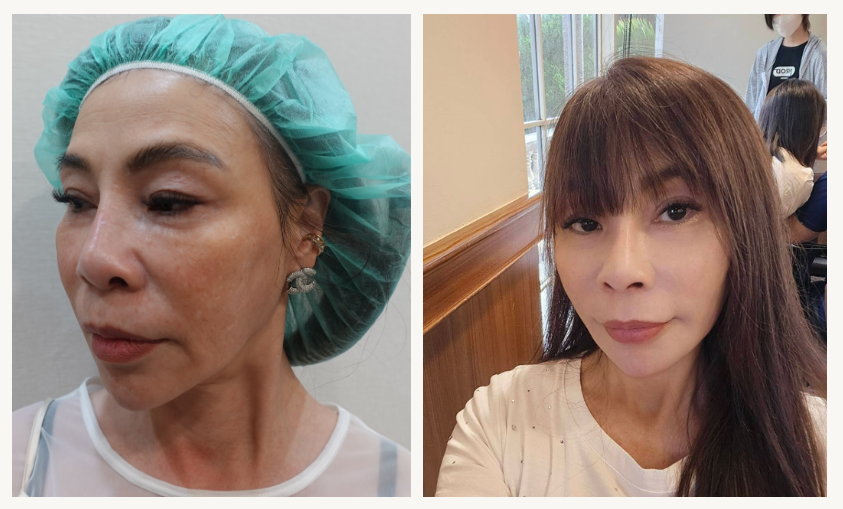
The patient in the photo below had a bit of all three types of nasolabial folds: muscle type, hollow type and sagging type. After filler in the cheek base area plus a thread lift, her folds became clearly lighter, but the muscle lines can never disappear completely, which is the limit of non-surgical treatment that I keep stressing.
4. Who is facial thread lifting suitable for?
Many people see thread lift before-and-after photos online that look great, and don't understand why their own results are not as dramatic.
I have to be very honest: facial thread lifting is very selective about candidates. This is why in some cases I can only tactfully ask the patient to consider other treatments, because after threading the effect would very likely be minimal.
Best results: long, slim faces and loose skin
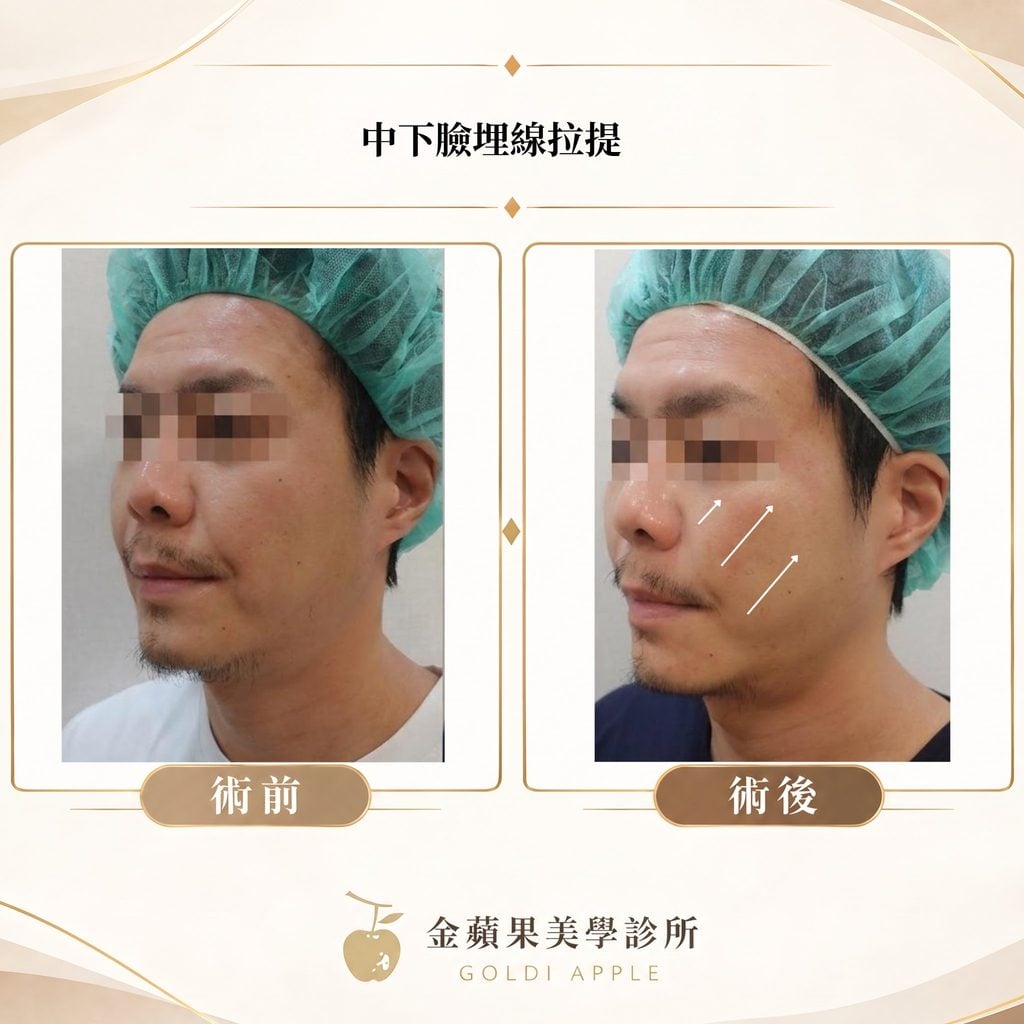
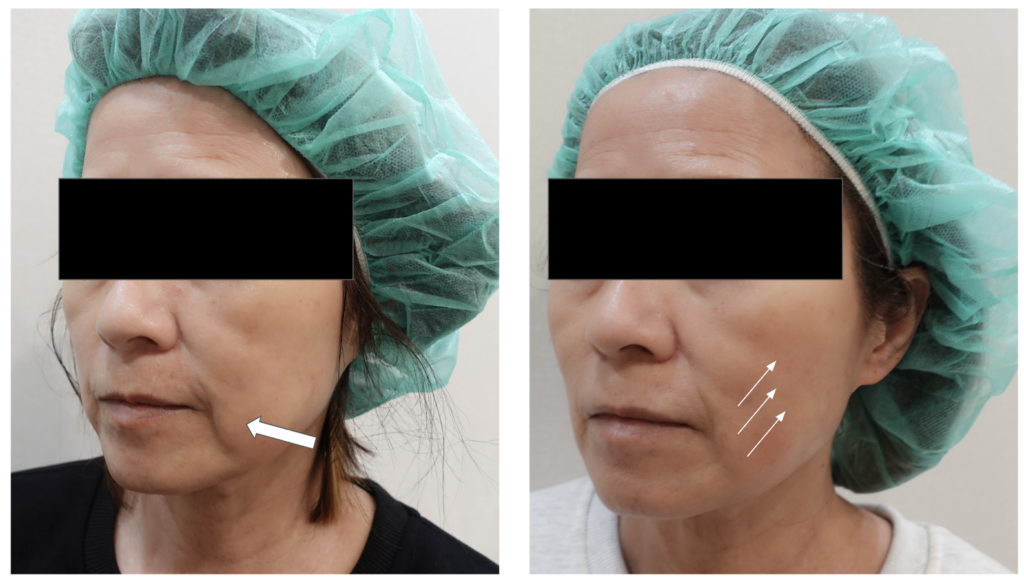
Long, slim faces and loose skin are the two types with the best thread lift results.
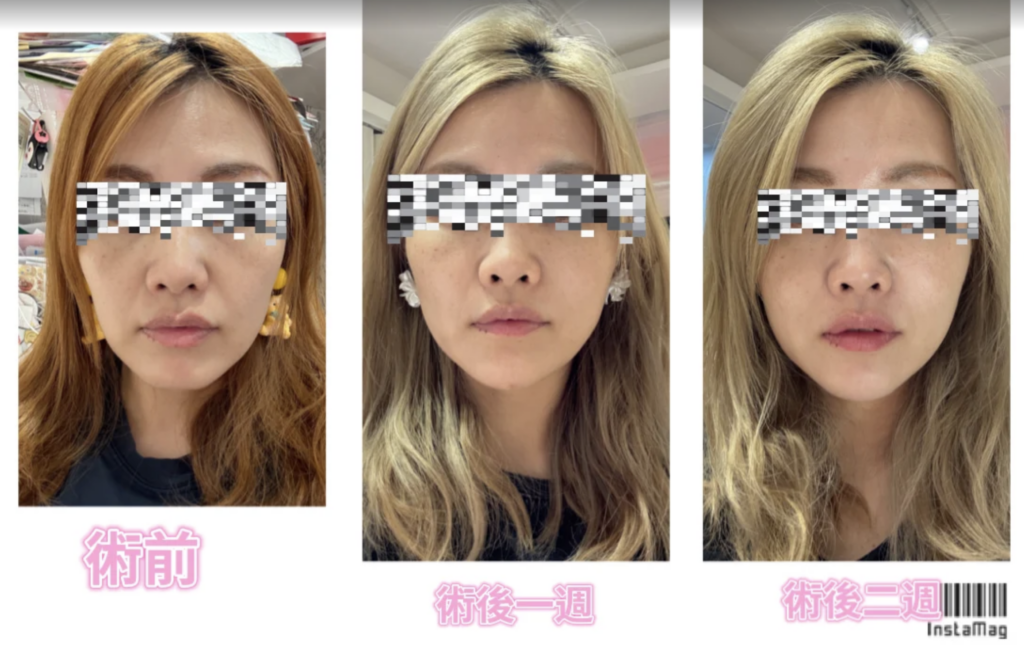
The reason is simple: each thread can only lift a fixed weight, so the more threads, the more obvious the effect (as long as the doctor places them along the correct paths).
The case below is skin sagging after rapid weight loss. After threads, the sagging nasolabial lines can be lifted upward.
Limited results: baby-fat faces and wide cheekbones
For "baby-fat" and "wide-cheekbone" faces, the thread lift effect is not obvious.
A fuller face may need 20 threads to reach 60% of the effect, and the results last only half as long.
Think of it this way: a fishing line hooked to a 10 kg fish versus one hooked to a 5 kg fish. The heavier load is certainly more likely to break the line.
| Face shape | Threads needed | Result | Duration |
|---|---|---|---|
| Long, slim face; loose skin | About 10 threads are very effective | Good | Normal |
| Baby-fat, fuller face | About 20 threads for 60% of the effect | Limited | Halved |
| Wide cheekbones | - | Limited, and may make the cheekbones more prominent | - |
What should people with fuller faces or wide cheekbones do first?
- More facial fat: consider intraoral fat removal, facial liposuction or weight loss with a GLP-1 pen first, and only then think about threads. Otherwise threading directly easily wastes money.
- Wide cheekbones: I suggest filler first, treating the temples or cheek hollows to smooth the outer contour before threading. Otherwise the face becomes V-shaped and the cheekbones look more prominent.
5. What are the side effects of facial thread lifting?
Just like hyaluronic acid and other fillers, almost all side effects come from technique failure.
If facial threads are placed correctly in the fascia layer, there should be no major side effects. Eating and making expressions should feel natural, and you should not feel the threads.
If the doctor lacks experience and places the threads in the wrong position, the following four situations can occur:
1. Hooking the expression muscles, causing persistent soreness
If threads are placed in the moving area of the expression muscles, hooking the muscle causes persistent soreness.
One patient went to a studio for a beginner doctor to practice on her, and the threads hooked straight into the masseter muscle. Eating became extremely painful, and she finally came to me to have the threads removed.
2. Placed too shallow, causing cheek hollows
A layer that is too shallow causes local hollows. This is also related to too few threads and each thread being pulled too forcefully. I explain how to deal with it in Can a failed thread lift be saved?
3. Wrong path planning, causing wider cheekbones
The direction of the threads decides where the tissue is pulled. With wrong path planning, the cheekbones may look wider after threading, the opposite of the intended effect.
4. Pulled too tight, threads break and expressions look stiff
Many people, in pursuit of results, ask the doctor to pull very hard and tight.
Although the before-and-after photos taken right after threading do look more obvious, just like a rubber band pulled very tight breaks easily, threads are the same. Pulled too tight, they easily break after placement, which actually makes the long-term result worse.
So I keep stressing: threads do not need to be pulled hard each time. Regular threading that reinforces the strength of the safety net in the fascia layer is the greatest long-term value of facial thread lifting.
6. Facial thread lifting cost
| Area | Golden Apple price |
|---|---|
| Mid and lower face | NT$42,000 |
| Upper face | NT$30,000 |
| Nose | NT$20,000 |
The number of threads actually needed depends on face shape, fat volume and degree of sagging. For unit prices and characteristics of each brand of thread, see What is thread lifting? 6 types of threads and full costs.
7. Frequently asked questions about facial thread lifting
Can facial threads be repeated again and again?
Yes. Facial thread lift threads are all absorbable. Many of my patients have repeated them for over ten years, and each time you cannot feel any past threads in the tissue, so they can be repeated indefinitely.
What threads are used for facial thread lifting?
Almost all legally approved threads in Taiwan are absorbable, such as bell threads, Tmira, Shenli lift, blue diamond fishbone threads and feather threads. In principle the lifting effect does not differ much; the key factors are the doctor's skill and the number of threads. A detailed comparison of threads and costs is in my thread lifting article.
Are facial thread lifting and thread lifting the same thing?
They are the same type of treatment with different names. "Thread lifting" is the general term, and "facial thread lifting" refers to its use on the face, divided into four areas: upper face (brow lift), midface (nasolabial folds), lower face (jowls and marionette lines) and nose. If you want to learn about thread types and costs, read the thread lifting article; this article covers the principle, suitable candidates and area planning.
My face is fuller. Can I get threads?
Yes, but the results will be discounted. Each thread can only lift a fixed weight. For a slim person about ten threads may be very effective, while a fuller face may need twenty threads to reach 60% of the effect, and it lasts half as long, just as a fishing line hooked to a 10 kg fish breaks more easily than one hooked to 5 kg. If you have more facial fat, I suggest considering intraoral fat removal, facial liposuction or weight loss first, then threads, otherwise it is easy to waste money.
Are threads suitable for people with wide cheekbones?
I do not recommend threading directly. For wide cheekbones I suggest filler first, treating the temples or cheek hollows to smooth the outer contour before threading. Otherwise the face becomes V-shaped and the cheekbones look more prominent.
How long do thread lift results last? Do the threads stay in the face forever?
No. PDO threads usually dissolve gradually over 3 to 6 months, so the physical lifting effect is not as obvious as right after placement. But the most important function of threads is not to keep hanging the flesh up, but to let the collagen growing around the threads make the tissue firmer overall and slow down sagging, and that effect lasts longer.
Why can't I just use Ellanse or Juvelook to lift?
Because the two lift in completely different ways. Threads lift along "lines and surfaces": collagen grows evenly along the whole thread and weaves into a mesh, and threads themselves have no volume effect, so no puffiness and no nodules. Collagen stimulators lift at "points": they were designed to improve hollows, not to lift, and injected at a single point they eventually grow volume. If the injected spot was not hollow, the grown volume can make the cheekbones look wider and the face look fatter.
Does facial thread lifting hurt? How long is the recovery?
Anesthesia is used during the procedure, so pain can be kept very low. Threads do not add any volume, so swelling afterward is the anesthetic wearing off and usually fades within a few days. If the threads are placed correctly in the fascia layer, eating and making expressions should feel natural, and you should not feel the threads.
Will threads make my expressions stiff?
Not when done correctly. Stiff expressions mostly come from pulling too tight: some people ask the doctor to pull very hard for results, and the photos right after look obvious, but threads pulled too tight break easily and the long-term result is worse. My approach is never to pull too hard, and to maintain the result by regularly reinforcing the safety net in the fascia layer.
Which is better, facial threads or ultrasound and radiofrequency?
They work at different levels and address different problems. Ultrasound and radiofrequency use heat to stimulate collagen contraction and renewal, and suit prevention and early maintenance. Threads physically pull the tissue back and weave a net, and suit people who already have sagging. If you really dare not get threads, I suggest regular ultrasound and radiofrequency maintenance instead of lifting with collagen stimulators at single points, which has more side effects.
Is it normal to feel the threads after threading?
No. When threads are correctly placed in the fascia layer, you should not feel them, and eating and making expressions should feel natural. If you can feel the threads, or have persistent soreness (possibly from hooking an expression muscle), local hollows or wider cheekbones, the thread position or depth is wrong, and I recommend returning for an evaluation.
Medical review and sources
This article was written and reviewed by Dr. Ou Chia-Hung of Golden Apple Aesthetic Clinic. Prices in the article are this clinic's prices. The actual number of threads and layout must be assessed in a face-to-face consultation, and results vary with face shape, fat volume and degree of sagging. Equal results are not guaranteed for everyone.
- Sulamanidze MA, Fournier PF, Paikidze TG, Sulamanidze GM. Removal of Facial Soft Tissue Ptosis with Special Threads. Dermatol Surg. 2002;28(5):367-371.
- Suh DH, Jang HW, Lee SJ, Lee WS, Ryu HJ. Outcomes of Polydioxanone Knotless Thread Lifting for Facial Rejuvenation. Dermatol Surg. 2015;41(6):720-725.
- Kang SH, Moon SH, Rho BI, Youn SJ, Kim HS. Wedge-Shaped Polydioxanone Threads in a Folded Configuration. Dermatol Surg. 2019;45(10):1323-1326.
- Niu Z, Zhang K, Yao W, et al. A Systematic Review and Meta-Analysis of Thread Lifting for Midface Rejuvenation. Aesthetic Plast Surg. 2021;45(5):2287-2297.
If you are not sure whether your face shape suits thread lifting, you are welcome to book a consultation. I will first assess your fat volume and sagging pattern, and if I judge that threads would help you very little, I will tell you directly rather than thread you first and explain later.