
The Short Answer: What HIFU Lifting Is and Who It Suits
HIFU lifting is medically known as High-Intensity Focused Ultrasound (HIFU). It focuses ultrasound energy at a fixed depth beneath the skin, creating tiny "thermal coagulation points" there. The tissue contracts, and new collagen grows over the following two to three months. It treats laxity and sagging, not hollowness. Golden Apple uses the Ultraformer III HIFU, priced at NT$29,000 for 600 shots and NT$36,000 for 800 shots.
| Item | Details |
|---|---|
| Treatment name | HIFU lifting (High-Intensity Focused Ultrasound, HIFU) |
| Device used at the clinic | Ultraformer III HIFU (Classys, Korea) |
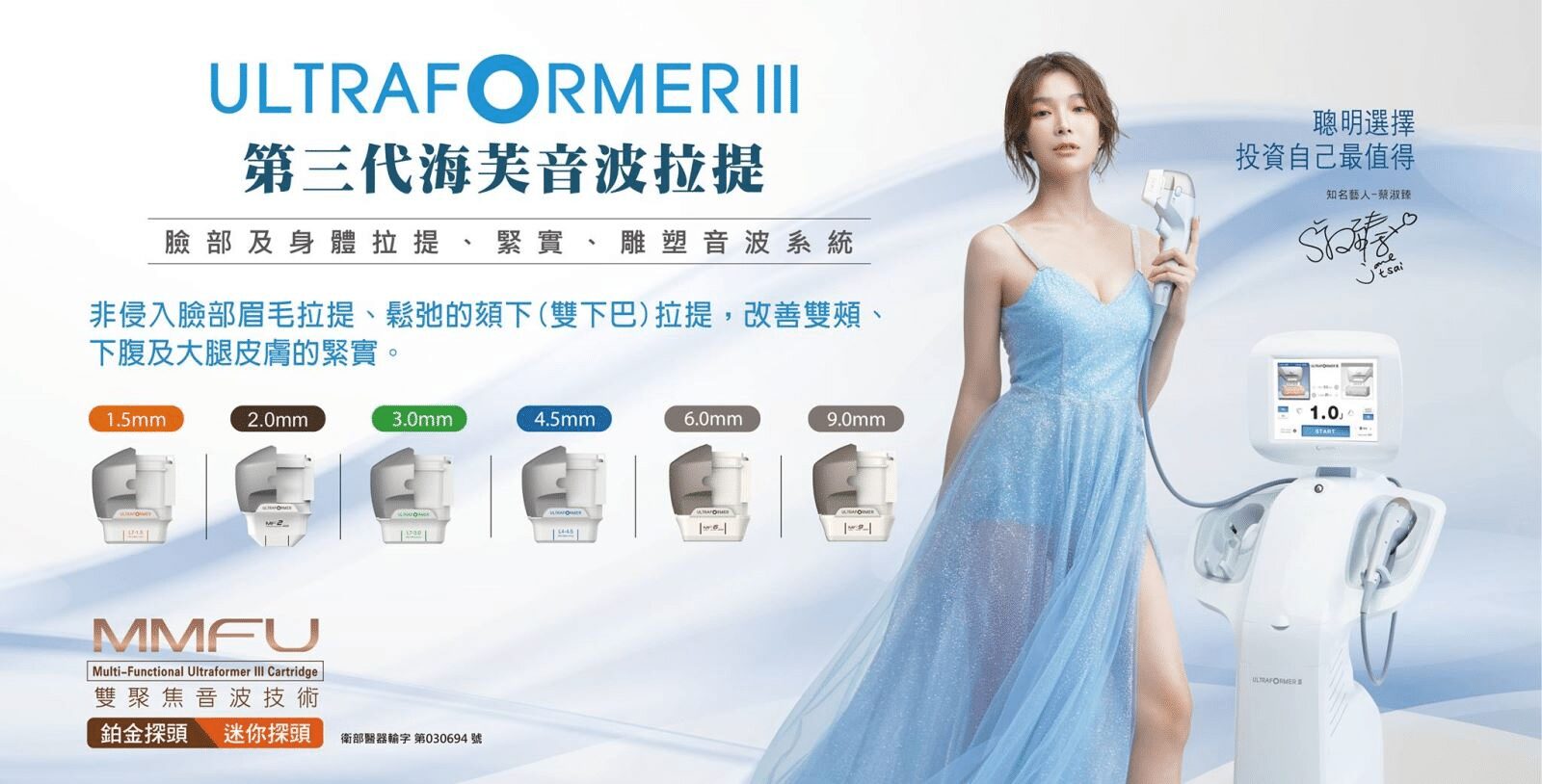
| Treatment depth | Four probes: 2.0 / 3.0 / 4.5 / 6.0 mm, reaching as deep as the SMAS layer |
| Main effects | Deep lifting, tightening the jawline contour, improving jowls |
| Suitable for | Mild to moderate laxity, jowls, a jawline that is starting to blur |
| Not suitable for | Severe laxity (already needing surgery), a naturally lean face, or a main concern of hollowness rather than sagging |
| Pain level | With the full pain-control routine, it can be nearly painless |
| Recovery | No downtime; some people have mild swelling or soreness that eases within about a week |
| When results appear | Immediate firming right after treatment; collagen remodeling peaks at about 2–3 months |
| How long it lasts | About 10–12 months |
| Golden Apple price | 600 shots NT$29,000 / 800 shots NT$36,000 |
This article was written by Dr. Ou Chia-Hung of Golden Apple Aesthetic Clinic and was last updated in October 2026.
The above are Golden Apple Aesthetic Clinic's prices. The number of shots and the treatment areas are confirmed after an in-person consultation and assessment by the doctor. Devices, shot-counting methods and fee standards differ between clinics, so quotes should not be compared directly.
- HIFU lifting treats "laxity," not "hollowness." If what you see in the mirror is sunken cheeks and deeper nasolabial folds, that is a volume-loss problem; HIFU would help only a little and could even make the face look thinner.
- Jowls are what HIFU is best at. The 6.0 mm probe can reach the deep fat of the jowls, a depth that radiofrequency cannot reach.
- Being afraid of pain does not mean you can't have HIFU. Pain mostly comes from a simplified routine: numbing cream not left on long enough, gel that was not chilled, or treating with the face turned to the side. When these four steps are done properly, pain can be kept very low.
- People with naturally slim faces should be cautious. HIFU reduces fat, and in someone with no excess fat to lose, it can leave the face looking older and more tired. I say this directly at the consultation.
Key Index
Key Index
- 1. What is HIFU lifting? Its medical name is High-Intensity Focused Ultrasound (HIFU) What actually lifts is the SMAS layer, not just "fat reduction" Four probes, four different depths
- 2. What HIFU lifting can and cannot improve Conditions suited to HIFU lifting Conditions where it is unsuitable or results are limited
- 3. How Ultraformer III differs from Ultherapy Specification comparison of the two devices Why I chose the Ultraformer III HIFU
- 4. HIFU lifting vs. radiofrequency lifting: how to choose Different depths treat different problems HIFU vs. radiofrequency comparison table Can I have both?
- 5. How many shots for HIFU lifting? Choosing between 600 and 800 shots 600 shots: concerns concentrated in the mid and lower face 800 shots: the whole face, at a lower price per shot
- 6. HIFU lifting prices
- 7. Does HIFU lifting hurt? My four pain-control steps I. Numbing cream for 40 minutes or more II. Pain medication before the procedure III. Chilled ultrasound gel IV. Lying flat, not turning the face to the side
- 8. When do results appear, and how long do they last?
- 9. Post-treatment reactions and precautions Normal reactions When to return to the clinic
- 10. HIFU lifting FAQ Can HIFU lifting make the face hollow or older? Can HIFU and radiofrequency lifting be done on the same day? How often can HIFU lifting be done? For a first treatment, should I choose 600 or 800 shots? Is HIFU lifting really painless? Why do some people say they felt nothing after HIFU? Which is better, Ultraformer III or Ultherapy? Can I wear makeup or exercise right after HIFU? Can pregnant or breastfeeding women have HIFU lifting? How does HIFU lifting differ from thread lift, and which should I choose?
- Medical Review and Sources
1. What Is HIFU Lifting?
Before HIFU lifting existed, there was really only one evidence-backed way to treat facial laxity: a facelift operation. The results of a facelift are beyond doubt; the problem is recovery. I have seen people after a facelift whose whole face stayed bruised for about two to three weeks. The results may be good, but most people are put off just by hearing about the recovery period.
The value of HIFU lifting is that it is an alternative that involves no incision and no recovery period. Of course its results are not equal to surgery, but for people whose condition is not yet severe enough to need an operation, it fills in the gap in between.
Its medical name is High-Intensity Focused Ultrasound (HIFU)
"HIFU lifting" is just the name used in the market. Its formal medical name is High-Intensity Focused Ultrasound (HIFU).
The technology was invented in 1942, so it now has a history of more than eighty years. Its earliest uses had nothing to do with aesthetics. It was used to treat tumors in organs, kidney stones and uterine fibroids, so that some patients who would otherwise have needed surgery did not have to go onto the operating table.
It was later found that the same principle used on the face can tighten loose tissue and reduce the fat of the jowls, and it has even been used on the abdomen. Aesthetic use is an extension of the technology, not its starting point.
What actually lifts is the SMAS layer, not just "fat reduction"
I want to be especially clear on this point, because many articles describe HIFU as "using ultrasound to burn away fat." That description is only partly correct, and it is misleading.
HIFU lifting relies on an external transducer that focuses ultrasound energy at one fixed depth beneath the skin. At that focal point, the temperature rises almost instantly to about 65–70°C, forming a thermal coagulation point less than one millimeter in diameter. The tissue outside the focal point, including the epidermis, is barely affected by the temperature, so there is no wound on the skin surface.
Two things then happen:
- Immediate contraction: the collagen at the thermal coagulation points is denatured by heat and contracts immediately. This is the firmness you can feel right after the treatment.
- Collagen remodeling: these tiny thermal injuries trigger a repair response, and new collagen grows over the following 2–3 months. This is the true source of the lifting effect.
When the focus is placed at the SMAS layer, 4.5 mm deep, what contracts is the fascia layer that supports the entire mid and lower face, and this is the main driver of the lifting effect. When the focus is placed at 6.0 mm, it is the deep fat that is treated. So "fat reduction" is only what one of the probes does, and tightening the SMAS is the core of HIFU lifting.
Why does this difference matter? Because if you think HIFU is about reducing fat, you will assume that the thinner your face, the more you should have it done. The truth is exactly the opposite.
Four probes, four different depths
The Ultraformer III HIFU has four probes, each representing a fixed heating depth. The doctor's job is to choose the right probe according to the skin thickness of each area:
| Probe | Heating depth | Main areas and tissues treated |
|---|---|---|
| 2.0 mm | Dermis | Areas with thinner skin, such as around the eyes and the forehead |
| 3.0 mm | Fat beneath the dermis | Superficial layer of the mid and lower face, for surface firming |
| 4.5 mm | SMAS layer | The main driver of deep lifting in the mid and lower face |
| 6.0 mm | Deep subcutaneous fat | The fat mass of the jowls |
Where the skin is thin, a deep probe delivers too much energy; where the skin is thick, a shallow probe's energy never reaches the layer it should. Choosing the wrong probe is one of the main reasons people feel nothing after HIFU, or feel a lot of pain afterward.
2. What HIFU Lifting Can and Cannot Improve
This is the part I spend the most time discussing at a consultation. HIFU lifting is not an all-purpose treatment; it has very clear indications and very clear no-go areas.
Conditions suited to HIFU lifting
- Jowls: this is what HIFU is best at. The 6.0 mm probe can reach the deep fat of the jowls, while the 4.5 mm probe tightens the SMAS: one reduces volume downward, the other lifts upward. I have written about the types and other approaches in how to get rid of jowls.
- A jawline contour that is starting to blur: after your thirties, the side contour of the face slowly becomes less defined, but there is no obvious sagging yet. HIFU at this stage gives the best return.
- Mild to moderate facial laxity: the skin still has some elasticity and the fat pads have only moved down slightly.
- Wanting to maintain without surgery: treat it as an annual maintenance routine, rather than waiting until the laxity is very obvious.
Conditions where it is unsuitable or results are limited
- A naturally slim face: there is no excess fat to reduce, and HIFU would only make the face more hollow and older-looking. For these people I usually do not recommend HIFU, and we first discuss volume replacement instead.
- A main concern of hollowness rather than sagging: sagging apple cheeks and hollow apple cheeks are two different things. If the problem is volume loss, HIFU cannot help.
- Severe laxity: if the skin is already clearly loose and the jawline has completely disappeared, HIFU does not provide enough lift, and you should go straight to discussing a non-incisional fascia lift, thread lift or surgery.
- A large amount of filler in the face: for people who have had a lot of hyaluronic acid or other fillers, heat may affect the stability of the filler, and may also make an overfilled face harder to assess. Always tell the doctor before treatment.
- Implants, metal or severe inflammation in the treatment area: these need individual assessment.
My practice is this: if my assessment shows that HIFU won't help you much, I will tell you so directly, rather than do one session first and say so afterward.
3. How Ultraformer III Differs from Ultherapy
The first HIFU device in Taiwan was Ultherapy, introduced in 2014 and made by Merz in the United States. There is nothing wrong with its results, but what it is most criticized for is pain. Clients at the time described it as "going through hell," paying money to suffer.
The Ultraformer III HIFU was launched by Classys of Korea in 2018. Its results are comparable, but the pain is greatly reduced.
Specification comparison of the two devices
| Ultraformer III HIFU | Ultherapy | |
|---|---|---|
| Manufacturer | Classys, Korea | Merz, USA |
| Probe depths | 2.0 / 3.0 / 4.5 / 6.0 mm | 1.5 / 3.0 / 4.5 mm |
| Pain | Nearly painless | Mild pain to severe pain |
| Overall lifting results | Good | Good |
| Lifting results for jowls | Good | Weaker (no 6.0 mm probe) |
| Flexibility in shots per session | High | Lower |
Why I chose the Ultraformer III HIFU
Both devices give good overall lifting results. The differences are in two places:
The first is probe depth. Ultherapy only goes as deep as 4.5 mm and has no 6.0 mm probe. The fat mass of the jowls sits deeper than that, and without this depth, the results on jowls are simply more limited.
The second is pain. This is not only a matter of comfort. If a client is in unbearable pain, the doctor has to lower the energy or skip some areas, so pain directly affects whether the treatment can be completed fully.
For these two reasons, the Ultraformer III HIFU is my current first choice. This is my personal clinical choice and does not mean Ultherapy is bad. Both are legally approved devices that have passed registration review.
4. HIFU Lifting vs. Radiofrequency Lifting: How to Choose
Different depths treat different problems
The simplest way to put it: radiofrequency handles the surface, HIFU handles the deep layers.
Radiofrequency works at a shallower level and mainly treats laxity on the surface of the face. Afterward there is a clear sense of firmness and a healthy glow. But it does not help much with jowls.
HIFU works at a deeper level, reaching straight to the SMAS layer, and treats deep laxity and sagging fat. It is better able to lift fat that has moved downward.
Here is an example you will certainly understand. If someone with obvious jowls has radiofrequency, the surface of the face does become firmer afterward, but they become "a person with very firm skin who still has jowls." The problem has not been solved; only the surface has improved.
HIFU vs. radiofrequency comparison table
| Ultraformer III HIFU | Radiofrequency | |
|---|---|---|
| Treatment depth | Deeper (up to 6.0 mm, reaching the SMAS) | Shallower (mainly the dermis) |
| Main effects | Deep lifting, reducing deep fat | Tightening the skin surface, improving skin texture and glow |
| Suitable for | Jowls, baby fat, wanting a slimmer face, a blurred contour | Many fine lines on the surface, surface laxity, wanting better skin quality |
| Pain | Nearly painless (requires the full pain-control routine) | Mild pain |
| Recommended dose | 600 shots (mid and lower face) / 800 shots (full face) | 900 shots |
| How long it lasts | About 10–12 months | About 10–12 months |
Can I have both?
Yes, and in some situations it makes sense, because they treat layers that do not overlap: one handles deep lifting, the other handles surface firming and skin quality.
But I do not recommend doing both on the same day. Stacking heat increases discomfort and swelling, and it is hard to tell which treatment caused a reaction. If you want both, my approach is to leave an interval of at least two to four weeks, doing HIFU first and radiofrequency afterward.
Also, if your budget is limited, I would suggest doing one properly rather than doing half of each. A treatment with too few shots easily loses effect.
5. How Many Shots for HIFU Lifting? Choosing Between 600 and 800 Shots
The number of shots determines the coverage: how much area can be treated and how densely each area can be treated. The most common result of too few shots is not "no effect" but "some areas respond and some were not treated," so the whole face looks uneven.
Golden Apple offers two plans:
| Plan | Coverage | Suitable for | Price | Average price per shot |
|---|---|---|---|---|
| 600 shots | Mainly the mid and lower face | Concerns focused on jowls and jawline, with no obvious problem in the upper face | NT$29,000 | About NT$48.3 per shot |
| 800 shots | Full face | Wanting to treat the whole face, or having laxity in the upper face and around the eyes too | NT$36,000 | NT$45 per shot |
600 shots: concerns concentrated in the mid and lower face
If your main concern is very clear (it is the jowls, it is the jawline) and you don't especially want to treat the forehead and eye area, 600 shots concentrated on the mid and lower face is a reasonable setup.
800 shots: the whole face, at a lower price per shot
800 shots costs only NT$3,000 more than 600 shots, but gives 200 more shots. Calculated out, the average price per shot drops from NT$48.3 to NT$40, so the extra shots are almost like adding them at a 30% discount.
So if you also want to treat the upper face or the eye area, or you are not sure where to focus, 800 shots is usually the better-value choice. How the shots are actually distributed, I will decide at the consultation according to the skin thickness and degree of laxity in each area of your face.
6. HIFU Lifting Prices
| Plan | Shots | Golden Apple price |
|---|---|---|
| Mid and lower face | 600 shots | NT$29,000 |
| Full face | 800 shots | NT$36,000 |
The above are Golden Apple Aesthetic Clinic's prices, which include the full pre-treatment pain-control routine (numbing cream, oral pain medication, chilled ultrasound gel).
When comparing prices, a few things are worth knowing first:
- Different devices cannot be compared on price directly. "HIFU" on the market includes original manufacturer devices, gray-market devices and various imitations, and the prices differ widely. When asking, ask directly for the device name and the manufacturer's certification.
- Shots may be counted differently. Some quotes count "shots" by area, and the total is not the same thing as the shot count for the full face.
- Be wary of very low prices. HIFU probes are consumables with a usage limit, and a quote below a reasonable cost usually means probes are being reused or the device's origin is unclear.
I won't say other clinics are expensive or cheap, but I suggest you get clear answers on these three things before deciding: the device model, how shots are defined, and whether the probe is a genuine, new manufacturer probe.
7. Does HIFU Lifting Hurt? My Four Pain-Control Steps
This is my signature, and where I think clinics differ the most.
The Ultraformer III HIFU is already less painful than the previous generation, but "nearly painless" is not something the machine achieves by itself; it comes from the routine. I have performed HIFU on more than two hundred patients and have put together four steps. Every one of them is skipped by clinics in a hurry, and every one directly affects how much pain you feel.