
Hollow cheeks can make a person look worn out. Many patients who come to me for hollow cheeks were prompted by a neighbor or friend asking, "Why has your face become so thin?" Asian cheekbones are naturally wider than those of Westerners, so once hollow cheeks appear, the whole face can look harsh and tired.
Hollow cheeks fall into three types: skeletal, collagen-loss and sagging. The principle is "fill what is hollow, lift what sags." For the collagen-loss type, the four most suitable filler materials are hyaluronic acid, Sculptra, Vivabella and Aesthefill: for a small local hollow, choose hyaluronic acid to fill it precisely; for a large area of hollowing, choose a collagen stimulator. I do not recommend Ellanse or Radiesse for hollow cheeks, because they are too firm and the cheek, being so soft an area, can feel stiff when you make expressions.
In this article I will explain, all in one place, the 3 types of hollow cheeks, whether taking collagen helps, the pros and cons of 4 filler materials, how to inject hyaluronic acid without turning hollow cheeks into bulging cheeks, 2026 prices by brand, and "whether cheeks become hollow after HIFU, botulinum toxin or thread lifts."

Hollow Cheeks at a Glance
| What hollow cheeks are | A hollow below the cheekbone that forms a shadow in sunlight, making the cheekbone look more prominent |
|---|---|
| 3 types | Skeletal, collagen-loss, sagging |
| Treatment principle | Fill what is hollow, lift what sags; for the sagging type, filling alone cannot fully improve it |
| Suitable filler materials | Hyaluronic acid, Sculptra, Vivabella, Aesthefill |
| Materials not recommended | Ellanse, Radiesse — too firm, the cheek feels stiff with expressions |
| How to choose | Small local hollow → hyaluronic acid; large area of hollowing → collagen stimulator |
| Key to hyaluronic acid injection | The ligaments must be released and the filler placed in the buccal fat pad above the masseter, otherwise the cheek will bulge |
| Recommended dose | Hyaluronic acid 2–4cc; Sculptra / Vivabella / Aesthefill 1–2 vials |
| Duration | Hyaluronic acid about 1–1.5 years; collagen stimulators about 2–3 years |
| Safety | One of the safest injection areas of the face, with no major arteries |
| Does taking collagen help? | No — it is broken down into amino acids in the small intestine |
| Reference prices | Hyaluronic acid 2cc NT$17,000–30,000; stimulator NT$23,000 per vial (2026) |
1. What Are Hollow Cheeks?
In one sentence: hollow cheeks are a hollow below the cheekbone that casts a shadow under the cheekbone in sunlight.
I developed hollow cheeks myself: after opening the clinic I had so much to worry about that I lost a good deal of weight, and after collagen loss my cheeks became hollow.
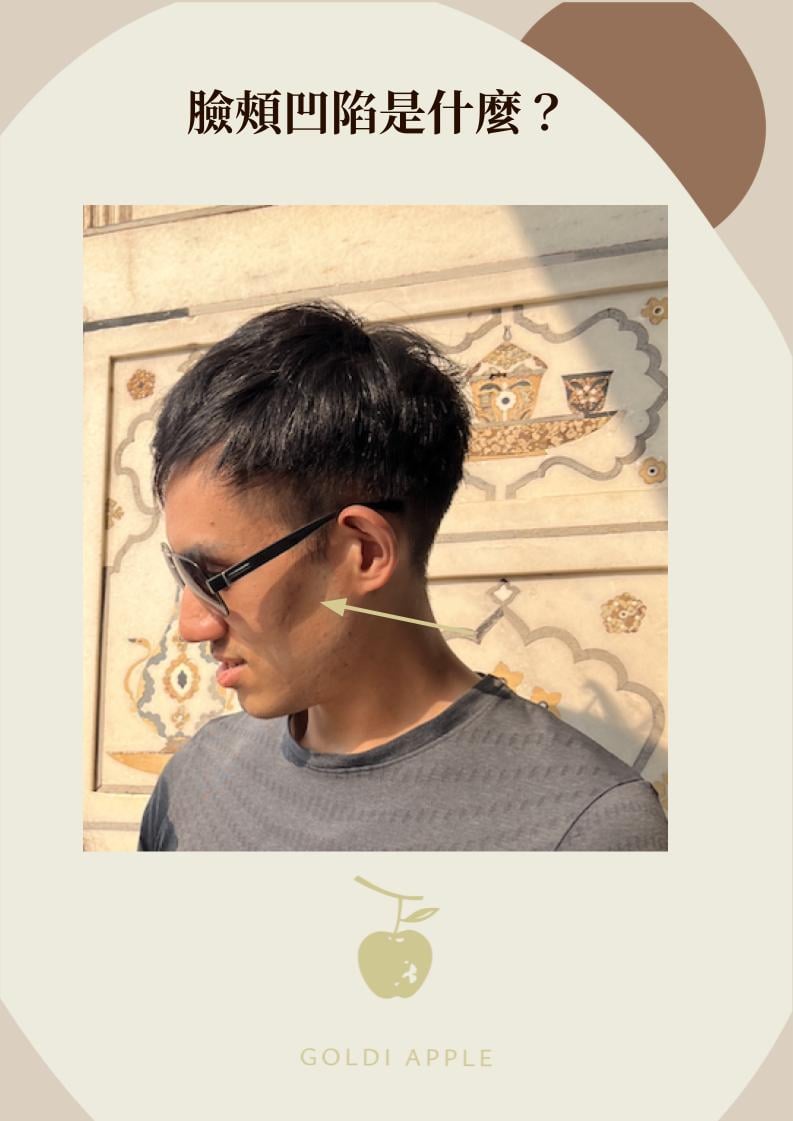
Many people have not only hollow cheeks but also hollow temples and hollow apple cheeks, so the facial contour looks uneven like waves and the cheekbones look even more prominent.
Many people think wide cheekbones can only be fixed by cheekbone reduction surgery, but in fact, once hollow temples and hollow cheeks are filled, the facial contour looks much softer.
2. Causes of Hollow Cheeks: 3 Types
In one sentence: hollow cheeks come in three types — skeletal, collagen-loss and sagging — and the treatments are completely different. The big idea is the same old line: loss (hollowing) is treated by filling, sagging is treated by lifting.
| Type | Cause | Main solution |
|---|---|---|
| Skeletal | Cheekbones are naturally positioned high, forming a large hollow area | Filling |
| Collagen-loss | Loss caused by age, smoking, staying up late or rapid weight loss, often together with hollow temples and apple cheeks | Filling (hyaluronic acid or stimulator) |
| Sagging | Apple cheeks sag and jowls accumulate, so the middle looks hollow by contrast | Lifting (thread lift or HIFU), combined with filling if necessary |
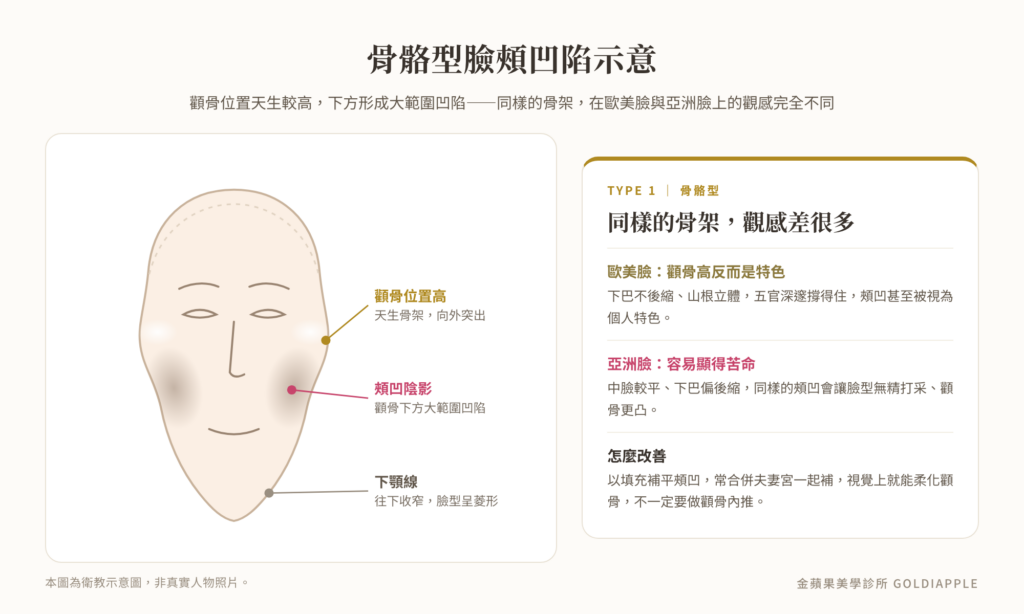
1. Skeletal Type: Naturally High Cheekbones, Common in Westerners
This type is usually due to bone structure: the cheekbones sit high, forming a large hollow area. Many Westerners develop it after thirty, but because their features are deep-set, hollow cheeks do not necessarily affect their appearance.
Many Western actresses have very obvious hollow cheeks. Westerners naturally have high cheekbones, but their chins do not recede and their nasal root is well defined, so high cheekbones actually look good on the whole face and are even seen as a personal trait; the same feature on an Asian face can look listless and make a person look unlucky.
2. Collagen-Loss Type: The Most Common, Can Suddenly Make You Look Years Older
With age, collagen is lost and hollows appear on both sides, usually together with hollow temples and hollow apple cheeks, and the overall facial hollowing makes the visual age increase rapidly. For this type, either hyaluronic acid or a collagen stimulator can restore fullness to the face.
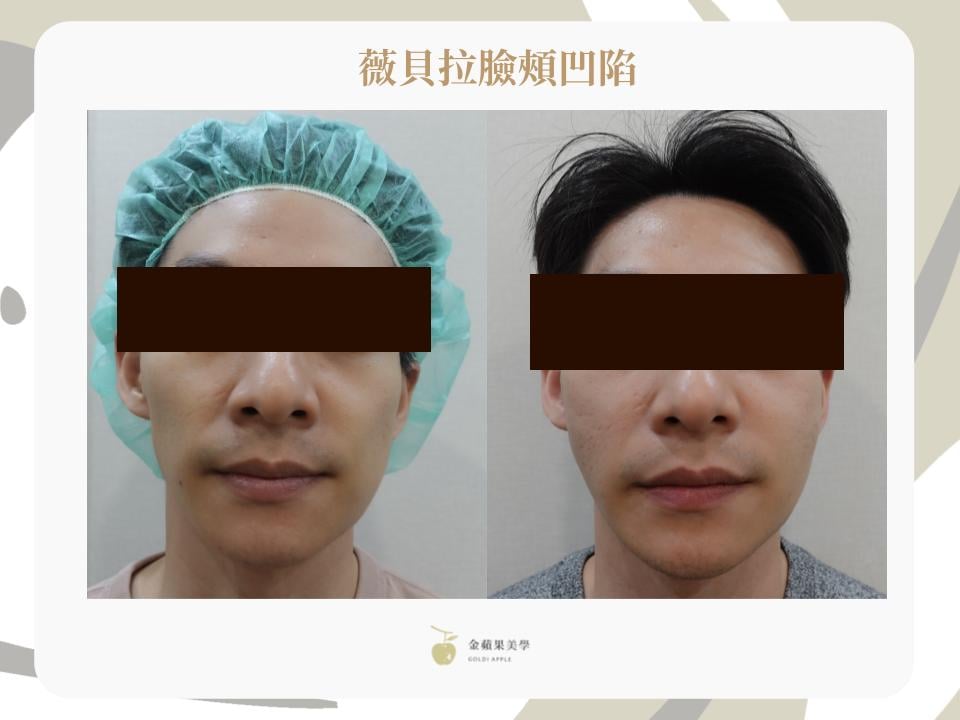
The patient in the photo below originally had hollow cheeks and looked tired. At a follow-up three months after Vivabella injections, his complexion was much better and he looked young and handsome again.
3. Sagging Type: Filling Alone Is Useless, Lift First
This is mainly due to sagging apple cheeks and fat accumulating in the jowls, so the middle looks hollow by contrast. For this type, simply filling with Sculptra or Aesthefill cannot fully improve it; it needs to be combined with a thread lift to pull the jowls upward.
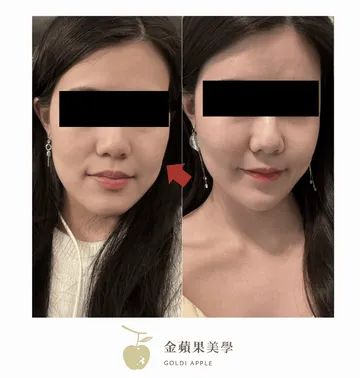
The patient in the photo below was very bothered by the dent in her facial contour. On assessment, it was not collagen loss but a sagging problem — after a thread lift the hollow cheeks were no longer obvious, and her face also looked firmer.
3. Does Taking Collagen Help Hollow Cheeks? Ways to Improve Without Injections
In one sentence: taking collagen does not help — all collagen that is eaten is broken down into amino acids in the small intestine, and too much can even become abdominal fat. For the collagen-loss type, the real fix is to quit smoking and stop staying up late; for the sagging type, you need HIFU or a thread lift.
1. Collagen-Loss Type: Quitting Smoking and Not Staying Up Late Is the Real Fix
For many typical collagen-loss hollow cheeks, the biggest cause is smoking or frequently staying up late. Nicotine and late nights both raise the body's metabolism and speed up collagen loss. Of course, after filling with hyaluronic acid you will look much better right away, but if you keep staying up late, collagen in other parts of the body is also being lost faster.
2. What to Eat for Hollow Cheeks? It Only Works for People Who Are Too Thin
Some people think their hollow cheeks are because they are too thin. If your BMI is truly too low, eating more does work; but if your body fat is not low and your BMI is normal or even high, nothing you eat will help.
Then surely taking collagen is fine? Unfortunately, all the collagen you eat is broken down into amino acids once it reaches the small intestine, and too much can even be stored as abdominal fat — the hollow cheeks do not improve, and you gain weight first.
3. Sagging Type: Use HIFU to "Pull" the Jowls Back into Place
If the facial ligaments are loose and the skin sags, you get the situation of "hollow cheeks but obvious jowls." In this case, HIFU lifting is used to pull the superficial fat that has gathered at the jowls back to the area that was hollow, which is the better way to solve the problem; for more obvious sagging, consider a thread lift.
4. What to Inject for Hollow Cheeks? Pros and Cons of 4 Filler Materials
In one sentence: the materials best suited to filling hollow cheeks are hyaluronic acid, Sculptra, Vivabella and Aesthefill. For a small local hollow, choose hyaluronic acid to fill it precisely; for a large area of hollowing caused by braces or rapid weight loss, start with a collagen stimulator, then finish the remaining small hollows with hyaluronic acid.
"Hollow cheeks," "sunken face," and "both cheeks hollow" are among the most discussed topics on Dcard. Many patients come to me for hollow cheeks because an elder at home said that hollow cheeks make them look like they lead a hard life.
| Hyaluronic acid | Sculptra | Vivabella / Aesthefill | Autologous fat | |
|---|---|---|---|---|
| Main component | HA | PLLA | PDLLA + HA / CMC | Autologous fat |
| Recommended dose | 2–3cc | 1–2 vials | 1–2 vials | — |
| Time to take effect | Immediate | 2–3 months | Immediate + 2–3 months | Immediate |
| Duration | 1–1.5 years | 2–3 years | 2–3 years | 5+ years (depends on retention rate) |
| Pros | Immediate filling, can precisely fill small areas, can be dissolved if you gain weight later | Produces the most collagen, suitable for large areas | Low nodule rate, immediate volume | Fewer allergy concerns, relatively low cost for a single session |
| Cons | Needs regular top-ups, many syringes needed for large areas | No effect at the time, amount of growth depends on constitution, cannot be dissolved | Produces less collagen than Sculptra, cannot be dissolved | Gains weight along with you, cannot be dissolved, retention rate depends on constitution |
| Treatment cost | NT$10,000–30,000 | NT$20,000–50,000 | NT$20,000–50,000 | NT$60,000–80,000 |
1. Hyaluronic Acid for Hollow Cheeks: First Choice for Small Local Hollows
- Pros: If only one small spot is hollow and you want to fill that spot "precisely," choose hyaluronic acid. Of the hollow-cheek hyaluronic acids I have used, I recommend Juvederm Volift most; its texture is closest to the real feel of the cheek
- Cons: For large-area hollow cheeks caused by braces or rapid weight loss, many syringes are needed, and your wallet will hurt lol. In this case I suggest first using Sculptra or Vivabella to grow collagen, then filling any remaining local hollows with hyaluronic acid; the stimulator's effect is also longer-lasting
- Who it suits: People with local hollows, and first-timers who want to keep the way out of "being able to dissolve it if I regret it"; it also suits people who may gain weight in future, since you can simply dissolve it if you do
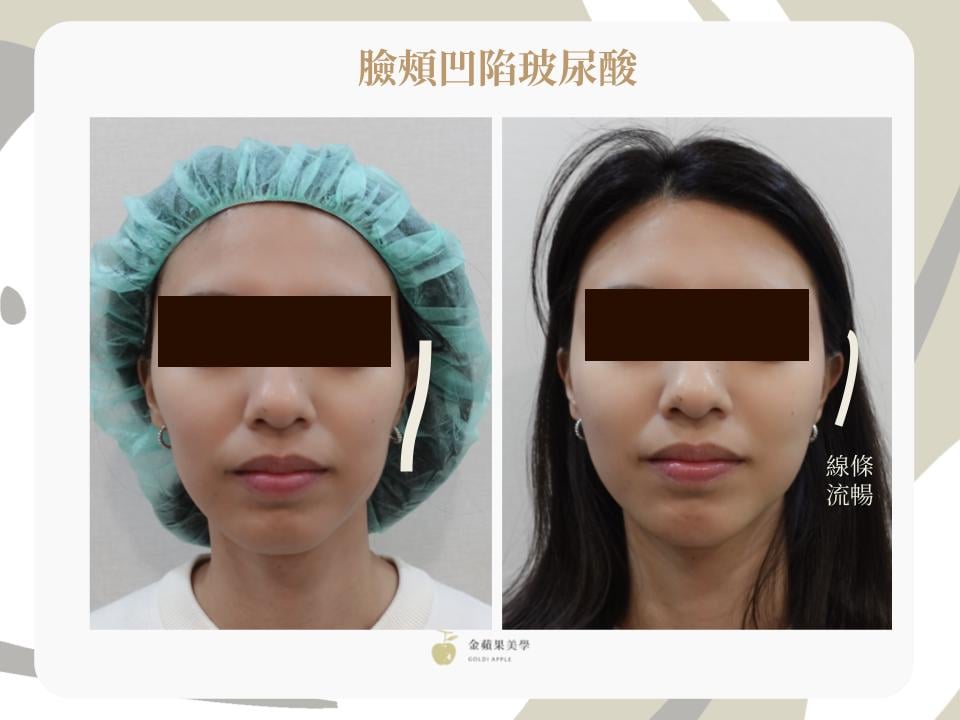
The case below used 2cc of cheek hyaluronic acid plus 2cc of temple hyaluronic acid; the face became fuller and the outer contour smoother.
2. Sculptra for Hollow Cheeks: Grows the Most Collagen, but Don't Keep Topping Up
- Pros: The best collagen-stimulating effect, suitable for large-area hollow cheeks
- Cons: No immediate filling effect, you have to wait 2–3 months for collagen to grow; the amount of growth depends heavily on constitution; cannot be dissolved
- Dose: 1 vial is enough for mild hollowing; for moderate or worse, one vial per side is recommended for a more noticeable effect
A special reminder: Sculptra has been shown in many studies to produce the most collagen, and continuing to top up easily leads to puffiness. After one vial, I would suggest that you do not need another for 2–3 years. I have heard of many people buying 5 or 6 vials at once during an anniversary sale and going back every six months for a top-up — that is really too much; the face does not need to grow that much flesh.
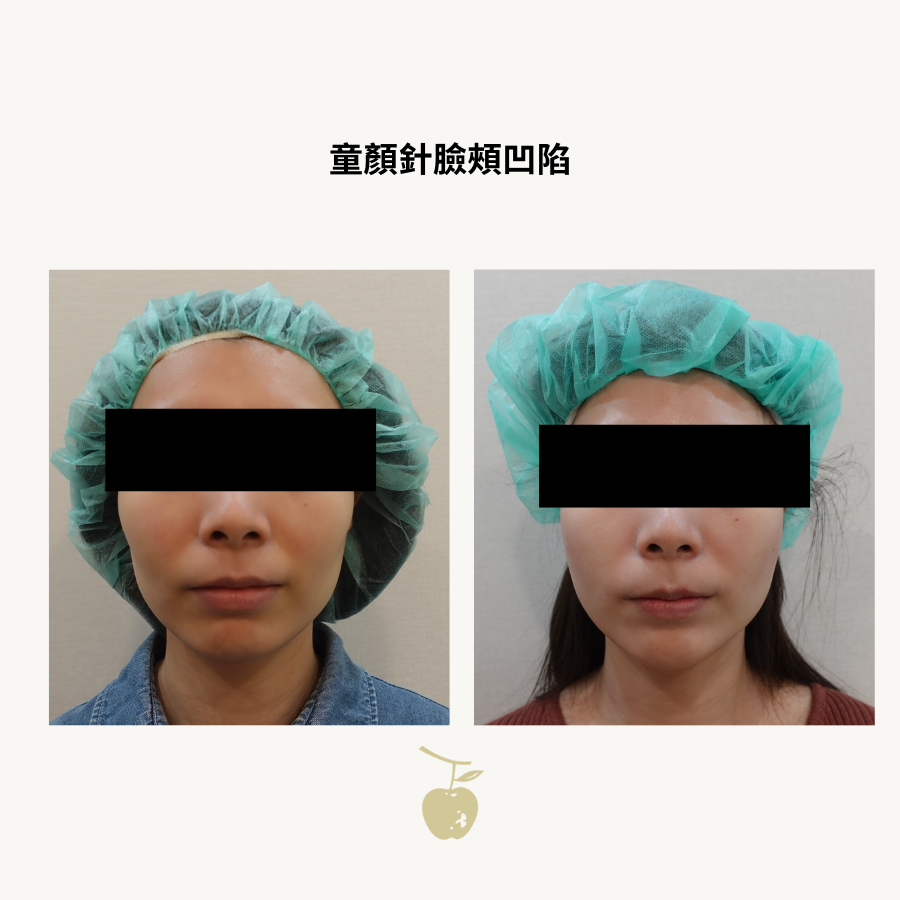
The photo below was taken at a follow-up four months after one vial of Sculptra; the hollow cheeks have clearly improved and the facial contour is much smoother.
3. Vivabella / Aesthefill for Hollow Cheeks: A Low-Nodule-Rate Option
The collagen-stimulating ingredient in Vivabella (the "Magic Needle") and Aesthefill is basically the same (in fact the same developer moved to a different company), so I discuss them together.
Use a bride and bridesmaid as an analogy: the bride in both is poly-D,L-lactic acid (PDLLA); the only difference is that Aesthefill's bridesmaid is a CMC gel, while Vivabella's bridesmaid is hyaluronic acid.
Why add a bridesmaid? Mainly to reduce the chance of nodules. The stimulator itself is a powder with no volume, and the powder must be evenly suspended in the tissue so that the collagen it grows does not clump into nodules. But a bridesmaid is still only a bridesmaid — she leaves within a month of injection, and what stays with you for life is the collagen you have grown yourself.
So if you see someone on Dcard or PTT say "Aesthefill or Vivabella stopped working after one month," it is usually just the volume of the gel and hyaluronic acid that has gone. Don't be too disappointed: this kind of product works slowly and steadily, Aesthefill in about 2–3 months and Vivabella in about 6 months, as collagen gradually grows — that is your true match.
- Pros: Low nodule rate; with the bridesmaid holding it up, there is volume right after injection
- Cons: Produces less collagen than Sculptra; cannot be dissolved
For the full specifications and price comparison of 6 stimulators including Aesthefill, Sculptra and Vivabella, see this article: How to Choose a Collagen Stimulator?
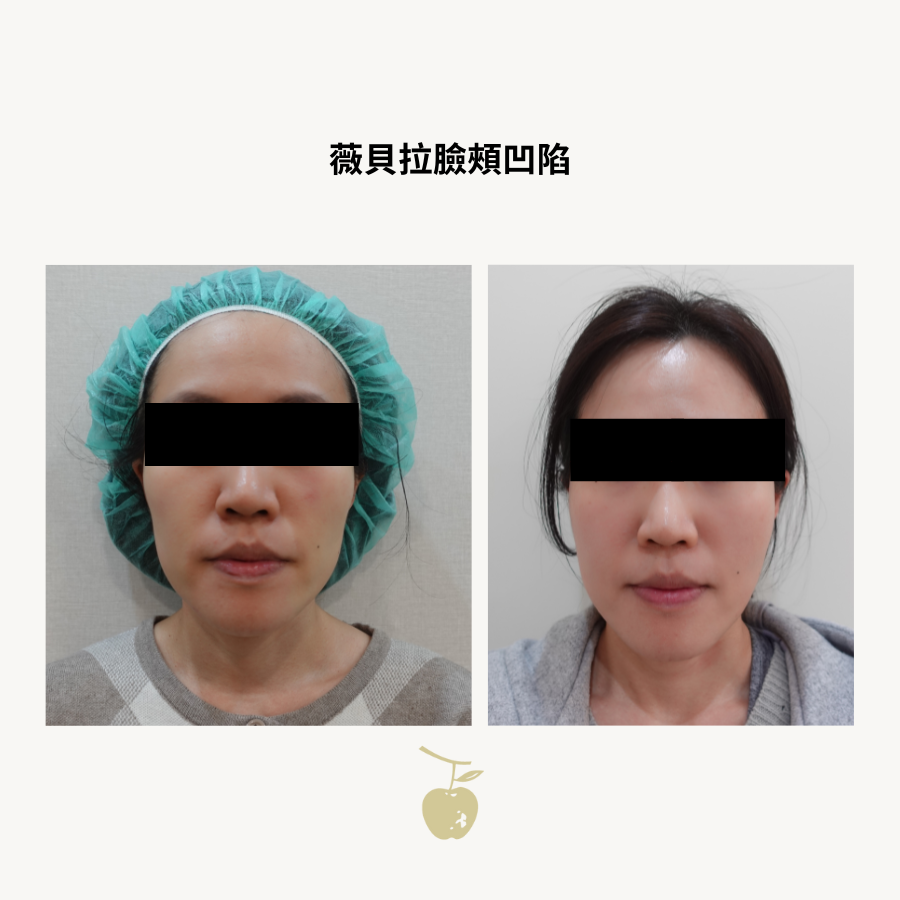
The patient in the photo below had more severe hollow cheeks and received two vials of Vivabella; at a follow-up one year later the result still looked naturally full. For a full explanation of Vivabella for hollow cheeks, see this article: Vivabella Is the New-Generation Answer to Hollow Cheeks.
4. Autologous Fat: Cheaper, but You May Regret It If You Gain Weight
Autologous fat can also improve hollow cheeks, and for people with very hollow faces its advantage is that it is relatively cheap — after all, several vials of stimulator cost a fair amount.
The biggest problem is that if your weight increases in future, your face will look much fatter. If you filled with hyaluronic acid, you can dissolve it when you gain weight and the face can slim back down, and may not even have hollow cheeks again; after fat grafting, if you gain weight, that is simply how it is. After middle age, fat accumulates in the face very quickly, and many people who had thin faces and hollow cheeks when young find their faces suddenly getting fleshier after 40 — quite a few of my patients regretted fat grafting after gaining weight.
5. Why Don't I Recommend Ellanse or Radiesse for Hollow Cheeks?
Because these two materials are particularly firm. They suit forehead hollows and temple hollows, which need skeletal support, but the cheek is a very soft area, and it easily feels stiff when you make expressions.
Quite a few clinics dilute Ellanse or Radiesse to inject hollow cheeks, but I have met many patients who had Ellanse and still felt the collagen it grew was on the firm side; the collagen grown by Sculptra and Vivabella has a feel closest to how the cheek originally was. I have set out the number of vials, number of sessions, timeline of results and post-treatment massage for Sculptra in the cheeks separately in: Does Sculptra Work for Hollow Cheeks? How Many Vials, How Long Until It Works, and Cost Explained.
If you really want to use Radiesse to improve hollow cheeks, my best formula is 1 syringe of Radiesse (1.5cc) mixed with 1cc of Korean hyaluronic acid, which brings the firmness closer to the real feel of the cheek while keeping the collagen-stimulating effect.
5. How to Inject Hyaluronic Acid for Hollow Cheeks? 3 Keys to Avoid Turning Hollow Cheeks into Bulging Cheeks
In one sentence: what you most want to avoid when treating hollow cheeks is "hollow cheeks turning into bulging cheeks." There are three keys — the ligaments must be released, the filler must go into the buccal fat pad above the masseter, and the line from cheekbone to jawline must be smoothed.
1. 3 Ligaments Divide the Cheek into 4 Zones: The Ligaments Must Be Released Before Filling
The cheek has 3 major ligaments that divide it into 4 zones. Not everyone is hollow in all 4 zones; some people are hollow in only one — the good thing about hyaluronic acid is that you can fill exactly the zone you want to fill.
If the doctor does not release the ligaments between the zones and simply injects a lot of hyaluronic acid into the cheek, all of the hyaluronic acid will be trapped in one zone, and a lump will bulge on the face when you make expressions. This is the most common complication of hyaluronic acid for hollow cheeks, and the main reason for "hollow cheeks turning into bulging cheeks." (Ref: Hee-Jin Kim, Kyle K. Seo, 2016)
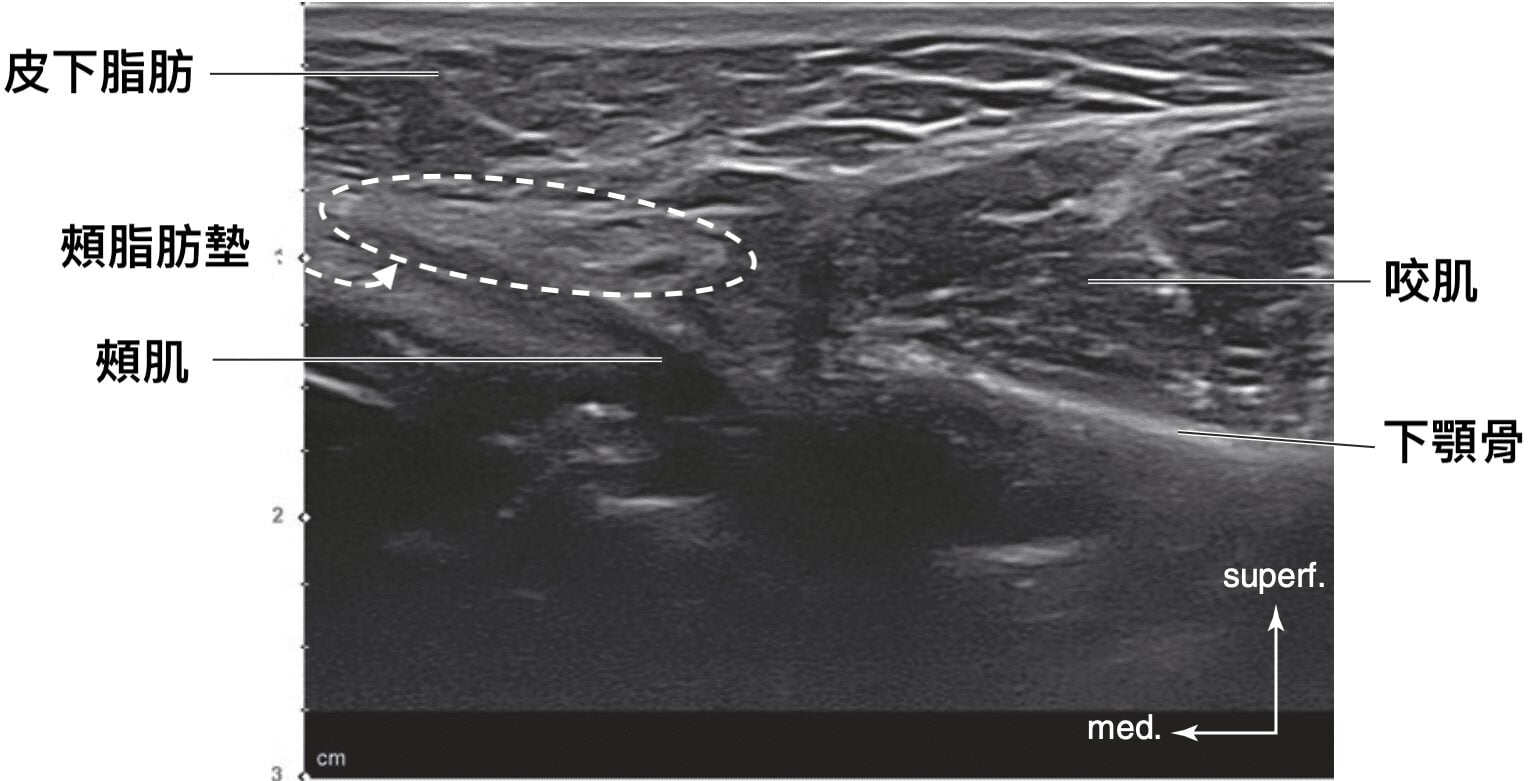
2. Inject into the "Buccal Fat Pad" Above the Masseter: Clearly Visible on Ultrasound
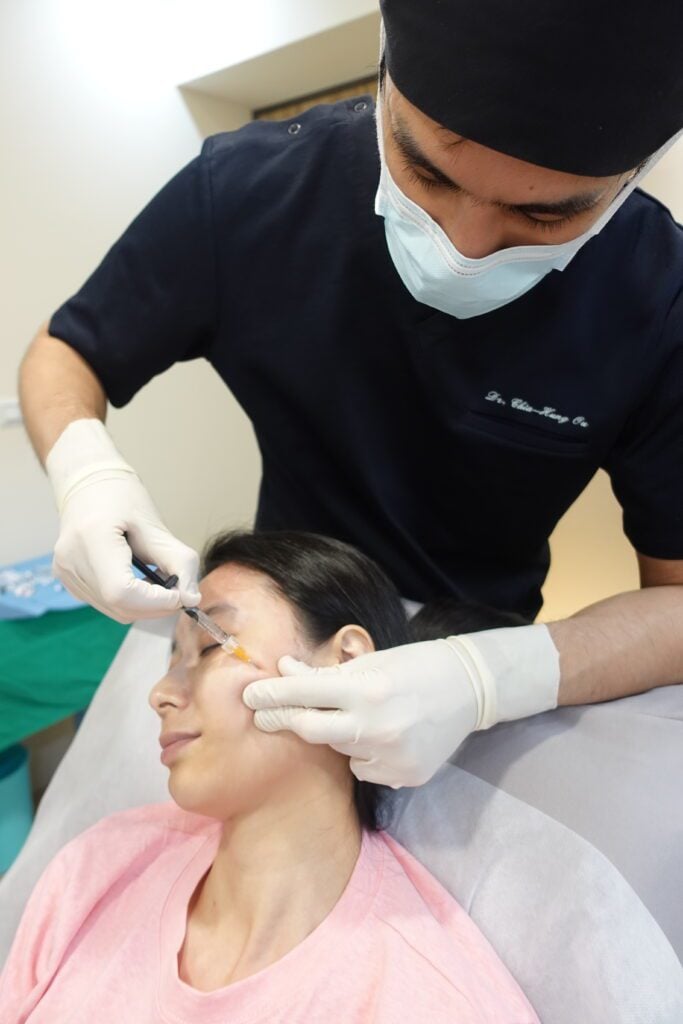
Feel your own masseter — when filling hollow cheeks, the hyaluronic acid is injected into the deep fat pad directly above the masseter (medically called the buccal fat pad).
What hyaluronic acid for hollow cheeks most fears is a needle that does not land in this layer. If it misses, the hyaluronic acid cannot be anchored and will float in the space of the cheek, a bit like floating in space. With ultrasound, the position of the buccal fat pad and the surrounding structures can be seen clearly.
3. Cheekbone → Masseter → Jawline: Three Points in One Line for a Smooth Result
When injecting hyaluronic acid for hollow cheeks, you must make the result "smooth," that is, cheekbone → masseter → jawline, three points joined in one line, for the contour to look good.
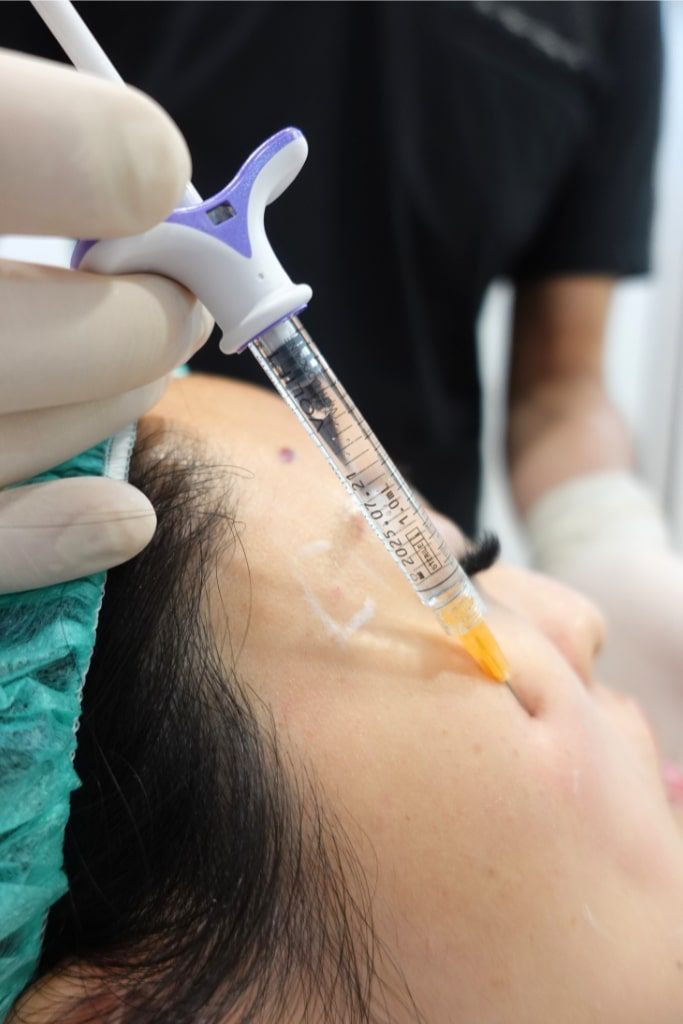
My method is to make one entry point 1 cm in front of the tragus, and use a fine blunt cannula to fill forward in a fan pattern. A blunt cannula is less likely to puncture blood vessels, and only one entry point is needed.
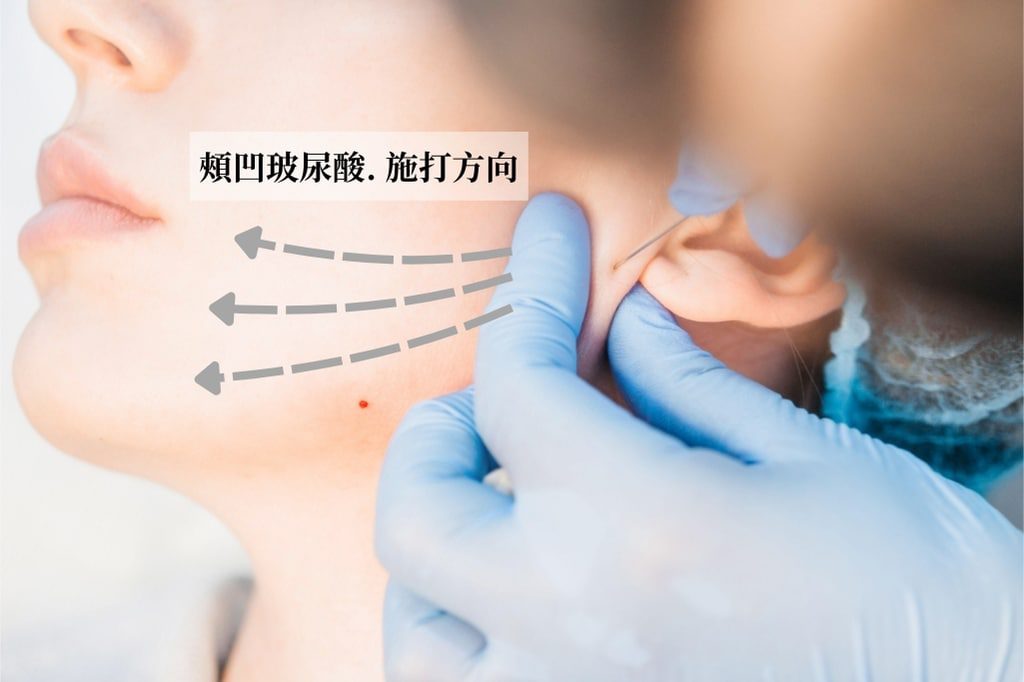
Ms. V below is a 33-year-old woman who was treated for hollow cheeks on both sides with 1 syringe of Juvederm Volift per side; there was no local bulging afterward, showing Volift's high resilience.
6. Cost of Hollow Cheek Treatment (2026)
The direct answer: hyaluronic acid for hollow cheeks costs NT$17,000–30,000 for 2cc depending on brand; Sculptra, Vivabella and Aesthefill are each NT$23,000 per vial; 1 syringe of Radiesse plus 1cc hyaluronic acid is NT$28,000; autologous fat is about NT$60,000–80,000.

| Treatment | Cost | Notes |
|---|---|---|
| Korean honeycomb hyaluronic acid 2cc | NT$17,000 | Best value choice, lasts about 1 year |
| Juvederm hyaluronic acid 2cc | NT$27,000 | Long-lasting type, about 1–1.5 years |
| Restylane hyaluronic acid 2cc | NT$30,000 | Must be reserved in advance for ordering |
| Teoxane hyaluronic acid 2cc | NT$30,000 | Must be reserved in advance for ordering |
| Sculptra / Vivabella / Aesthefill 1 vial | NT$23,000 | One vial at a time is recommended; decide whether to add more after 2–3 months |
| Sculptra / Vivabella / Aesthefill 2 vials | NT$44,000 | For moderate or worse hollowing, one vial per side |
| Radiesse (regenerative injection) 1 syringe + 1cc hyaluronic acid | NT$28,000 | Mixed to reduce firmness, closer to the feel of the cheek |
| Autologous fat | NT$60,000–80,000 | Cannot be dissolved if you gain weight |
This clinic is a Juvederm contracted clinic. Restylane and Teoxane are not regularly stocked brands, so if you want to specify one, please tell us in advance when you book, and I will order it from a friend's clinic. For the full price list, see: Golden Apple Clinic Treatment Prices.
7. Will Cheeks Become Hollow After HIFU, Botulinum Toxin or Thread Lifts?
In one sentence: HIFU lifting, masseter botulinum toxin and thread lifts are not in themselves the cause of hollow cheeks, but the wrong technique can indeed make hollow cheeks "look" more obvious.
1. HIFU Lifting: No Link Found in the Literature, but Two Situations Can Make Hollow Cheeks More Obvious
This question is quite interesting. I searched PubMed and could not find any link between "hollow cheeks" and "HIFU lifting"; but many patients, after reading Dcard, say that cheeks become hollow after HIFU. There are two main reasons:
- After HIFU lifts the sagging flesh upward, the original hollow cheeks look more obvious visually
- Too many shots with the fat-reduction cartridge, so the hollow cheeks appear after the face slims down
2. Masseter Botulinum Toxin: Injecting the Upper Part Causes Hollowing
When injecting masseter botulinum toxin, never inject the upper part of the masseter. The masseter connects upward to the cheekbone, and injecting the upper part not only does not help a slim face but also makes the area below the cheekbone cave in, causing hollow cheeks after treatment.
3. Thread Lift: Pulling Too Hard or Threads Running into the Hollow Area Makes It More Hollow
If a thread lift is pulled too hard, it may indeed make hollow cheeks worse — the nasolabial folds disappear, but the hollow cheeks become more obvious. So the effect and the side effects must be weighed; during a thread lift, the hollow cheek area must also be avoided, so that no threads run into it.
People who already have slightly hollow cheeks and want a thread lift are advised to combine it with hyaluronic acid, Sculptra or Aesthefill as a combined treatment, so the hollow cheeks do not look worse after the threads. For details, see: Thread Lift Complete Guide.
Hollow Cheeks FAQ
What causes hollow cheeks?
They fall mainly into three types: skeletal, collagen-loss and sagging. Most patients under 45 in my clinic are the collagen-loss type, suited to filling with hyaluronic acid or a collagen stimulator; the sagging (loose) type is more common over 45, and lifting with HIFU or threads is recommended instead.
What material should be injected for hollow cheeks?
The four most suitable are hyaluronic acid, Sculptra, Vivabella and Aesthefill. For a small local hollow, choose hyaluronic acid to fill it precisely; for a large area of hollowing, first inject a collagen stimulator, then finish the remaining small hollows with hyaluronic acid. I do not recommend Ellanse or Radiesse for hollow cheeks; these two are too firm, and the cheek easily feels stiff with expressions.
How many cc of hyaluronic acid are needed for hollow cheeks?
Depending on the degree of hollowing, usually 2–4cc. For ordinary local hollows, 2cc can smooth the contour; for hollowing caused by rapid weight loss or heavy loss, hyaluronic acid would exceed 3cc, and in that case you can consider 1–2 vials of Sculptra or Aesthefill instead.
Are there side effects of hyaluronic acid for hollow cheeks?
The most common is "hollow cheeks turning into bulging cheeks." The cheek has 3 ligaments that divide it into 4 zones; if the doctor injects without releasing the ligaments, the hyaluronic acid gets trapped in one zone and bulges when you make expressions. So for hollow cheeks the ligaments must be released and the filler placed in the buccal fat pad above the masseter.
Is hyaluronic acid for hollow cheeks safe?
The cheek is one of the safest injection areas of the face, with no major arteries or vessels, so there is little need to confirm vessel positions with ultrasound as for the tear trough. However, ultrasound can still confirm whether the hyaluronic acid has been placed in the buccal fat pad, to avoid it floating without being anchored.
Does filling hollow cheeks with hyaluronic acid hurt?
Not much. The buccal fat pad itself has few nerves, a blunt cannula is used, and most hyaluronic acid today contains anesthetic, so the comfort during injection is much higher than without anesthetic.
How long does hyaluronic acid for hollow cheeks last?
About 1–1.5 years. In the past, hyaluronic acid cross-linking technology was immature and it lasted only about a year; now, whether budget or premium brands, most last 1–1.5 years. The dose for a second top-up usually does not need to be as much as the first.
How much does hyaluronic acid for hollow cheeks cost?
Korean honeycomb hyaluronic acid 2cc NT$17,000, Juvederm 2cc NT$27,000, Restylane 2cc NT$30,000, Teoxane 2cc NT$30,000 (2026). Sculptra, Vivabella and Aesthefill are each NT$23,000 per vial; 1 syringe of Radiesse plus 1cc hyaluronic acid is NT$28,000.
Does Sculptra work right after injection?
No. Sculptra has the strongest collagen-stimulating effect, but there is no immediate filling effect after injection, and it usually takes 2–3 months for collagen to slowly grow. I suggest one vial at a time; for severe hollowing, another vial can be added after 3 months, but do not keep topping up, as it easily leads to puffiness.
Is it normal for Aesthefill or Vivabella to stop working after one month?
Yes. Aesthefill's CMC gel and Vivabella's hyaluronic acid are only carriers that help the powder disperse evenly, and they leave within a month of injection; once the volume is gone you feel it has "stopped working." The real effect is the collagen your body grows afterward — peaking at about 2–3 months for Aesthefill and about 6 months for Vivabella.
Does taking collagen help hollow cheeks?
No. Collagen you eat is broken down into amino acids in the small intestine, and too much can be stored as abdominal fat. Only people with a very low BMI who are truly too thin will see hollow cheeks improve by eating to gain weight.
Will cheeks become hollow after HIFU, masseter botulinum toxin or thread lifts?
They can "look" more hollow, but for different reasons: after HIFU lifts the sagging flesh upward the hollow cheeks become more obvious, or too many fat-reduction shots make the face thinner; masseter botulinum toxin injected into the upper part makes the area below the cheekbone cave in; and a thread lift pulled too hard or with threads running into the hollow area also worsens the hollowing.
Conclusion
The most common misconception about hollow cheeks is treating every hollow as something that "needs filling." First work out whether you are the skeletal, collagen-loss or sagging type — for the collagen-loss type, the right material works very well; for the sagging type, filling without lifting only makes the face look more swollen the more you fill.
As for materials, use hyaluronic acid to fill small local hollows precisely, and leave large-area hollowing to collagen stimulators; whichever you choose, releasing the ligaments and placing the filler in the correct buccal fat pad layer is the real key to whether hollow cheeks turn into bulging cheeks.
Not sure whether your hollow cheeks are the collagen-loss or sagging type? Consult Dr. Ou at Golden Apple now!
Online consultation
Written and updated by Dr. Ou Chia-Hung (founder and director of Golden Apple Aesthetic Clinic) | Last updated: September 30, 2026. This article is health education information and does not constitute an individual diagnosis or treatment recommendation; the actual treatment and dose should be determined by an in-person assessment.
Want to know which type your hollow cheeks are? Add us on LINE and send one front photo plus one 45-degree side photo, and Dr. Ou will give a preliminary assessment: @goldiapple (remember to include the @)