
"Doctor, my friend looks amazing after Sculptra, but I feel nothing after mine." This is something I hear very often in clinic, and the person asking has usually only just finished their injection two weeks earlier.
This is where Sculptra is most easily misunderstood: it is not a treatment that makes you look better the day you get it. It is completely different from hyaluronic acid: hyaluronic acid "pads up" the hollow, while Sculptra lets your own collagen "grow back." Once you understand this, your expectations will be right and your money won't be wasted.
This article explains Sculptra's ingredients, mechanism, results timeline, pros and cons, the difference between 3D and 4D, post-treatment massage, nodule risk and cost, all in one place.
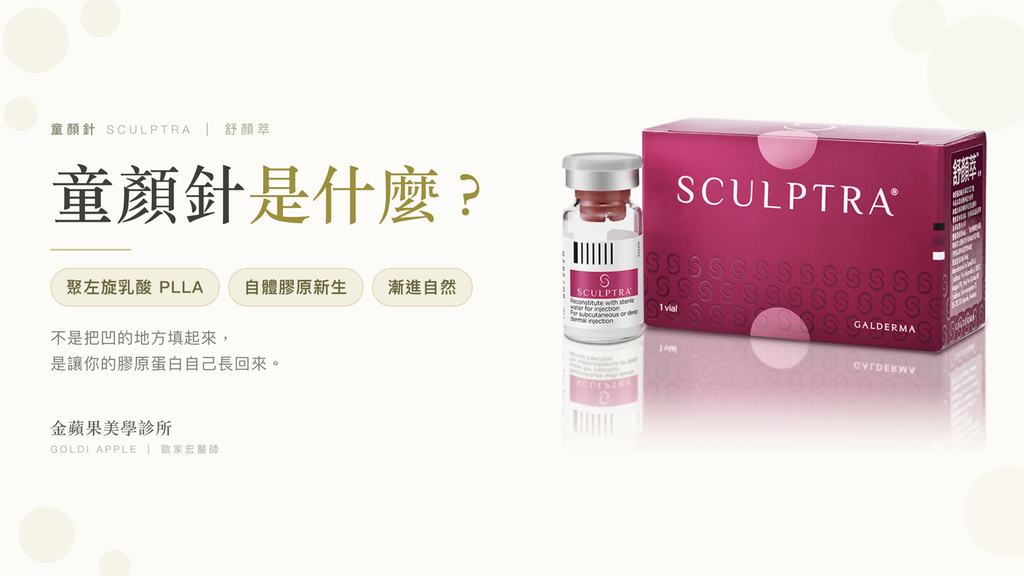
The "baby-face needle" = Sculptra = PLLA: all are the same product. "Baby-face needle" is the market nickname, "Sculptra" is the manufacturer's brand name, and PLLA is its ingredient.
Sculptra at a Glance
| Item | Details |
|---|---|
| Also known as | Baby-face needle = Sculptra = PLLA: the same product |
| Product type | Collagen stimulator (not hyaluronic acid, not a filler) |
| Ingredient | Poly-L-lactic acid (PLLA) |
| Form | Dry powder that the doctor must mix and dilute before injection |
| How it works | Wakes up fibroblasts so they grow your own type I collagen |
| When results appear | Noticeable from weeks 4–6, clearer at months 2–3 |
| Longevity | About 25 months after completing the full course |
| Recommended sessions | 2–3 sessions, about six months apart |
| Biggest advantage | Natural; what stays on your face is your own tissue; good for large-area collagen rebuilding |
| Biggest risk | Cannot be dissolved, no antidote; improper mixing or dilution easily causes nodules |
| Best areas | Hollow cheeks, temples, nasal base and nasolabial folds, neck and hands |
| Not recommended areas | Around the eyes, lips; small "point" areas such as the apple cheeks are also not recommended |
| Reference price | About NT$25,000–35,000 per vial |
1. What Is the Baby-Face Needle? Sculptra Is the Same Needle
Let me clear up the names first, since this is what confuses people most. Baby-face needle = Sculptra = PLLA are all the same thing: "baby-face needle" is the market nickname, Sculptra is the manufacturer's brand name, and PLLA is the ingredient. Some people also use other nicknames for it, and they all mean the same thing.
So "Sculptra" and the "baby-face needle" are not two products or two treatments. The Sculptra you hear about at a clinic, the baby-face needle you see online, and the Sculptra on the manufacturer's packaging all refer to the same bottle of PLLA powder. The different names are purely a matter of market nickname versus brand name.
(1) Sculptra ingredient: poly-L-lactic acid (PLLA)
Sculptra's main ingredient is poly-L-lactic acid (PLLA). It was originally invented to treat patients with HIV, helping their severely hollow cheeks grow collagen.
Because Sculptra grows collagen so well, it was later applied to aesthetic treatment, and it has now been on the market for decades. Some absorbable surgical sutures are also made of PLLA. The body slowly metabolizes it, and its biocompatibility is very good, which is the basis of its safety.
Since launch it has gained approval from the US FDA, the EU CE mark and Taiwan's Ministry of Health and Welfare, with a long clinical track record.
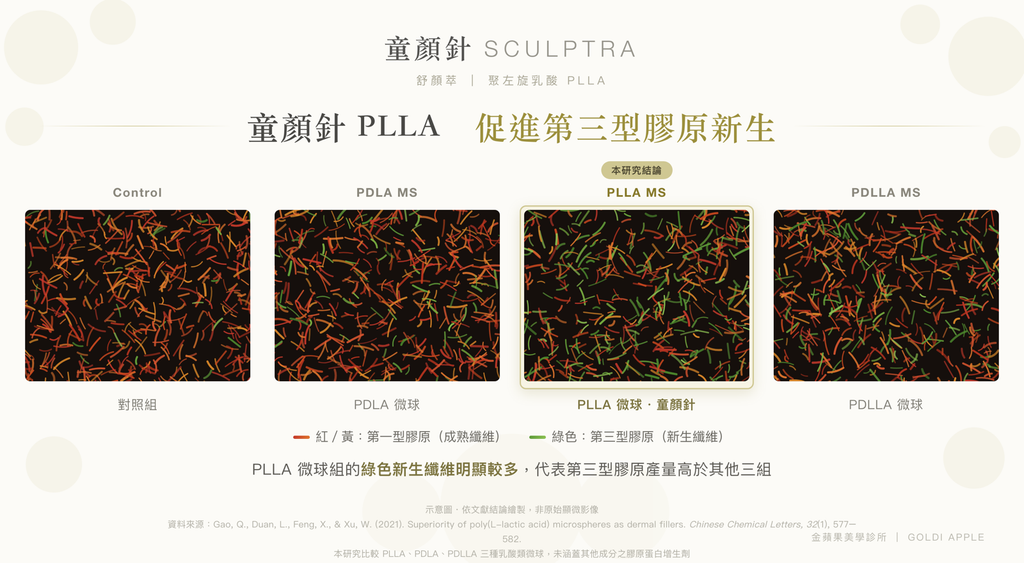
According to published studies, compared with PDLLA (AestheFill, Vivabella), Sculptra's PLLA produces notably more collagen; in the image below, the green is the amount of collagen produced. From what I observe in my own patients, Sculptra does grow more.
One thing to stress: Sculptra is a powder, not a ready-made gel. It comes as a bottle of dry powder, and the doctor must first reconstitute it with water for injection and dilute it to the right concentration. This "mixing" step looks unremarkable, but it almost decides the success of the whole treatment: whether it is mixed long enough, whether the dilution ratio is right and whether it is evenly dispersed directly affect results and nodule risk.
(2) How it works: not filling, but waking up your fibroblasts
The analogy I use most in clinic is growing grass.
Hyaluronic acid is like laying a piece of artificial turf: it is green the moment it is laid and looks good, but that turf is not yours, it will be removed when its time is up, and the soil underneath is still the same as before.
Sculptra is like fertilizing. You sprinkle it on, and on that day no grass appears, you may not see anything at all. But after a few weeks the soil itself becomes richer and the grass grows by itself. What grows is your own collagen, not a foreign material.
Mechanically it works like this: after PLLA particles are injected under the skin, they trigger a mild, controlled tissue reaction that recruits fibroblasts. Fibroblasts are the workers in the skin that make collagen. Once awakened, they continuously produce type I collagen and gradually rebuild the supporting structure of the dermis. Meanwhile, the PLLA itself is broken down into lactic acid and then metabolized into carbon dioxide and water and expelled from the body.
So after the course is over, what remains on your face is not Sculptra but tissue you grew yourself. This is the essential difference from fillers, and it is why the result looks natural and rarely has a "filled" feel.
2. How Does Sculptra Work? What Are Its Pros and Cons?
(1) Results timeline: the puffiness right after injection is not the result
The biggest difference between Sculptra and hyaluronic acid is that it cannot provide volume right away. So if a patient tells me she is getting married within a month or has an important performance, I recommend hyaluronic acid for its immediate filling effect.
- Day of injection: the face is a bit puffy, but that is from the dilution water, not collagen.
- Days 2–3: the water is absorbed and the face "goes back." This is normal, not a failure. Many people come back to the clinic at exactly this point feeling cheated.
- Weeks 4–6: fibroblasts start working and you slowly feel the skin is "a little firmer," though you usually can't say what is different.
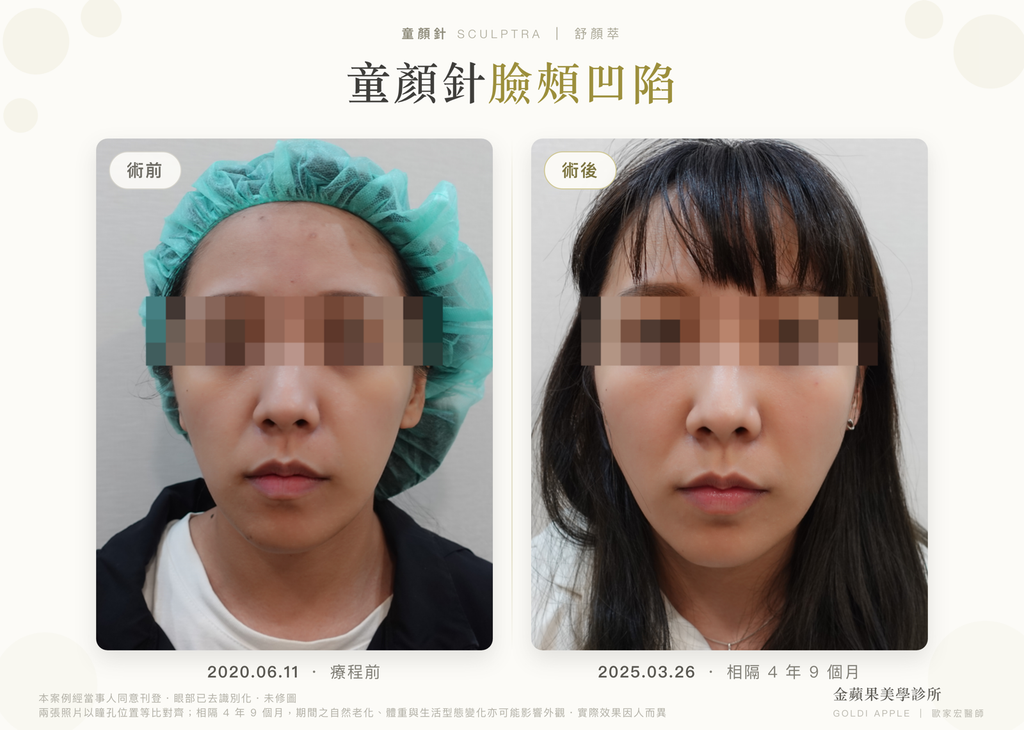
- Months 2–3: collagen has accumulated to a certain level, hollowness improves and the contour becomes smoother. Only now has the result truly arrived.
- After completing the full course: results last about two years, depending on individual constitution, metabolism and lifestyle.
Another key point: Sculptra is not a one-time treatment. The standard approach is 2–3 sessions, about six months apart, letting collagen build up layer by layer. The amount that grows is more controllable and looks more natural than injecting a lot at once.
| Time | What happens | What you feel |
|---|---|---|
| Day of injection | Dilution water holds up the volume | The face is a bit puffy, but this is not the result |
| Days 2–3 | The water is absorbed | It "goes back"; this is normal, not a failure |
| Weeks 4–6 | Fibroblasts start working | Skin is a little firmer, but you usually can't say what is different |
| Months 2–3 | Collagen accumulates to a certain level | Hollowness improves and contour smooths; the result has truly arrived |
| After the full course | Your own collagen keeps supporting | Lasts about 25 months, depending on constitution and metabolism |
(2) Pros of Sculptra
- Natural, others can't tell what you did: what grows is your own tissue, not volume pushed in, so expressions and touch feel more natural
- Long-lasting: about 25 months after the full course, near the top among collagen stimulators
- Good for large-area, overall improvement: its strength is not sculpting a single point but pulling back a whole sagging, hollow area, while also improving skin quality
- Plenty of clinical data: it has been on the market for a long time, and its safety and long-term performance are backed by extensive literature and experience
(3) Cons of Sculptra
Having covered the pros, the cons must be stated clearly too. These are not signs that the product is bad; they are its characteristics, and you should be able to accept them to be a good candidate.
- Slow: you have to wait at least 1–3 months. If you have an important event in two weeks, this needle can't help you
- Cannot be dissolved: hyaluronic acid can be dissolved with hyaluronidase if it goes wrong, but Sculptra has no antidote. So if the dose or layer is wrong, it is much harder to deal with than hyaluronic acid
- Done in sessions: usually 2–3 sessions to complete, so plan time and budget together
- Nodule risk needs relative attention: because it is a powder that must be mixed and evenly dispersed, the mixing quality and injection layer both matter.
- Not good for fine sculpting: if you want to raise a single point, or want a defined nose bridge or chin contour, hyaluronic acid or a more supportive material suits better
3. Who Is Sculptra For? What Can It Improve?
(1) Who Sculptra suits
More suitable:
- People with overall collagen loss whose face is "saggy" but who can't point out where it is hollow
- People who want a natural, gradual result and don't want it to be obvious they had work done
- People who have had hyaluronic acid but found it metabolizes too fast and want something longer-lasting
- People who are willing to wait and cooperate with the sessions and aftercare
Less suitable:
- People who need to see results immediately
- People who want to keep the "I can dissolve it if I regret it" fallback
- People who only want to treat a single fine line or one small hollow (hyaluronic acid is more precise and cheaper)
- People who previously had a lot of collagen stimulators or fat grafting in the apple cheeks and already show mild puffiness (overfilled look)
(2) Common Sculptra treatment areas
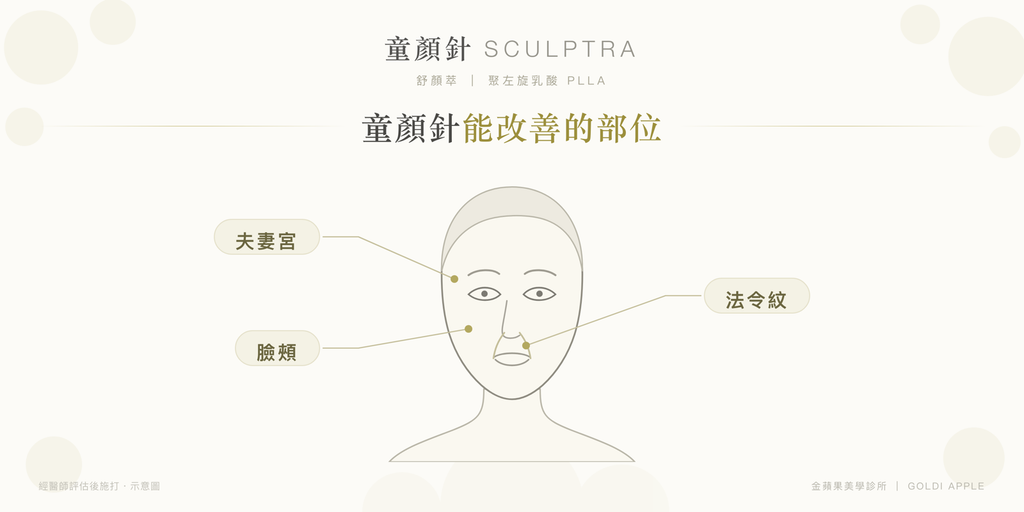
- Temples: hollowness, an aged look, cheekbones that look prominent
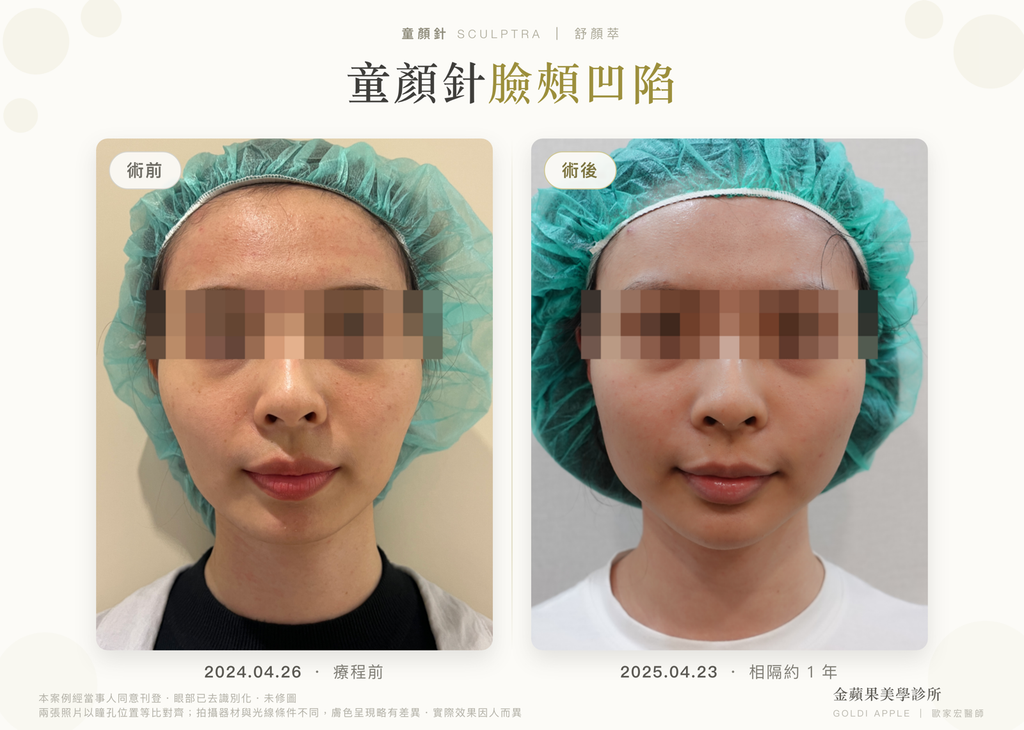
- Hollow cheeks: whole-area hollowness and laxity, the most typical home turf of Sculptra
- Nasolabial folds (nasal base): improves the supporting strength of the tissue around the line, not filling the groove flat
- Turkey neck and crepey hands: neck laxity and loose skin on the arms and hands
Note that areas with very thin skin or heavy movement, such as around the eyes and the lips, are generally not recommended for Sculptra. The risk of nodules and unevenness is higher, and these areas have more suitable materials.
For a full comparison of options for hollow cheeks, see: How to improve hollow cheeks? 3 types and 4 filler materials compared by pros, cons and price.
For temples, see How to improve hollow temples? 5 filler materials compared by pros, cons and price, and for Sculptra in the temples see Is Sculptra for the temples right for you? Principles and precautions. For a material comparison for nasolabial folds, see How to improve nasal base hollowness? 5 materials compared with prices.
4. What Is the Difference Between 3D and 4D Sculptra?
Many patients keep confirming with me whether it is 4D Sculptra. It certainly is. I honestly don't know where you could find 3D Sculptra now, because it was discontinued long ago.
Many people mistakenly think 3D and 4D are two different ingredients. Both have PLLA as the main ingredient, and the difference lies in improved mixing method and dilution recommendations. Think of it as one being an iPhone 17 and the other an iPhone 18: both run iOS, just a version upgrade, and the biggest difference is that 3D needs massage and 4D does not.
| 3D Sculptra | 4D Sculptra | |
|---|---|---|
| Main ingredient | PLLA poly-L-lactic acid | PLLA poly-L-lactic acid (same) |
| Mixing method | Needs pre-mixing several hours to overnight | Can be mixed in a short time, ready to use |
| Post-treatment massage | Requires you to follow the "555 rule" | Not mandatory, but massaging yourself can spread it more evenly |
| Nodule rate | Low | Lower (better dispersion) |
| Longevity | Similar for both, about 25 months after the full course |
Conclusion: don't agonize over the model. What is available on the Taiwan market now is 4D Sculptra, and what decides success has never been 3D versus 4D but the quality of mixing and dilution and the injection layer.
5. How Does Sculptra Differ from Other Treatments?
(1) Sculptra vs. hyaluronic acid: one holds a place, the other leaves something behind
Hyaluronic acid holds a place. Once injected, it is a lump with volume sitting there, propping up the hollow. It shapes finely, works the same day, and if it is not ideal it can be dissolved with hyaluronidase, which is its biggest advantage. But all it does is hold a place; once the place is held, your skin tissue itself has not improved.
Sculptra grows your own material. It doesn't hold a place, and you may even feel "it's gone" a few days after the injection. But what remains months later is your own collagen and supporting structure.
So the two are not competitors. A common clinical approach is hyaluronic acid for structure and three-dimensionality, and Sculptra for overall collagen rebuilding, each doing its own job. Whether to combine them and how to divide them is planned by the doctor according to your facial conditions.
(2) Sculptra vs. other collagen stimulators
I usually divide these collagen stimulators into two teams: "points" and "areas." The "point" stimulators, such as Ellanse and Radiesse, are firm enough to be injected precisely at one location and give shape immediately. The "area" stimulators are Sculptra, Vivabella and AestheFill, which suit large areas such as hollow cheeks.
| Material | Ingredient | Suitable areas | When I usually use it |
|---|---|---|---|
| Sculptra | PLLA | Hollow cheeks, temples, nasal base | Overall collagen loss, large-area sagging and hollowness |
| Radiesse | CaHA | Temples, forehead, nasal base, chin, apple cheeks | Need deep support, collapsed skeleton, lost contour |
| Ellanse | PCL | Temples, forehead, nasal base, chin | Want immediate filling plus long-term collagen growth; longevity can be extended by type |
| Vivabella (Juvelook) | PDLLA | Hollow cheeks, temples, nasal base | Black and white molecules work on deep and superficial layers |
| AestheFill | PDLLA | Hollow cheeks, temples, nasal base | Shows results a bit faster than PLLA, suits more delicate areas |
I wrote a separate article with full specifications, prices and suitable areas for the six collagen stimulators: How to choose a collagen stimulator? Ellanse, AestheFill, Sculptra, Vivabella, Nevre and Radiesse compared. To understand Radiesse in full, see: What is Radiesse? 3 injection techniques, pros, cons and price explained.
6. Pre-Treatment Notes, Aftercare and Side Effects
(1) Pre-treatment notes
- Stop irritating skincare such as retinoids and exfoliants one week before treatment, and increase moisturizing and sun protection
- Stop anticoagulants or blood-activating supplements (aspirin, fish oil and so on) one week before to reduce bruising
- Be sure to tell your doctor if the treatment area has had surgery or implants, or if you had hyaluronic acid, Radiesse, Ellanse or similar injections within the past six months
(2) Aftercare
Although 4D Sculptra no longer requires massage, I still recommend pressing the area now and then when you have time. The aim is to help PLLA particles disperse more evenly in the tissue and reduce later local clumping that forms lumps.
- Redness, bruising and mild pain within 24 hours are normal and can be eased with a cold pack (avoid ice touching the skin directly)
- Avoid makeup for 24 hours to reduce infection risk
- If you have persistent redness, swelling, heat and pain, an obvious lump or any discomfort, return to the clinic immediately
(3) Side effects of Sculptra
Side effect 1: nodules
Sculptra is generally very safe, but one risk deserves its own mention: nodules, meaning palpable hard lumps.
The cause is not "a bad product" but PLLA that was not evenly dispersed. Common reasons include:
- Improper mixing: not mixed long enough or not shaken evenly, so the powder is not fully dispersed
- Insufficient dilution: the concentration is too high and too much accumulates in one spot
- Injected too shallow: PLLA should go in the subcutaneous layer, and injecting into the superficial dermis makes it easy to feel
- Injected in an unsuitable area: for example around the eyes or lips where the skin is very thin
This is why I keep stressing that mixing and dilution matter. You occasionally see Sculptra courses at especially low prices. One possibility is a vial that has been over-diluted to spread the cost. Insufficient concentration not only weakens results; when a vial is split and sold, some people get mostly saline with little effect, while others get a lump of powder, which easily leads to nodules. Don't compare only the price of a single vial; ask about the total dose and the dilution method.
If you already feel a lump, I wrote about how to deal with it here: What to do if Sculptra, AestheFill or Ellanse fails?
Side effect 2: puffiness (overfilled look)
I meet too many patients with this wrong idea: treating Sculptra like skincare and getting it regularly, ending up with an overfilled, puffy face. After all, Sculptra grows your own collagen, which does not metabolize as fast as hyaluronic acid. Once it has grown to the fullness you want, the same area does not need a top-up every year.
In my own observation, Sculptra rarely disappears within at least two years, so once you have decided on Sculptra, never force an injection just because you once bought many vials and left them in storage.
The area where Sculptra most easily causes puffiness is the apple cheeks, and I personally really dislike using Sculptra there. As mentioned, Sculptra suits large "areas," while the apple cheeks are a local "point." Sculptra powder gathered in this spot easily grows too well and causes puffiness, and Sculptra puffiness cannot be treated by dissolving. So please pay close attention to total dose and frequency.
7. How Much Does Sculptra Cost?
The short answer: Sculptra is priced per vial, with a market range of about NT$23,000–32,000 per vial.
Sculptra is priced per vial, with a market range of roughly NT$25,000–35,000. If a clinic sells 2 cc or 4 cc, it may not be a full vial, so ask clearly.
I usually recommend starting with one vial per area, then deciding after 2–3 months, based on how the collagen grows, whether to top up.
| Item | Reference cost | Notes |
|---|---|---|
| Sculptra, one vial | NT$23,000–32,000 | Start with one vial per area, and decide on a top-up after 2–3 months depending on collagen growth |
| Full course (2–3 vials) | NT$46,000–96,000 | Injected in sessions so collagen builds up layer by layer |
When comparing prices, be sure to ask whether it is "a full vial" or "split." Sculptra courses labeled 2 cc or 4 cc are probably not a full vial. Insufficient concentration weakens results, and splitting also makes the amount of powder each person receives inconsistent: some get almost only saline and some get too much powder, which is how nodule risk arises. For the full price list, see Golden Apple Clinic treatment prices.
Sculptra FAQ
What is the baby-face needle? How is it different from Sculptra?
They are the same thing. "Baby-face needle" is the market nickname and Sculptra is the manufacturer's brand name; the main ingredient is poly-L-lactic acid (PLLA). Some people use other nicknames, but they all refer to the same product.
How soon do I see results from Sculptra, and how long do they last?
Sculptra is a gradual treatment. You start to notice around weeks 4–6, and results are clearer at months 2–3. After completing the full course, they last about 25 months, depending on individual constitution, metabolism and lifestyle.
My face was puffy the day of Sculptra, so why did it go away two days later?
Normal. The fullness right after injection comes from the dilution water, not collagen, and it is absorbed within 2–3 days. The real result has to wait for fibroblasts to produce collagen, which shows up in about 1–3 months.
How many Sculptra sessions are needed?
A standard course is usually 2–3 sessions about six months apart, letting collagen build up layer by layer. The amount that grows is more controllable and looks more natural than injecting a lot at once. The actual number of sessions is decided by the doctor according to your degree of collagen loss.
Can Sculptra cause nodules? How can the risk be reduced?
It can. The cause is usually PLLA that was not evenly dispersed: improper mixing, insufficient dilution, injecting too shallow, not massaging properly afterward, or injecting very thin-skinned areas such as around the eyes or lips. The keys to lowering risk are the quality of mixing and dilution, the correct injection layer, and completing post-treatment massage as instructed.
Can Sculptra be dissolved?
No. Sculptra has no antidote like hyaluronidase for hyaluronic acid, and PLLA is metabolized naturally over time. That is why evaluation before injection, dose control and injecting in sessions are especially important.
What is the difference between 3D and 4D Sculptra? Which one should I choose?
Both have PLLA as the main ingredient; the difference is a generation of mixing method and dilution recommendations. 4D needs shorter mixing time and disperses better, so it relies less on self-massage after treatment.
How is Sculptra different from Radiesse and Ellanse?
The ingredients and strengths differ. Sculptra (PLLA) excels at large-area, overall collagen rebuilding; Radiesse (CaHA) excels at deep support and contour structure and gives support the same day; Ellanse (PCL) combines immediate filling with long-term collagen growth. The right choice is decided by the doctor according to the treatment area.
Does Sculptra hurt? Is there downtime?
There is a slight needle sensation during injection, and ice or topical anesthetic is usually applied beforehand to reduce discomfort. Most people have no obvious downtime. Mild redness, swelling or bruising may appear and usually eases within 2–3 days.
Who should not get Sculptra?
It is not recommended for pregnant or breastfeeding women, people prone to keloids, people with autoimmune disease, those with infection or inflammation at the treatment site, or those allergic to the ingredients. Also, if you need immediate results, want to keep a dissolvable fallback or only want to treat a single fine line, other materials will suit you better.
Are Sculptra and the baby-face needle the same thing?
Yes, exactly the same. Baby-face needle = Sculptra = PLLA all refer to the same product, whose ingredient is poly-L-lactic acid (PLLA). "Baby-face needle" is the market nickname and Sculptra is the manufacturer's brand name. The names you see at different clinics and in different articles all describe the same bottle of PLLA powder, and you don't need to compare them separately.
How much is a vial of Sculptra?
The market range is about NT$23,000–32,000 per vial, priced per vial. If you see a quote labeled 2 cc or 4 cc, ask whether it is a full vial. Splitting may mean insufficient concentration, which not only weakens results but also raises nodule risk.
Which areas can Sculptra be injected into?
Best suited are hollow cheeks, temples, the nasal base and nasolabial folds, and large-area laxity and hollowness such as the neck and hands. Areas with very thin skin or heavy movement, such as around the eyes and the lips, are not recommended. I also don't recommend small "point" areas such as the apple cheeks, since the product easily concentrates and causes puffiness.
Is Sculptra right for me? Consult Dr. Ou at Golden Apple now!
Online consultation
Medical Review and Data Notes
- Written and updated by: Dr. Chia-Hung Ou (founder and director of Golden Apple Aesthetic Clinic) | Last updated: October 4, 2026.
- Sculptra is a medical device approved by the US FDA, the EU CE mark and Taiwan's Ministry of Health and Welfare, and must be used by a licensed physician. Ingredients, indications and longevity follow the manufacturer's labeling and the approved content of the health authority.
- The costs in this article are publicly available reference ranges on the Taiwan market and are not an individual quote.
- The result timelines, session counts and longevity in this article are common clinical ranges and are not a guarantee of results. Individual results depend on the quality of mixing and dilution, injection layer, dose and personal constitution.
- Redness, bruising and pain can still occur after injection. The risks that deserve more attention are nodules and puffiness, and PLLA cannot be dissolved with hyaluronidase the way hyaluronic acid can. If you have persistent redness, swelling, heat and pain or an obvious lump, return to the clinic immediately.
- This article is health education and cannot replace an in-person consultation. Whether any treatment suits you must be decided after evaluation by a doctor.