
The Short Answer: How to Inject Calf Botulinum Toxin So It Works
Calf botulinum toxin is injected into the gastrocnemius muscle to relax it and reduce its volume, improving muscular calves (often called "radish legs"). After 2002 it replaced gastrocnemius resection surgery, which carried higher risk and was irreversible. Three things decide the outcome: whether your calves are truly muscular, whether the dose is sufficient, and whether it is given in two stages. If the full large dose is given at once, the muscle rebounds by 20 weeks; split into two doses, results can last 9–12 months.
| Item | Details |
|---|---|
| Treatment name | Calf botulinum toxin (botulinum toxin injection into the gastrocnemius) |
| Suitable for | Muscular calves (the calf bulges visibly when flexed) |
| Not suitable for | Fatty calves, where even a large dose is unlikely to work |
| First-stage dose | 100–200U per side, 300–400U for both legs combined |
| Second-stage dose | 100–150U per side after three months |
| Minimum dose | Under 100U per side shows almost no effect |
| Maximum total per session | Over 400U (200U per side) easily causes temporary muscle weakness |
| When results appear | About 3–4 weeks (large muscles take time to shrink) |
| Duration with a single dose | If not topped up after 12 weeks, back to original size in about 20 weeks |
| Duration with two doses | 9–12 months |
| Volume reduction | Medial gastrocnemius volume reduced by about 30–35% (measured by ultrasound) |
| Price range | About NT$15,000–40,000 depending on brand |
| Common side effect | Temporary weakness when walking, improving in about 3–4 weeks |
The doses above are clinical reference ranges. The actual dose is decided after an ultrasound assessment of muscle distribution. Prices vary with the brand and the number of units needed, and each clinic sets its own pricing.
- Confirm first that you have muscular calves. I have met clients who had 500U with no effect at all; an ultrasound scan showed they had very little gastrocnemius muscle and mostly fat. In that case no dose will help.
- An insufficient dose is money wasted. Under 100U per side basically shows no effect; rather than half a treatment, it is better to save the money.
- It must be done in two stages. Over 400U at once easily causes temporary muscle weakness, and with only one dose the muscle rebounds by 20 weeks.
- This is a long-term commitment. Once injections stop, the muscle slowly returns. The good news is that with continued top-ups the muscle gets smaller and smaller, and the dose needed later also decreases.
Table of Contents
Table of Contents
- The Short Answer: How to Inject Calf Botulinum Toxin So It Works
- 1. Why Get Calf Botulinum Toxin?
- 2. First, Find Out: Are Your Calves Muscular or Fatty? Why 500U didn't work 2022 paper: classifying calves into four types by ultrasound Why calf botulinum toxin must use a long needle
- 3. How Many Units of Calf Botulinum Toxin?
- 4. Why Must It Be Done in Two Stages? Stage one: 100–200U per side Stage two: after three months, 100–150U per side
- 5. Ultrasound Guidance: The Key to Results
- 6. How Soon Does Calf Botulinum Toxin Work?
- 7. How Much Does Calf Botulinum Toxin Cost?
- 8. How to Choose a Calf Botulinum Toxin Brand?
- 9. Side Effects and Risks of Calf Botulinum Toxin
- 10. Comparing the Three Botulinum Toxin Slimming Areas: Calves, Masseter, Shoulders
- 11. Calf Botulinum Toxin FAQ How many units of calf botulinum toxin are enough? Why is calf botulinum toxin split into two sessions? I had 500U of calf botulinum toxin with no effect. Why? How can I tell whether I have muscular or fatty calves? How soon does calf botulinum toxin work? How long does calf botulinum toxin last? Is calf botulinum toxin a one-time fix? Does calf botulinum toxin have side effects? How to choose a calf botulinum toxin brand? How much does calf botulinum toxin cost? How does calf botulinum toxin compare with liposuction and surgery?
- Medical Review and Sources
1. Why Get Calf Botulinum Toxin?
Calf botulinum toxin was a major step forward in treating calf contours, because it replaced what used to be the only option: surgery.
In the 1990s, the only way to improve calf contour was surgical removal of the gastrocnemius (or tibial neurectomy). This surgery had several drawbacks that were hard to accept:
- It leaves a 2–3 cm scar
- Because of individual differences in nerve branching, results of the surgery were inconsistent
- After surgery there may be nerve damage and abnormal sensation, and these are irreversible
These risks kept most people from going ahead.
It was not until 2002, when doctors began using botulinum toxin for calf contouring, that things changed. Compared with surgery and electrotherapy, calf botulinum toxin is considerably safer, leaves no scars, and has noticeably fewer side effects, and it has no obvious effect on daily life afterwards.
More importantly, botulinum toxin works whether the calf muscle is large or small, and it can be repeated. In addition, as more botulinum toxin brands have appeared over the past decade, the price of calf botulinum toxin has dropped significantly, which is good news for anyone wanting slimmer calves.
2. First, Find Out: Are Your Calves Muscular or Fatty?
This is the most important section of the whole article. If this step is judged wrongly, no dose afterwards will help.
Why 500U Didn't Work
I have heard many clients complain that they once had 500U of calf botulinum toxin and felt nothing at all.
An ultrasound scan reveals the reason right away: their gastrocnemius muscle was actually small, and most of the calf was fat. For this type of calf, even a very large dose is unlikely to have a significant effect, because botulinum toxin acts on muscle, not fat.
A simple way to judge for yourself: stand on tiptoe so the calf tenses. If the calf visibly bulges into a hard lump, it is muscular; if there is little difference before and after tensing and it feels soft, it is most likely fatty. This is only a preliminary judgment, and it still needs to be confirmed by ultrasound.
2022 Paper: Classifying Calves into Four Types by Ultrasound
The biggest problem with calf botulinum toxin in the past was that the data came from cadaver dissection, which differs considerably from the real calf shapes of living people.
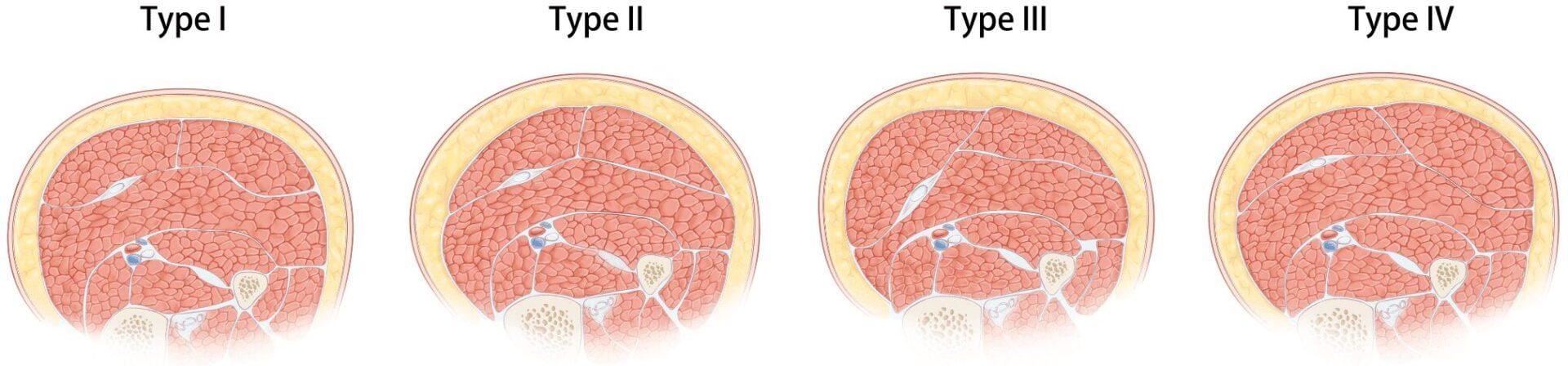
A 2022 paper finally made it possible to classify calves into four types by ultrasound, of which Type I was the most common, at 55%.
Taking Type I as an example, in the outermost gastrocnemius, the medial gastrocnemius is about 17.8 mm thick and the lateral about 16.5 mm, both thicker than the middle part. This directly determines how the dose is distributed.
Why Calf Botulinum Toxin Must Use a Long Needle
The thickness figures above show the problem: the needles used at ordinary clinics are simply not long enough.
The subcutaneous fat of the calf is naturally thicker than that of the face, and the gastrocnemius lies deeper. With an ordinary needle, the product may well end up entirely in the subcutaneous fat, never reaching the muscle.
So for calf botulinum toxin, you must switch to a long needle. This detail is easily overlooked, but it directly decides whether the treatment works.
3. How Many Units of Calf Botulinum Toxin?
| Stage | Dose per side | Both legs combined |
|---|---|---|
| First session | 100–200U | 300–400U |
| Follow-up top-up | 100–150U | 200–300U |
The minimum dose matters: under 100U per side, it is basically hard to get any visible effect.
In that situation I would advise the client not to have it done at all — the money saved can be used for many other things, and a half-dose treatment is just throwing money into the water.
Also be mentally prepared: calf botulinum toxin is a long-term commitment. Once injections stop, the muscle slowly rebounds. So anyone considering it should first think carefully about whether they have the perseverance and enough budget for regular top-ups.
The good news is that with continued top-ups the muscle gets smaller and smaller, and the dose needed later can be reduced accordingly.
4. Why Must It Be Done in Two Stages?
I often hear that many clinics treat calf contour with "one very large dose (over 500U)".
But evidence shows this causes two problems:
- It easily causes temporary muscle weakness
- If a second dose is not given after 12 weeks, the calf returns to its original size in about 20 weeks
If instead it is given in two doses, the calf contour can be greatly extended to 9–12 months.
| Approach | Total per session | Duration |
|---|---|---|
| All at once | Over 400–500U | Back to original size in about 20 weeks, and prone to muscle weakness |
| Two stages | Stage one ≤400U, second dose after three months | 9–12 months |
Stage One: 100–200U per Side Recommended
For calf botulinum toxin, if the total dose in one session exceeds 400 units (200 units per side), temporary muscle weakness is likely. This is why it must be done in two stages.
The stage-one dose is distributed across three muscles according to how thick the muscle is:
| Stage-one dose (per leg) | Mild | Moderate | Severe |
|---|---|---|---|
| Total per leg | 100U | 150U | 200U |
| Medial gastrocnemius | 50U | 70U | 80U |
| Lateral gastrocnemius | 30U | 30U | 60U |
| Peroneus longus | 20U | 50U | 60U |
You can see that the medial gastrocnemius receives the largest dose, which matches the classification data mentioned earlier — the medial gastrocnemius is the thickest and also the most visually prominent bulge.
Stage Two: After Three Months, 100–150U per Side
Please return for the second session after three months. The dose is adjusted after the effect is assessed by ultrasound, and the second session is usually smaller than the first.
Why three months? Look at how the muscle changes and it makes sense:
| Time | Muscle status |
|---|---|
| 2–3 months after injection | The bulge of the medial gastrocnemius disappears and the contour becomes much smoother. Ultrasound shows volume reduced by 30–35% |
| From 2–3 months after injection | The paralysing effect begins to fade, and muscle strength and firmness gradually return |
| 6 months (no top-up) | The muscle regains about half of its volume |
| 9–12 months (no top-up) | Muscle volume mostly returns to its original state |
| Second dose at 3 months | The contour can last 6–9 months or more |
In other words, three months is exactly the turning point when the effect has started to fade but has not yet worn off, and a top-up at that time lets the effect carry on.
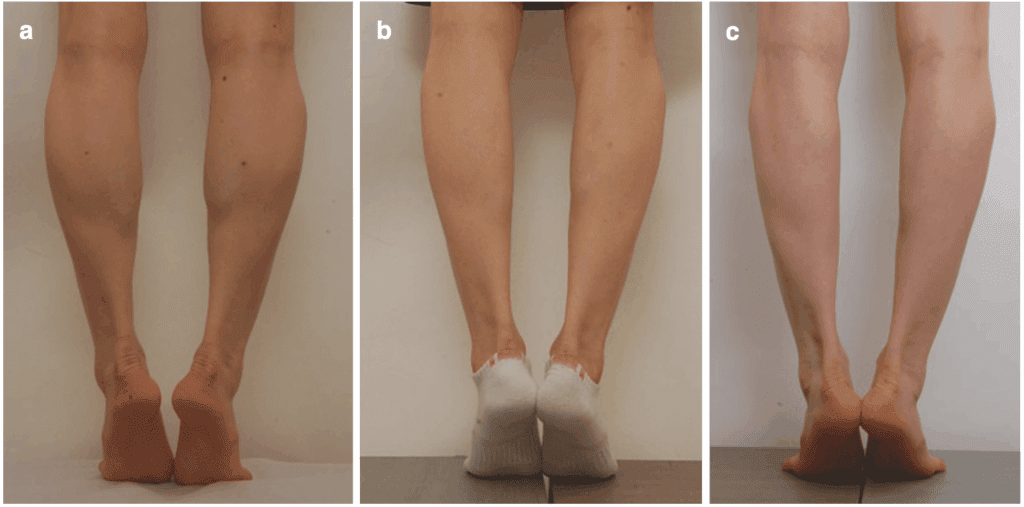
The photos below are consecutive photos of the same client. The first dose was 150U per side, and the second dose was 100U per side.
5. Ultrasound Guidance: The Key to Results
Ultrasound has come up repeatedly above; here is why it matters so much.
In the past, our understanding of the gastrocnemius and soleus came mainly from cadaver dissection data. But for each person's actual calf, we could only look or feel.
The problem is that muscle is unevenly distributed in each person's calf, and by looking it is really hard to calculate precisely how much to inject in each area, so some people get a good result while others get a less than ideal one.
With ultrasound, the situation is completely different:
- It can directly measure the depth of the muscle, making sure the needle goes into the muscle rather than the subcutaneous fat
- It can confirm the distribution pattern of the gastrocnemius (which of the four types it is)
- It can quantify how much dose each area needs, rather than relying on feel
- At follow-up, volume changes can be compared objectively to decide the second-dose amount
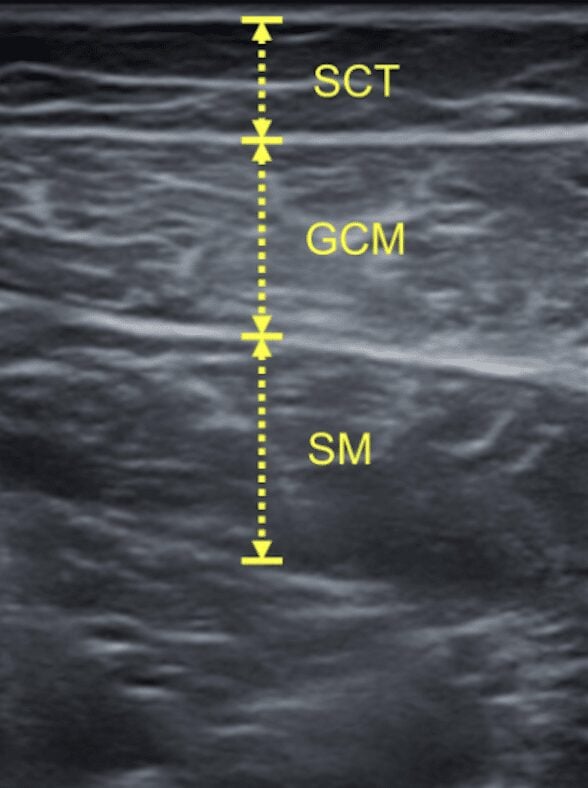
The image below clearly shows the client's subcutaneous fat (SCM), gastrocnemius (GCM) and soleus (SM), with their depth and size plain to see.
6. How Soon Does Calf Botulinum Toxin Work?
The calf is a large muscle group, and botulinum toxin needs time to spread and relax the muscle, so changes usually take 3–4 weeks (about one month) to appear.
This is completely different from facial wrinkle treatment — forehead lines and crow's feet show a response 3–7 days after injection, but large muscle groups depend on the muscle shrinking in volume, which only happens after the muscle has stopped working hard for some time.
So it is normal to feel "nothing has changed" one week after calf botulinum toxin; please wait until week three or four to assess. I have summarised the differences in onset time across areas in the botulinum toxin price article.
7. How Much Does Calf Botulinum Toxin Cost?
The direct answer: calf botulinum toxin costs roughly NT$15,000–40,000, depending on the brand.
| Brand | Calf botulinum toxin price |
|---|---|
| Korean botulinum toxin (Meditoxin, etc.) | NT$15,000–25,000 |
| Dysport | NT$20,000–30,000 |
| Botox | NT$30,000–40,000 |
Because calf botulinum toxin needs regular top-ups about every six months, the cumulative cost over time is not small. So my advice is practical: choose a brand you can afford within your budget. There is no need to chase a particular brand and then be unable to keep going — if you stop, the muscle rebounds.
For brand unit conversion (especially the fact that 1U of Dysport is not equivalent to 1U of Botox), I wrote about it in how botulinum toxin prices are calculated.
8. How to Choose a Calf Botulinum Toxin Brand?
| Brand | Characteristics | Suitable for |
|---|---|---|
| Korean Meditoxin | Affordable and stable results, good value | Limited budget but wanting a noticeable slimming effect |
| British Dysport | Good diffusion, can achieve more thorough relaxation | Muscle spread over a wider area, wanting a larger diffusion range |
Both give natural results with low risk, and are currently common choices for calf botulinum toxin at clinics.
Brand choice for calves differs from facial wrinkle treatment in one way: because the calf muscle area is large, "diffusion" is a practical consideration. Dysport's diffusion characteristics are actually an advantage on large muscle groups, which is the opposite of the logic for the face, where the diffusion range must be tightly controlled.
9. Side Effects and Risks of Calf Botulinum Toxin
The most important thing to know is temporary weakness when walking.
Even when the dose is kept within 200 units, a small number of people still experience a lack of strength when walking.
But there is no need to worry too much — it improves in about three to four weeks.
- Avoid vigorous exercise for a few days after injection, especially running and jumping that need explosive power.
- Be careful on stairs and when standing for long periods; if you feel weak, slow down.
- Controlling the total dose is key: this is also why a single session is not recommended to exceed 400U, and why it is given in two stages.
- Tell your doctor at the next injection so the dose and distribution can be adjusted.
10. Comparing the Three Botulinum Toxin Slimming Areas: Calves, Masseter, Shoulders
Finally, let me share the "three botulinum toxin slimming areas" again — slimmer calves, slimmer face, slimmer shoulders. These are the three most common uses of botulinum toxin on large muscle groups:
| Calf botulinum toxin | Masseter botulinum toxin | Shoulder botulinum toxin | |
|---|---|---|---|
| Target muscle | Gastrocnemius, soleus | Masseter | Upper trapezius |
| First-session dose (both sides combined) | 200–400U | 40–80U | 120–200U |
| Time to take effect | 3–4 weeks | 3–4 weeks | 3–4 weeks |
| Further reading | This article | Masseter botulinum toxin | Shoulder botulinum toxin |
What the three have in common is that all take 3–4 weeks to show results, and all need regular top-ups to maintain them. The difference is the dose range required, and the calf is the highest of the three.
If you would like to first understand the basic principles, indications and side effects of botulinum toxin, you can start with the what is botulinum toxin aesthetics article.
11. Calf Botulinum Toxin FAQ
How many units of calf botulinum toxin are enough?
For both legs, 300–400U is recommended for the first session, and about 200–300U for later top-ups. The key point is not to go below 100U per side — below that dose it is basically hard to get any visible effect, and rather than half a treatment, I would suggest not having it done and saving the money. The actual dose is still decided after an ultrasound assessment of muscle distribution.
Why is calf botulinum toxin split into two sessions?
Two reasons. First, a total dose of over 400 units in one session (200 units per side) easily causes temporary muscle weakness. Second, with only one dose, if there is no top-up after 12 weeks, the calf returns to its original size in about 20 weeks. With two doses (the second after three months), the calf contour can be greatly extended to 9–12 months.
I had 500U of calf botulinum toxin with no effect. Why?
The most common reason is that you may not have muscular calves. I have met clients who had 500U and felt nothing at all; an ultrasound scan showed that the gastrocnemius was actually small and most of the calf was fat — botulinum toxin acts on muscle, and with fatty calves even a large dose is unlikely to work. Another common reason is that the needle was not long enough, so the product went into the subcutaneous fat and not the muscle, which is why calf botulinum toxin must use a long needle.
How can I tell whether I have muscular or fatty calves?
As a preliminary check, stand on tiptoe so the calf tenses: if the calf visibly bulges into a hard lump, it is most likely muscular; if there is little difference before and after tensing and it feels rather soft, it is most likely fatty. But this is only a rough judgment; the thickness and distribution of the gastrocnemius still need to be confirmed by ultrasound to decide whether to have it done and how much to inject.
How soon does calf botulinum toxin work?
The calf is a large muscle group, so it takes time for botulinum toxin to spread, relax the muscle and shrink its volume, usually 3–4 weeks (about one month). This differs from facial wrinkle treatment, which shows a response in 3–7 days, so it is normal to see no change after one week; please wait until week three or four to assess.
How long does calf botulinum toxin last?
It depends on whether you have the second dose. With only one dose, the muscle regains about half its volume after 6 months, and mostly returns to its original state after 9–12 months. If a second dose is given after three months, the contour can last 6–9 months or more, and the overall effect can be extended to 9–12 months.
Is calf botulinum toxin a one-time fix?
No. Once injections stop, the muscle slowly rebounds; this is a long-term commitment. The good news is that with continued top-ups the muscle gets smaller and smaller, and the dose needed for later top-ups can be reduced accordingly. So before starting, think carefully about whether you have the perseverance and budget to maintain it regularly.
Does calf botulinum toxin have side effects?
The most common is temporary weakness when walking. Even when the injection is kept within 200 units, a small number of people still experience this, but there is no need to worry too much — it improves in about three to four weeks. This is also why a single session is not recommended to exceed 400U, and why it is given in two stages.
How to choose a calf botulinum toxin brand?
Korean Meditoxin is affordable with stable results and good value, suitable for those with a limited budget who still want a noticeable effect; British Dysport has good diffusion, suitable for those whose muscle is spread over a wider area and who want a larger diffusion range. Both give natural results with low risk. Because the calf needs regular top-ups, I recommend simply choosing a brand you can afford within your budget.
How much does calf botulinum toxin cost?
Depending on the brand, roughly NT$15,000–40,000: Korean botulinum toxin about 15,000–25,000, Dysport about 20,000–30,000, Botox about 30,000–40,000. Because a top-up is needed about every six months, the long-term cost is not small, and choosing a brand within your budget makes it easier to keep going.
How does calf botulinum toxin compare with liposuction and surgery?
In the 1990s, the only way to improve calf contour was surgical removal of the gastrocnemius, but it left a 2–3 cm scar, results were inconsistent because of individual differences in nerve branching, and it could cause irreversible nerve damage and abnormal sensation. Since the switch to botulinum toxin from 2002, no recovery period is needed, there is no scarring, side effects are noticeably fewer, and it can be repeated. For fatty calves, botulinum toxin cannot help, and what to discuss are fat-reduction approaches.
Medical Review and Sources
This article was written and reviewed by Dr. Ou Chia-Hung of Golden Apple Aesthetic Clinic. The doses in the article are clinical reference ranges, and the actual dose and distribution are decided after an ultrasound assessment, adjusted for each person's gastrocnemius thickness, type and injection history; results vary from person to person.
- Lee HJ, Lee DW, Park YH, et al. Botulinum Toxin Type A for Calf Contouring: Ultrasonographic Classification of the Gastrocnemius Muscle. 2022.
- Han KH, Joo YH, Moon SE, Kim KH. Botulinum Toxin A Treatment for Contouring of the Lower Leg. J Dermatolog Treat. 2006;17(4):250-254.
- Lee HJ, Lee DW, Park YH, Cha MK, Kim HS, Ha SJ. Botulinum Toxin A for Aesthetic Contouring of Enlarged Medial Gastrocnemius Muscle. Dermatol Surg. 2004;30(6):867-871.
- Kim NH, Park RH, Park JB. Botulinum Toxin Type A for the Treatment of Hypertrophy of the Masseter Muscle. Plast Reconstr Surg. 2010;125(6):1693-1705.
If you are not sure whether you have muscular or fatty calves, you are welcome to book a consultation. I will first use ultrasound to confirm the thickness and distribution of the gastrocnemius, and then tell you whether calf botulinum toxin is worthwhile for you.