
Tear trough hyaluronic acid is the signature treatment of Golden Apple Aesthetic Clinic. I inject over a thousand tear troughs every year and also help dissolve a great many failed tear trough cases, and injecting tear troughs has become muscle memory for me.
In this article I will lay out who tear trough hyaluronic acid suits, its pros and cons, and the deep and superficial layer techniques, then test 10 commonly used tear trough hyaluronic acid brands on the market, and finally summarize costs, duration and aftercare, so you know what to ask before your consultation. (If what you want to treat is the hollow of the upper eyelid rather than under the eye, see How to improve hollow eye sockets? — that area can only use small-molecule hyaluronic acid.)
Tear trough hyaluronic acid is one of the few tear trough filling methods that can be dissolved and returned to the original state: hyaluronic acid fills the hollow under the eye and lifts the apple cheeks, noticeably improving dark circles and a tired look. Its biggest advantage is that it is "reversible" — whether you are unhappy with the result or have allergic swelling, hyaluronidase can restore the original state. This is why, in all my years of injecting tear troughs, I have always put hyaluronic acid first.
The tear trough is one of the areas of the face with the highest technical barrier, and quite a few failed tear trough hyaluronic acid cases circulate on Dcard, PTT and Threads. Let me first state one principle: failed tear trough filling (commonly called 'caterpillar' lumps) is almost always caused by injecting at the wrong layer. Whether it is hyaluronic acid, Ellanse, Aesthefill or fat grafting, it is the same: the technique is wrong, not the material.
How to choose tear trough hyaluronic acid? Conclusion first
Nine-tenths of the success of tear trough hyaluronic acid is not the brand but the layer. The standard technique is 2cc: one syringe of medium-to-large molecule placed deep, beneath the orbicularis oculi muscle (SOOF), for support, and one syringe of small molecule placed superficially, above the muscle, to smooth. There is little room to go wrong in the deep layer; in the superficial layer, as soon as medium-to-large molecule is mixed in, it becomes the dreaded 'tear trough caterpillar' lump or the bluish look under the eye from the Tyndall effect.
For the superficial layer, simply choose small-molecule hyaluronic acid: European and American brands include Juvederm Volite, Teoxane RHA1, Restylane Vital Light and Belotero Soft; among Korean brands you can choose honeycomb hyaluronic acid. 2cc of hyaluronic acid costs about NT$15,000-30,000; European and American brands last about 1.5-2 years, and Korean brands about 8-12 months.
The greatest value of hyaluronic acid is that it is reversible — if it is done badly, it can be dissolved with hyaluronidase and redone; with Ellanse, Aesthefill and other collagen stimulators, once they land in the superficial layer you can only wait for them to be metabolized or have them removed surgically.
Quick overview
| Question | Short answer |
|---|---|
| What is tear trough hyaluronic acid? | Using hyaluronic acid to fill the hollow under the eye and lift the apple cheeks, improving the dark circles and tired look caused by the hollow |
| Who is it best for? | People aged 25-45 with few eye bags and simple under-eye hollowing |
| Who is it not suited to? | People with moderate to severe eye bags. Filling only covers them up and makes the bag look bigger; surgery is recommended first |
| How many cc? | Usually 2cc: one syringe of medium-to-large molecule deep and one of small molecule superficially. Injecting only 1cc the first time easily produces a step-off feeling |
| How much does it cost? | About NT$15,000-30,000 for 2cc |
| How long does it last? | 1-2 years |
| Which brands for the superficial layer? | Juvederm Volite, Teoxane RHA1, Restylane Vital Light; for a budget option, Korean honeycomb small molecule |
| Why do lumps form? | Medium-to-large molecule was placed in the superficial layer; it is not a dose problem but a layer problem |
| Why does the under-eye turn bluish? | The Tyndall effect. Large molecules placed too shallow refract light like a convex lens, making dark circles look deeper instead |
| Can it be rescued if done badly? | Hyaluronic acid can be dissolved with hyaluronidase and redone; non-dissolvable materials can only be left to metabolize naturally or removed surgically |
| Will it bruise? | Blunt-cannula injection usually leaves only two entry points, and ordinary concealer hides any bruising |
| How long until it looks natural? | It absorbs water and swells in the first week; after about a week it blends with the tissue and looks natural |
Further reading: if you are not sure which type of tear trough you have, first read → What is a tear trough? Know the 3 types and how to treat them; to compare approaches other than hyaluronic acid → What aesthetic treatments are there for tear troughs? Pros, cons and costs of 7 treatments
Contents
Contents
- 1. What is tear trough hyaluronic acid?
- 2. Who is tear trough hyaluronic acid suitable for? 1. Hollow-type tear troughs under the eye 2. Mild eye bags or after eye bag surgery 3. Who should not get tear trough hyaluronic acid?
- 3. Pros and cons of tear trough hyaluronic acid 1. Pros 2. Cons 3. Comparison with other filling materials
- 4. How to inject tear trough hyaluronic acid naturally? Two steps: deep and superficial layers. Deep layer: medium-to-large molecule for support. Superficial layer: small molecule to smooth; the wrong layer causes lumps. Injected too shallow it turns bluish: the Tyndall effect
- 5. Tear trough hyaluronic acid brand recommendations: 10 fillers tested. How to choose? Start with the "shade" firmness chart. Comparison table of 10 tear trough fillers. Recommended brand 1: Juvederm Volite. Recommended brand 2: Teoxane RHA1. Recommended brand 3: Restylane Vital Light. Other fillers tested (shade 5, not recommended for beginners)
- 6. Tear trough hyaluronic acid cost, duration and aftercare. How much does it cost? How long does it last? Aftercare
- 7. What if tear trough hyaluronic acid fails?
- Tear trough hyaluronic acid FAQ: How many cc? How long does it last? How much does it cost? Will it disappear? Will it bruise? What is the aftercare? How long until it looks natural? Will it migrate? It bulges when I smile; do I need hyaluronidase? Which brand is recommended? Why does it become a caterpillar lump? Why is it bluish under the eye afterward? Which is better: hyaluronic acid, Ellanse or Aesthefill?
- Taipei tear trough aesthetic treatment recommendation: Golden Apple Aesthetic Clinic
1. What is tear trough hyaluronic acid?
Tear trough hyaluronic acid uses the volume of hyaluronic acid to fill the hollow under the eye. By filling the hollow of the apple cheeks, it restores the plump, bright look of youth.
Of course, the tear trough is a technically demanding area, and many people fail by injecting at the wrong layer, giving tear trough hyaluronic acid quite a bad reputation.
In fact tear trough filling is not so complicated; just grasp one important principle: for the deep layer of the tear trough, large-molecule hyaluronic acid or Ellanse is recommended as the foundation, while the superficial layer is like the upper structure of a house and can only use small-molecule hyaluronic acid.
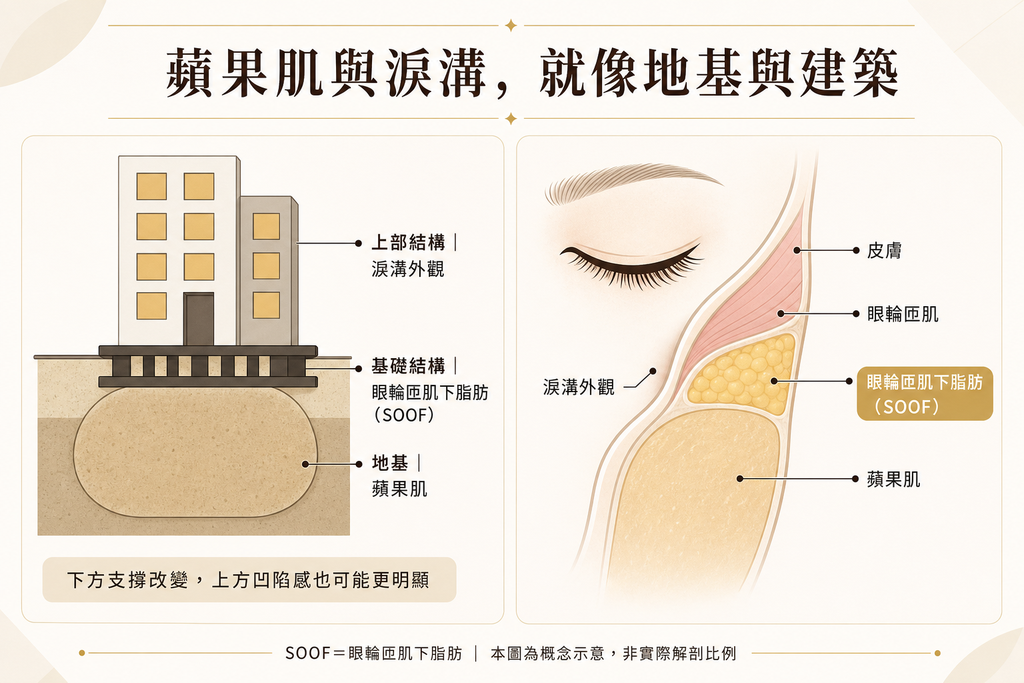
Several of my tear trough articles repeat this principle, because I dissolve tear troughs for clients of other clinics all too often. The biggest cause of failed tear trough filling is putting large molecules in the superficial layer. Even with fat grafting, if fat particles are accidentally placed in the superficial layer (above the SOOF), a bulge when smiling very easily appears.
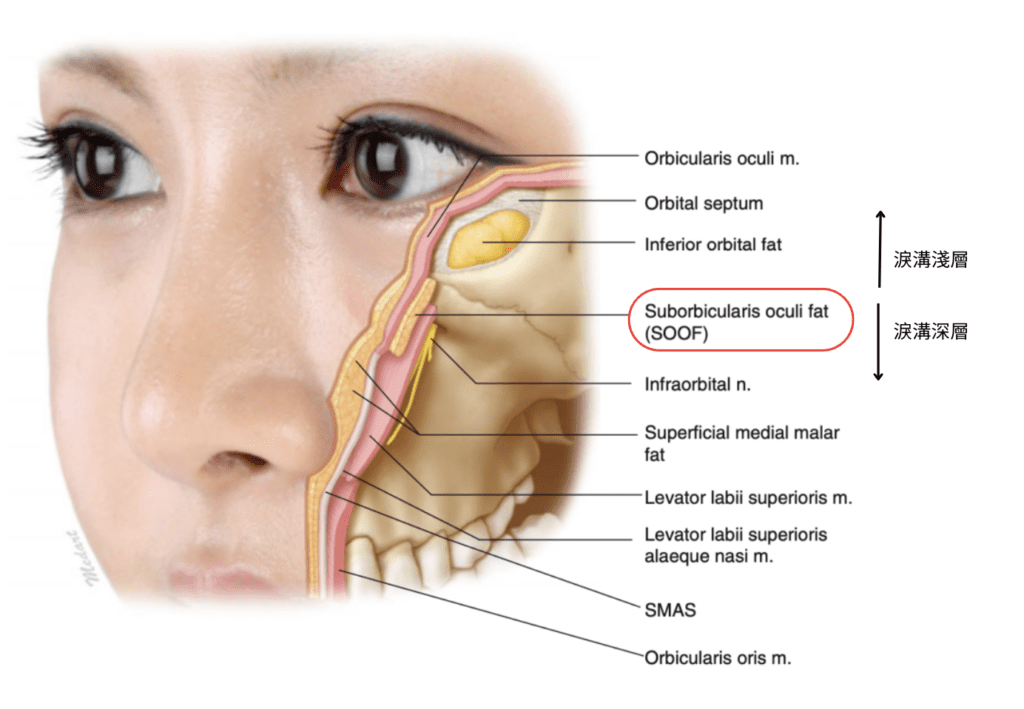
Deep-layer injection of the tear trough is relatively easy. The principle is to build support where the apple cheeks are, which can achieve a 70-point improvement of the tear trough.
When a consultant at an ordinary clinic tells you to get Ellanse for the tear trough or Aesthefill for the tear trough, they actually mean filling the deep apple cheek area of the tear trough. Collagen stimulators of course have a big advantage: they are extremely long-lasting, and when done well you will find them very worthwhile, but if it fails it is a nightmare.
2. Who is tear trough hyaluronic acid suitable for?
The direct answer: tear trough hyaluronic acid is best for people aged 25-45 with few eye bags and simple under-eye hollowing. People with mild eye bags can use it to cover them temporarily, but once eye bags are obvious, filling only makes the bag look bigger, and surgery should be considered first.
1. Hollow-type tear troughs under the eye
Tear trough hyaluronic acid is best for ages 25-45, people with few eye bags and simple under-eye hollowing. People of this type usually see a clear improvement in the dark circles caused by the hollow after tear trough hyaluronic acid, and their complexion looks better.
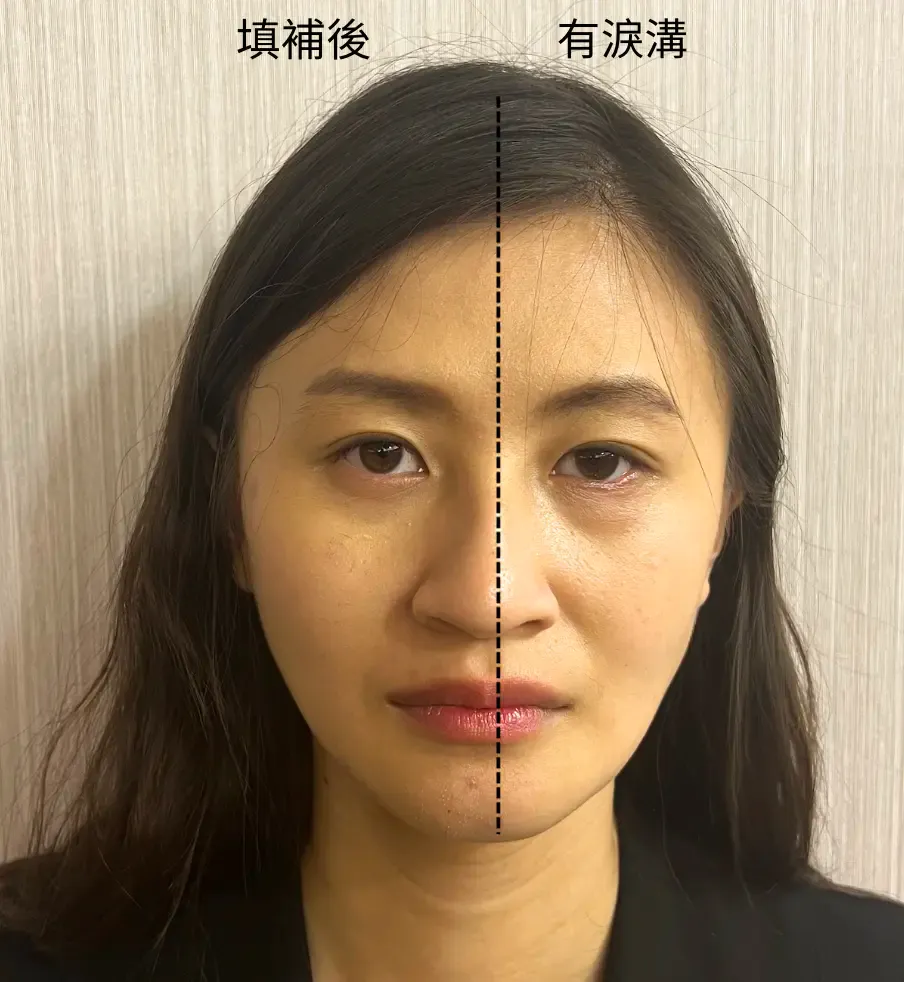
In the picture below, my wife is a typical tear trough hollow. After tear trough filling with hyaluronic acid, her dark circles became lighter. But since hyaluronic acid is transparent, it cannot make the color of allergy-type dark circles disappear completely; still, makeup can already cover much of it.

If your dark circles are mainly caused by pigment or blood vessels (hyaluronic acid is transparent and cannot change color), you can first read How to remedy the 4 types of dark circles with aesthetic treatment? Does the Panda Injection work? to determine which type you have.
2. Mild eye bags or after eye bag surgery
People aged 35-45 with mild eye bags who are not really mentally prepared for surgery can use tear trough hyaluronic acid to hold things off for a while, making the eye bags look less obvious.
But as you get older, the eye bags buried under the hyaluronic acid will one day grow and flourish, and one day you may suddenly find the area under your eyes looks bulging. This is not a 'tear trough caterpillar' caused by the doctor's technique, but hyaluronic acid no longer being able to cover the eye bags. At that point I still recommend consulting a surgeon to have the eye bags removed.
The picture below shows relatively mild eye bags. After tear trough injection the eye bags are less obvious, but you can still faintly see a slight bulge. This is as far as tear trough hyaluronic acid can improve eye bags; if your eye bags are worse than in the picture below, I recommend going straight to surgery.
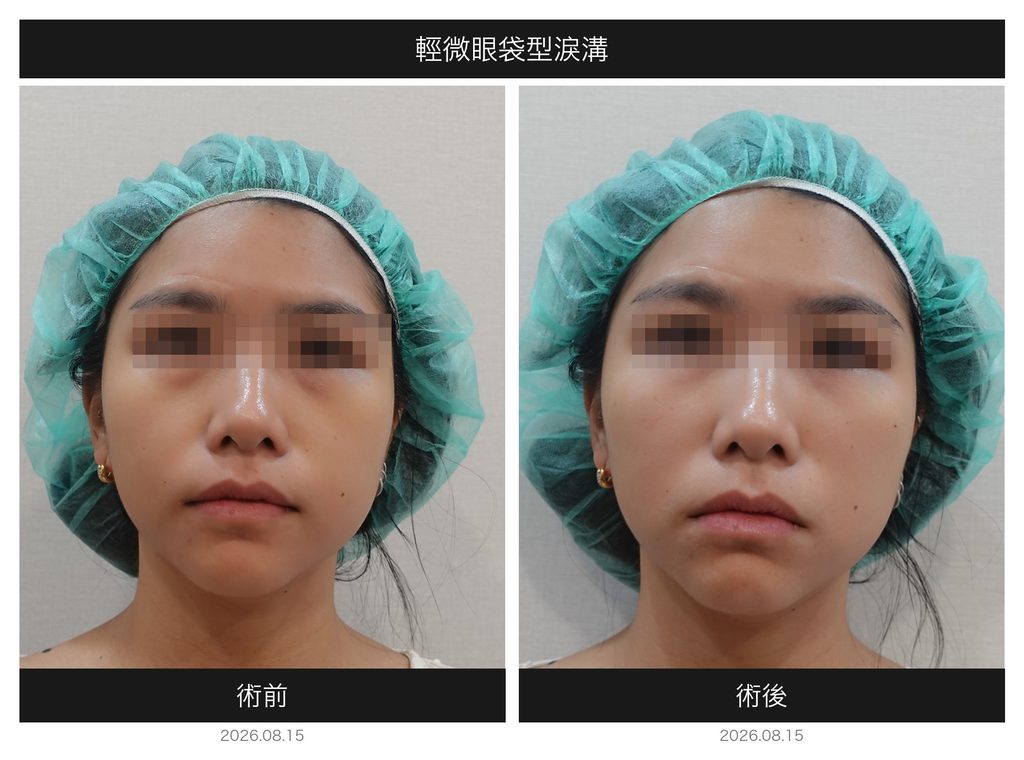
No matter how much you fill eye bags, it is only an attempt to cover them up and cannot truly remove them. After all, eye bags are accumulated aging fat. If it is not removed by subtractive surgery and you rely only on additive tear trough hyaluronic acid filling, it very easily makes the eye bag look bigger.
After eye bag surgery, some people find the hollow under the eye suddenly becomes very severe. If you want to improve the hollow of the apple cheeks, you can follow up with tear trough hyaluronic acid filling.
I had a 55-year-old client who wanted tear trough injections, and I turned her down and recommended she have eye bag surgery. At the time she was actually not very happy, since she had specially taken leave to come for the tear trough injection.
One day a year later she came back to me for tear trough hyaluronic acid. I didn't recognize her at first (because she looked so much younger), and she told me, 'Dr. Ou, I'm so glad I listened to you and had my eye bags done. Having no eye bags makes such a difference!'
Further reading: I wrote a complete guide on whether to fill or operate → Don't inject tear troughs blindly? Tear trough filling vs. eye bag surgery: how to choose without stepping on landmines
3. Who should not get tear trough hyaluronic acid?
Not everyone is suited to direct filling. In the following situations, I ask clients to deal with other problems first, or use another approach:
| Situation | Why direct filling is not recommended | Suggested direction |
|---|---|---|
| Moderate to severe eye bags | Filling only covers them up; adding volume makes the bag look bigger | Consult about eye bag surgery first, then reassess filling afterward |
| Dark circles mainly pigment or vascular type | Hyaluronic acid is transparent and cannot change color | First determine the [type of dark circles](https://goldiapple.com/dark-circles-aesthetic-treatment/), then consider the [Panda Injection](https://goldiapple.com/panda-injection/) or laser |
| Previous delayed allergic reaction to hyaluronic acid | High risk of repeated swelling | Dissolve and observe first, then discuss alternatives |
| A non-dissolvable material with lumps already under the eye | Adding more filler only makes it bulge more | First deal with the existing lumps; see [what to do when a stimulator fails](https://goldiapple.com/sculptra-aesthefill-ellanse-failure/) |
3. Pros and cons of tear trough hyaluronic acid
1. Pros of tear trough hyaluronic acid
The biggest advantage of tear trough hyaluronic acid is that it can be dissolved. Reversibility is the biggest strength in aesthetic medicine. Don't underestimate it, because many people's failed tear troughs are irreversible, leaving many of them afraid to smile or make normal expressions.
Ms. A in the picture below came to me to dissolve a failed tear trough. She had delicate features to begin with, but after tear trough hyaluronic acid, two white strips of hyaluronic acid hung under her eyes. This is a typical failed tear trough with large molecules placed in the superficial layer.
After dissolving, she returned to the original under-eye hollow. I then used Juvederm hyaluronic acid, medium molecule in the deep layer and small molecule in the superficial layer, and she regained a plump, bright look; the under-eye became flat again and the two tear trough caterpillar lumps disappeared.
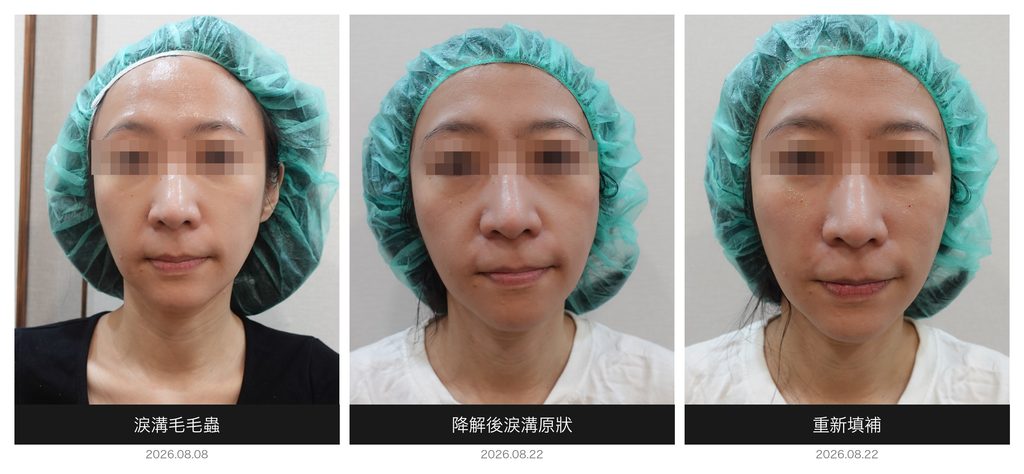
If hyaluronic acid fails, it can at least be dissolved. If you had Aesthefill or Ellanse in the tear trough and it was accidentally placed in the superficial layer, then sorry, there is nothing I can do.
Like large-molecule hyaluronic acid, collagen stimulators form non-dissolvable lumps if placed in the superficial layer, which may not go away for years and usually end up needing debridement by a surgeon. Evaluate carefully before injecting these products.
2. Cons of tear trough hyaluronic acid
Tear trough hyaluronic acid is metabolized over time and fades somewhat; it is not as long-lasting as collagen stimulators. Its biggest drawback is that it needs to be injected regularly.
The most common drawback of tear trough hyaluronic acid is allergic swelling. There is no filler in the world with a 0% allergy rate. Although the allergy rate of hyaluronic acid is already very low (among the more than two thousand clients I inject a year, I usually encounter 1-2 cases), the benefit is that hyaluronic acid can be dissolved.
If the hyaluronic acid swells repeatedly during menstruation or a cold, it is usually a delayed allergic reaction. I recommend returning to the original clinic so the doctor can help dissolve it. If delayed too long, hyaluronic acid nodules and hard lumps may form that can no longer be dissolved, so be sure to deal with it early, at the first sign of allergy.
Further reading: Is hyaluronic acid hard after injection? Side effects of hyaluronic acid in 5 areas|What to do about a puffy face? 2 ways to treat puffiness
3. Comparison with other filling materials
One-sentence summary of this table: only hyaluronic acid can be used in both the deep and superficial layers, and only hyaluronic acid can be dissolved. The other materials can only handle the deep layer, and once they stray into the superficial layer there is no way back.
| [Hyaluronic acid](https://goldiapple.com/what-is-hyaluronic-acid/) | [Ellanse](https://goldiapple.com/ellanse-for-tear-trough/) | Aesthefill / [Sculptra](https://goldiapple.com/collagen-stimulator-comparison/) | Radiesse | [Vivabella for tear trough](https://goldiapple.com/vivabella-tear-trough/) | |
|---|---|---|---|---|---|
| Tear trough deep layer | O | O | O | O | O Vivabella Black |
| Tear trough superficial layer | O | X | X | X | △ Vivabella White |
| Duration | 12 months | 18-24 months | 12-18 months | 12-18 months | 12-18 months |
| Dissolvable? | O | X | X | X | X |
Further reading: a full comparison of tear trough treatments → What aesthetic treatments are there for tear troughs? Pros, cons and costs of 7 treatments; how to choose among stimulators → How to choose a collagen stimulator? 6 compared; another tear trough material → What is Neofilera? 3 severity levels of tear troughs
4. How to inject tear trough hyaluronic acid naturally? Two steps: deep and superficial layers
Nine-tenths of whether tear trough hyaluronic acid looks natural depends on whether the "layer" is right. The structure of the tear trough can simply be divided into deep and superficial layers. The two layers need hyaluronic acid of different firmness and are treated separately, which is why tear trough hyaluronic acid usually needs 2cc: one syringe of medium-to-large molecule for the deep layer and one of small molecule for the superficial layer.
Deep layer: medium-to-large molecule for support
The deep layer of the tear trough is injected beneath the orbicularis oculi muscle (SOOF), against the periosteum. The purpose is to prop up the apple cheeks so that the under-eye hollow is filled from the root. Doing this layer well achieves a 70-point improvement of the tear trough.
This layer can use medium-to-large molecule hyaluronic acid, and some clinics also use firm, well-supporting fillers such as Ellanse, Aesthefill and Radiesse. The deep layer is held in place by the muscle, so it is not prone to migration or puffiness, and it is also the relatively easy layer to inject.
Superficial layer: small molecule to smooth; the wrong layer causes lumps
The remaining 30 points are in the superficial layer, the layer above the orbicularis oculi muscle. The tissue here is very thin, and this is where skill is tested. Only soft small-molecule hyaluronic acid can be slowly spread flat. If medium-to-large molecule is injected here, an obvious ridge appears under the eye, hanging like a worm even when you aren't smiling. This is the dreaded "tear trough caterpillar" that people talk about on Dcard and PTT.
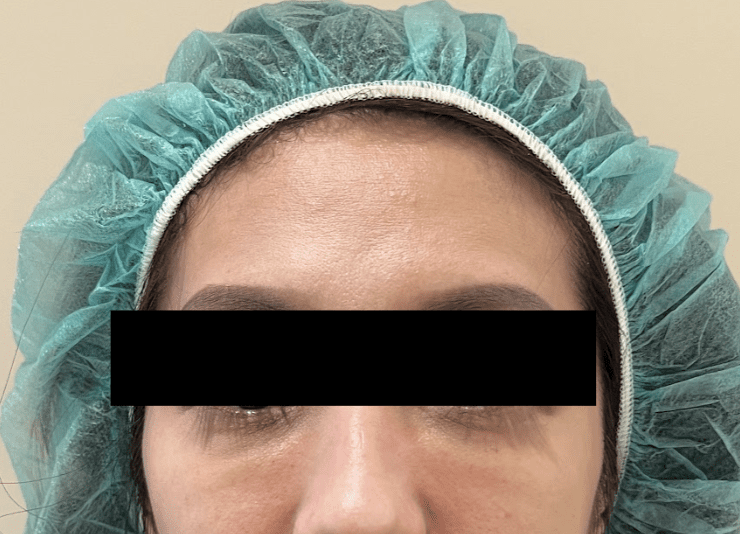
Many clients tell me they are "afraid of injecting too much", but the dose is not the point. The layer is. Placing 1cc of large molecule in the deep layer is completely fine, but with the same material, as little as 0.1cc straying into the superficial layer will bulge, however small the dose.
The good thing about tear trough hyaluronic acid is that even if the wrong layer is injected, it can be dissolved with hyaluronidase and redone (the dissolving case in Chapter 3 was handled this way); but if the material is non-dissolvable, such as Ellanse or Aesthefill, you can only wait for it to metabolize naturally or seek surgical removal.
Further reading: what to do when it has already gone wrong → 4 tear trough complications: what to do about a failed tear trough and tear trough caterpillar lumps?
How to avoid the superficial-layer minefield → Precise tear trough hyaluronic acid injection using ultrasound
Injected too shallow it turns bluish: the Tyndall effect
I have had several clients come to me to dissolve their filler and ask, 'Dr. Ou, why do I look more tired after my tear trough filling? My colleagues ask why my dark circles are getting worse.'
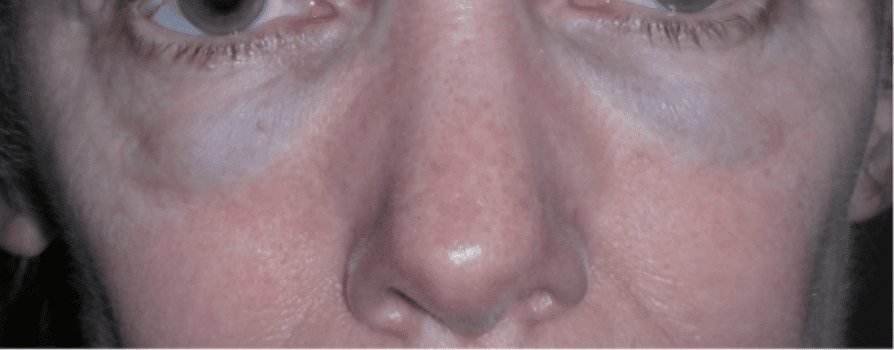
The slightly bluish area under her eyes is a typical Tyndall effect. Large-molecule hyaluronic acid placed in the superficial layer refracts light like a convex lens, producing a bluish caterpillar under the eye and making the dark circles look worse.
This is why I recommend that for the superficial layer of tear trough hyaluronic acid, you must choose only extremely small-molecule hyaluronic acid. Below I will continue to share which brands are better suited to tear trough injection.
The superficial layer is so thin and has so many blood vessels; how to avoid the minefield during injection is described in full in Is the chance of blindness from hyaluronic acid high? Safe tear trough injection with ultrasound + blunt cannula.
Want to know your own tear trough type? Consult Dr. Ou at Golden Apple now!
Online consultation
5. Tear trough hyaluronic acid brand recommendations: 10 fillers tested
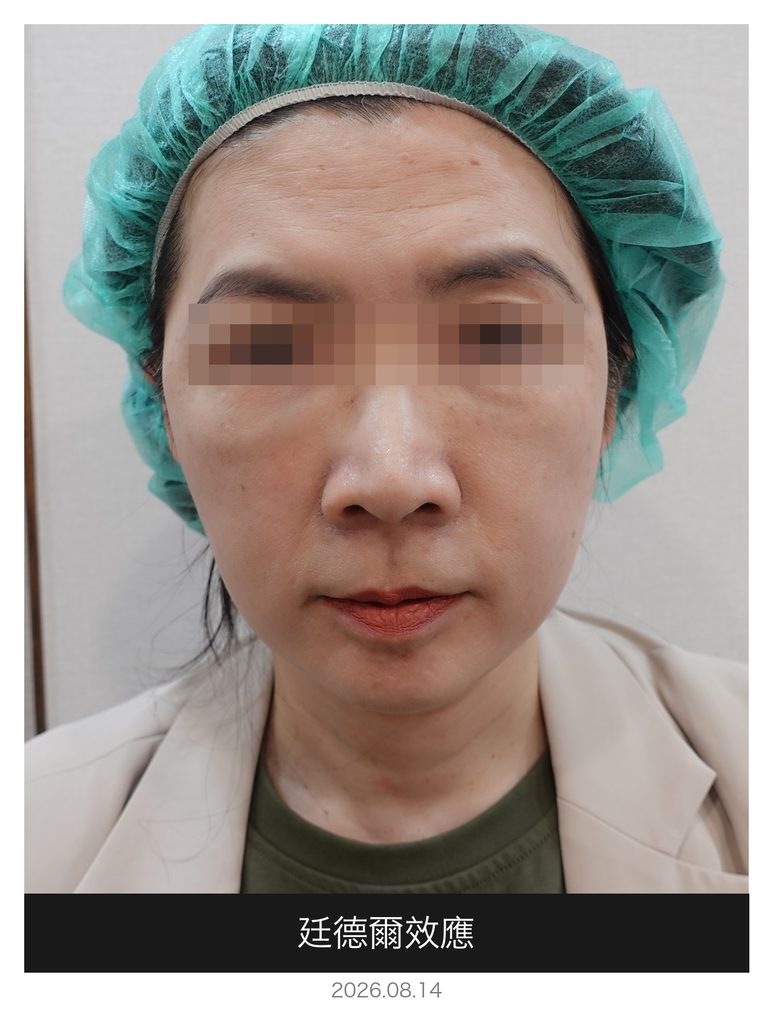
Thanks to my then-girlfriend, who selflessly offered her tear troughs and every part of her face so that I could observe the changes of different brands of tear trough hyaluronic acid every day. (So in the end I had no choice but to marry her and take responsibility, XD.) As of this year, 2026, the tear trough brands used on my wife over these four years are as follows; the left and right eyes usually take turns with different brands so that I can observe how long they last.
2023: Juvederm hyaluronic acid Volite (right) / 2024: Belotero hyaluronic acid Balance (left) / 2025: Restylane Vital Light (left) / 2026: Teoxane RH1 (right)
Straight to my wife's preference ranking: first place is Juvederm Volite, second is Teoxane RHA1. What she likes least is Belotero, which dissolved away not long after it was injected.
How to choose tear trough hyaluronic acid? Start with the "shade" firmness chart
As explained earlier, tear trough hyaluronic acid usually needs 2cc: one syringe of medium-to-large molecule in the deep apple cheek for support and one syringe of small molecule in the superficial layer for refinement. Whether it looks natural depends on the small-molecule hyaluronic acid in the superficial layer.
As mentioned before, deep-layer injection achieves a 70-point improvement, and the remaining 30 points are the hardest part of tear trough hyaluronic acid: the superficial layer of the tear trough, where skill is tested. Whether the tear trough can be smoothed flat depends most on the small-molecule hyaluronic acid in the superficial layer.
Based on my experience injecting over a thousand tear troughs a year and having used many different hyaluronic acid brands, I wrote this tear trough hyaluronic acid brand review for your reference.
Tear trough hyaluronic acid fillers are like lipstick shades for women. Every time I look at my wife's lipstick shades I am completely baffled about how these reds differ, but she insists there is a difference. It is the same for doctors: depending on age, whether there are eye bags and other factors, each client needs a different filler firmness.
I am attaching a paper with a hyaluronic acid shade chart compiled by an overseas tear trough expert. Great minds think alike, and the conclusion is:
For the deep layer of the tear trough you can choose shades 2 and 3; for the superficial layer, I recommend: simply choose shade 5 and 6.
Small-molecule fillers are easy to push flat and not prone to bulging, and their extremely fine molecules are also not prone to the Tyndall effect. If it is your first time filling the tear trough, I suggest choosing the extremely small-molecule shade 6 as the safest choice; if you cannot get even the fillers below flat, then it is truly a technique problem.
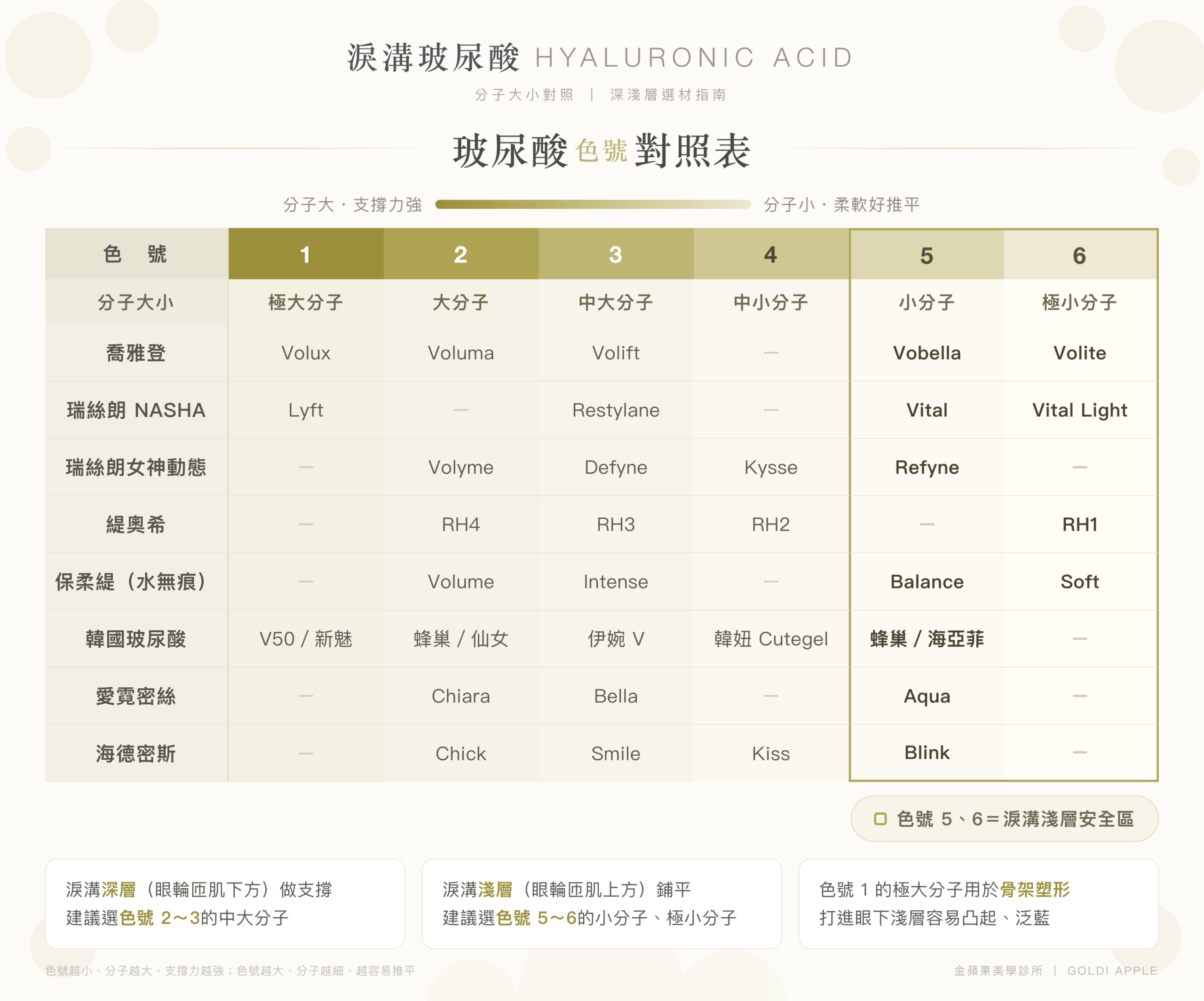
To compare the characteristics of each brand, just as women go to the counter and swatch every lipstick on their wrist, I bought all these fillers suited to the tear trough to test their firmness and flexibility, and finally wrote this review.
Comparison table of 10 tear trough hyaluronic acid fillers
Conclusion first: for the superficial layer, simply choose shade 6 (Volite, RHA1, Vital Light, honeycomb small molecule); leave shade 5 for the deep layer or the small apple cheek area, and do not inject it into the superficial layer. Below are the results of fillers I actually bought, injected and tracked over the long term.
| Filler | Brand series | Suggested layer | Texture | Duration | My assessment |
|---|---|---|---|---|---|
| Juvederm Volite | [Juvederm](https://goldiapple.com/hyaluronic-acid-juvederm/) | Superficial layer | Extremely fine molecule, 'watery' texture; easy to push flat and not prone to clumping | Nearly 3 years in a tested case (2023.3→2026) | ★ First choice for the superficial layer |
| Teoxane RHA1 | Teoxane | Superficial layer | Texture close to Juvederm, slightly firmer | Injected in 2026, still being tracked | ★ Second choice |
| Restylane Vital Light | [Restylane NASHA](https://goldiapple.com/restylane-hyaluronic-acid/) | Superficial layer | Molecules cut extremely fine, soft and easy to push flat; flexibility is lower than Juvederm | Hard to exceed 1 year | ○ Acceptable |
| Korean honeycomb hyaluronic acid, small molecule | [EPTQ](https://goldiapple.com/hyaluronic-acid-eptq/) | Superficial layer | Low allergenicity, affordable | About 50% or more still remains after 1 year | ○ High value for money |
| Juvederm Vobella | [Juvederm](https://goldiapple.com/hyaluronic-acid-juvederm/) | Small apple cheek area (superficial layer not recommended) | Higher support; a firm lump feeling is obvious when placed superficially | 12 months or more | △ Easy to get wrong |
| Restylane Vital | [Restylane NASHA particle type](https://goldiapple.com/restylane-hyaluronic-acid/) | Not recommended for tear troughs | Particle type; the Tyndall effect easily appears if placed too shallow | — | ✕ The one I recommend least |
| Restylane Refyne (Goddess Dynamic) | [Restylane OBT gel type](https://goldiapple.com/restylane-hyaluronic-acid/) | Deep layer / small apple cheek area | Good elasticity, natural with expressions, but the highest price | Lasting well (case 2023→2026) | △ Good result but expensive |
| Belotero Balance | Belotero | Small apple cheek area | Not prone to the Tyndall effect, but an obvious lumpy feeling; older cross-linking technology | Relatively short | △ Easy to get wrong |
| [Vivabella White](https://goldiapple.com/vivabella-tear-trough/) (not hyaluronic acid) | Collagen stimulator PDLLA | Dermis layer (not recommended in the superficial layer under the eye) | The only one approved in Taiwan for the dermis layer, but cannot be dissolved | About 1.5-2 years | For the tear trough, use Vivabella Black in the deep layer instead |
| [Panda Injection](https://goldiapple.com/panda-injection/) (not hyaluronic acid) | Collagen | Superficial layer (to cover pigment) | No support; used to improve dark circle pigment | 3-6 months | Needs to be combined with hyaluronic acid |
The table above focuses on "how to choose for the superficial layer". For deep-layer support, medium-to-large molecules of shade 2-3 are generally chosen, commonly fillers such as Juvederm Voluma and Restylane Lyft. For each brand's full range of fillers and suitable areas, see Comparison of 4 hyaluronic acid brands: what is the difference between Juvederm and Restylane?.
Recommended tear trough hyaluronic acid brand 1: Juvederm Volite
I injected my then-girlfriend's right tear trough in 2023.3. For a small-molecule hyaluronic acid, this duration already exceeded expectations, and only in 2026 did I top her up with Teoxane.
The biggest difference between Juvederm and Restylane Refyne is the cross-linking method: Juvederm is very 'watery', while Restylane is like clay, very 'bouncy'.
For lip hyaluronic acid, if you want a very defined, sculpted shape I recommend Restylane, which is bouncy and can be pinched into different shapes. For the tear trough, however, Juvederm is more suitable: its extremely fine molecules are easy to push flat and not prone to clumping or bulging.
Further reading: How to choose Juvederm for the tear trough? Comparison of 3 fillers, suitable situations and duration|Juvederm hyaluronic acid prices and an introduction to 5 fillers
Recommended tear trough hyaluronic acid brand 2: Teoxane RHA1
Teoxane, Juvederm and Restylane are basically direct competitors, dividing up the top-tier hyaluronic acid market.
Teoxane hyaluronic acid has a texture very close to Juvederm (Teoxane was actually founded by a team that left Juvederm's R&D), and the feel and texture of the two brands when injected are similar.
Teoxane is slightly firmer than Juvederm. This year, 2026, I attended a seminar and injected RHA1 in my wife, mixed with one Panda Injection. It also gave a fairly natural, easy-to-smooth result in the tear trough. Since it was only injected this year, I will have to update you on its duration next year.
Recommended tear trough hyaluronic acid brand 3: Restylane Vital Light
This filler is mainly Restylane's brand for skin booster injections. Its molecules are very fine, the texture is soft and easy to push flat, and it looks very natural in the tear trough.
It belongs to Restylane's NASHA series. Its flexibility is slightly lower than Juvederm, it fades relatively faster, and it is hard for it to last beyond one year.
Other tear trough hyaluronic acid fillers tested (shade 5, not recommended for beginners)
The larger the molecule, the harder it is to push flat and the greater the chance of getting it wrong. Shade 5 is usually used in the small apple cheek area of the tear trough, and is mainly suited to some people with small apple cheek hollows, so I will not go into detail here.
I will briefly go over my past experience with shade 5, but I still recommend that everyone choose shade 6 as the safest.
Juvederm Vobella
Although the manufacturer positions this filler for the periorbital area, the periorbital area it suits is the small apple cheek area I mentioned above, not the superficial layer of the tear trough. Many doctors see that the package insert says it suits the periorbital area and inject it in the most superficial position, and I have dissolved many failed cases of Juvederm Vobella.
Although Juvederm Vobella lasts somewhat longer than Volite (12 months or more is no problem) and has higher support, any shade 5 placed in the superficial layer gives a more obvious lump feeling.
Restylane Vital
One of the most frequently dissolved tear trough fillers. A certain chain uses this one specifically for tear troughs, so I have met several clients who came to have it dissolved who were injected with this filler.
Restylane has two series: NASHA is particle-type hyaluronic acid and Refyne (Goddess Dynamic) is gel-type. Although this Vital is small-molecule, it is not as fine as Vital Light, and since it is NASHA-series particle-type hyaluronic acid, the Tyndall effect easily appears if it is placed too shallow. Its flexibility is also not as good as Refyne, so I do not really recommend using it for tear troughs.
For exactly how particle type and gel type differ, I explain fully in What is hyaluronic acid? How to tell particle type from gel type.
Restylane Refyne (Goddess Dynamic) hyaluronic acid
Refyne, as the small molecule of the Goddess Dynamic line, is relatively better suited to tear trough injection.
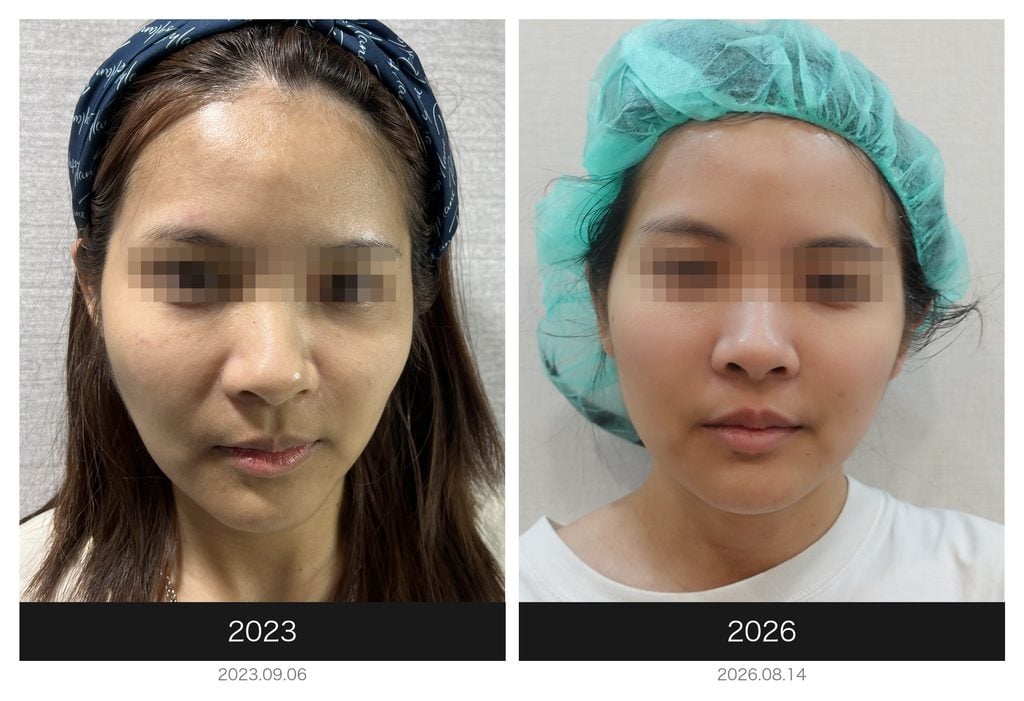
As the most expensive hyaluronic acid, Goddess Dynamic does have its strengths. After injection the elasticity is very good, and it moves very naturally with expressions, truly 'dynamic'. The client in the picture below had Restylane Vital in 2023, had it dissolved and then re-injected with Refyne. When she recently came back to me for other treatments, I found her tear trough hyaluronic acid was still holding up very well.
But the drawback of Goddess Dynamic is the price. 2cc of Goddess Dynamic usually costs NT$35,000-40,000, quite a bit higher than other brands, and my clinic does not mainly promote Restylane Goddess Dynamic for tear troughs.
Belotero Balance
Injected in my wife's left tear trough in 2024.9, then dissolved afterward.
The advantage of Belotero hyaluronic acid is that it is not prone to the Tyndall effect, but Balance is ultimately shade 5, and the lumpy feeling under the eye is more obvious than shade 6. My wife did not like it very much, so I dissolved it for her later.
In addition, Belotero's cross-linking technology is older compared with Juvederm and Restylane, and its duration is relatively not as long.
Korean honeycomb hyaluronic acid, small molecule
Among affordable hyaluronic acids, this is the one I recommend most for tear troughs: low allergenicity plus good duration. About 30% of clients at my clinic choose this brand for tear troughs. From my current observation, about 50% or more usually remains after one year, making it the first choice for value for money.
Further reading: What is honeycomb hyaluronic acid? A full analysis of 3 fillers and suitable areas|The effects and duration of 20 Korean hyaluronic acid brands I injected in my wife
Vivabella White (small-molecule hyaluronic acid + collagen stimulator)
Vivabella (VIVABELLA) is in fact the Korean Juvelook, and White (VIVABELLA 50) is the small-molecule filler and the only collagen stimulator currently approved in Taiwan for injection into the dermis layer.
Many clinics' promotional materials say "White can be injected into the tear trough". I want to be clear here: being approved for the superficial layer and being suitable for under the eye are two different things.
So my approach for the tear trough is: use Black in the deep layer of the apple cheek to build the foundation, and leave the superficial layer to dissolvable small-molecule hyaluronic acid. I do not really recommend using White as a filler in the superficial periorbital layer, since the possibility of nodules still exists.
Further reading: Can Vivabella be used for tear troughs? 2 Vivabella fillers and tear trough techniques|What is Vivabella: features, effects and prices at a glance|What are the side effects of Juvelook? How to deal with Juvelook failure?
Panda Injection (collagen, not hyaluronic acid)
The Panda Injection is a collagen injection, not hyaluronic acid.
I have given my wife the Panda Injection 4 times in total. The Panda Injection itself has no support and is not suitable for filling hollows; it is mainly used to cover dark circle pigment, so I suggest it still be injected together with hyaluronic acid.
The Panda Injection fades 3-6 months after injection and needs regular top-ups. If your budget is ample, tear trough hyaluronic acid + Panda Injection can be done together; if the budget is a concern, prioritize hyaluronic acid, after which you can at least use concealer to cover dark circles.
Further reading: What is the Panda Injection? A full analysis of its effect on tear trough dark circles, price and side effects
6. Tear trough hyaluronic acid cost, duration and aftercare
How much does tear trough hyaluronic acid cost?
The direct answer: 2cc of tear trough hyaluronic acid costs about NT$15,000-30,000, with the difference coming mainly from the brand. Price is not the point; if it is done badly, you have to pay to dissolve it and then pay to redo it. I have also met consulting clients who say to me, 'Getting hyaluronic acid in XX country is so cheap!' and I give them a polite smile: 'Of course, no problem. If it goes wrong and you come to have it dissolved, it's NT$5,000 per area.'
| Choice | Reference cost for 2cc of tear trough |
|---|---|
| Korean / Taiwanese brands (e.g. [honeycomb small molecule](https://goldiapple.com/hyaluronic-acid-eptq/)) | About NT$15,000-17,000 |
| Juvederm / Teoxane / Belotero 2cc | About NT$27,000-36,000 |
| Restylane Goddess Dynamic 2cc | About NT$35,000-40,000 |
| Dissolving after a bad result (hyaluronidase) | About NT$5,000-10,000 |
The above are public reference ranges; the actual price is subject to the clinic's on-site quote. For the full price list see Golden Apple clinic treatment prices; for a price comparison of different filling materials see How much does a tear trough injection cost? Prices of 3 tear trough fillers.
How long does tear trough hyaluronic acid last?
Generally about 1 year; European and American brands, because their cross-linking technology is newer, can usually last 1.5-2 years. Metabolism around the eyes is on the slow side, and clinically quite a few people do not need a top-up even 2-3 years after tear trough hyaluronic acid.
| Situation | Duration |
|---|---|
| Ordinary hyaluronic acid | About 1 year |
| Top European and American brands (newer cross-linking technology) | About 1.5-2 years |
| [Panda Injection](https://goldiapple.com/panda-injection/) (collagen) | 3-6 months, needs regular top-ups |
| Bulges caused by the wrong layer | Lacking blood circulation around them to metabolize, they may not fade for 5-10 years and must be treated with [hyaluronidase](https://goldiapple.com/hyaluronic-acid-hyaluronidase/) |
Aftercare for tear trough hyaluronic acid
- Almost no downtime: Blunt-cannula injection leaves only two entry points, which usually heal the same day.
- Not prone to bruising: Ordinary concealer hides it. But if you are having it dissolved, bruising is certain.
- Swelling in the first week: Hyaluronic acid absorbs water and swells; feeling puffy around the cheekbones in the first week is normal, and after a week it blends with the tissue and looks natural.
- Avoid facial massage in the first month: The material has not yet fully blended with the tissue.
- Return early if repeated swelling appears: Especially swelling during menstruation or a cold may be a delayed allergic reaction. If delayed it forms nodules that cannot be dissolved, so be sure to deal with it early.
Further reading: What happens during hyaluronic acid recovery?
7. What if tear trough hyaluronic acid fails?
The direct answer: if hyaluronic acid was used, just dissolve it with hyaluronidase and redo it. This is hyaluronic acid's biggest insurance. The real trouble is when a non-dissolvable material is placed in the superficial layer; then you can only wait for natural metabolism or seek surgical removal.
- A ridge under the eye (tear trough caterpillar): medium-to-large molecule strayed into the superficial layer. Treatment is to dissolve it and redo the superficial layer with small molecule → 4 tear trough complications: what to do about a failed tear trough and tear trough caterpillar lumps?
- Bluish under the eye, dark circles even deeper: the Tyndall effect, also caused by injecting too shallow. Dissolving improves it.
- Repeated swelling, a hard lump can be felt: may be a delayed allergy or a nodule; return early → What to do about failed tear trough filling? How to handle 3 kinds of failed tear trough filling
- Ellanse, Aesthefill or other stimulators were used: cannot be dissolved → What to do about failed Sculptra, Aesthefill and Ellanse?
- The whole face looks swollen or distorted: may be accumulated over-filling → What to do about a puffy face? 2 ways to treat puffiness
For how hyaluronidase is injected and whether you become more hollow afterward, see What to do about puffiness? After hyaluronidase you don't get more hollow, and can even Reset
Tear trough hyaluronic acid FAQ
How many cc of tear trough hyaluronic acid?
Injecting the tear trough usually needs 2cc: one syringe for deep support and one for superficial refinement. People who have previously had the apple cheeks filled can do only the superficial layer, about 1cc.
For people filling the tear trough for the first time, injecting only 1cc is not recommended because it will look worse: after the apple cheeks are propped up, the groove in the middle looks deeper. Most clients who had 1cc at other clinics could not stand the step-off feeling in the middle and ended up coming for another 1cc of superficial layer.
How long does tear trough hyaluronic acid last?
Tear trough hyaluronic acid usually lasts 1 year. European and American brands, with more advanced cross-linking technology, usually last 1.5-2 years. Because metabolism around the eyes is slow, quite a few people do not need a top-up for 2-3 years after tear trough hyaluronic acid.
How much does tear trough hyaluronic acid cost?
The price of 2cc of tear trough hyaluronic acid falls between NT$15,000 and 30,000. Of course price is not the point; if it is done badly you have to pay to dissolve it and then redo it. I also meet consulting clients who say to me, 'Getting hyaluronic acid in XX country is so cheap!' and I give them a polite smile: 'Of course, no problem. If it goes wrong and you come to have it dissolved, it's NT$5,000 per area.'
Will tear trough hyaluronic acid disappear?
Hyaluronic acid can be metabolized by the body, and usually returns to the original state gradually after 1-2 years.
If the wrong layer was injected and a bulge formed, there is no blood circulation around it to metabolize it, so it often has not faded after 5-10 years. Unless hyaluronidase is injected, it is hard to remove naturally.
Will tear trough hyaluronic acid bruise?
Tear trough hyaluronic acid injected with a blunt cannula usually has only two entry points and is not prone to bruising; ordinary concealer hides it.
Of course, dissolving tear trough hyaluronic acid will definitely bruise.
What is the aftercare for tear trough hyaluronic acid?
After tear trough hyaluronic acid there is actually not much downtime; there are only two entry points, which usually heal the same day.
In the first month, since it has not yet fully blended with the tissue, avoid facial massage.
How long until tear trough hyaluronic acid looks natural?
In the first week there is usually a swollen foreign-body feeling. Hyaluronic acid absorbs water and swells, so feeling puffy around the cheekbones in the first week is normal. As it blends with the tissue the foreign-body feeling gradually disappears, and after a week it looks natural.
Will tear trough hyaluronic acid migrate?
The deep layer of tear trough hyaluronic acid is injected beneath the orbicularis oculi muscle (SOOF) and held in place by the muscle, so if the position is right there should be no migration problem. But superficial-layer hyaluronic acid is placed above the muscle, and if the chosen molecule is not soft enough, the hyaluronic acid cannot blend evenly into the tissue, and it is easily pushed along with the muscle into migration or an unnatural bulge.
Tear trough hyaluronic acid bulges when I smile; do I need hyaluronidase?
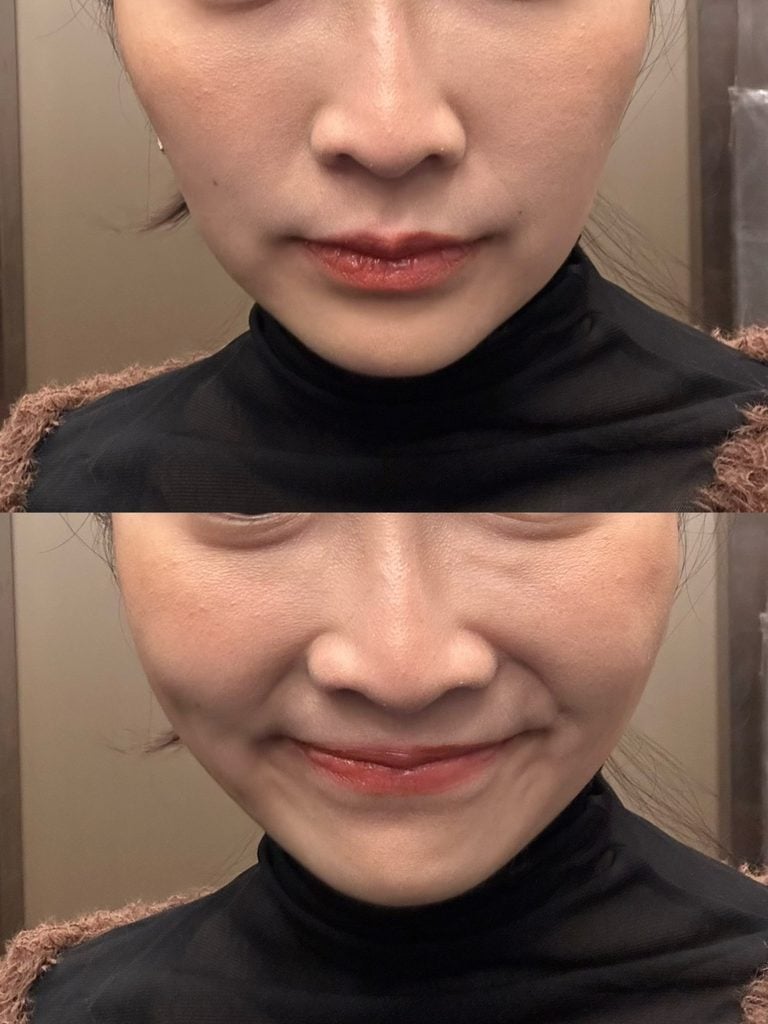
Some people naturally have a muscle that bulges when they smile. After tear trough hyaluronic acid you may find the bulge when smiling is more obvious, because the underlying apple cheek has been propped upward. This is not a tear trough caterpillar lump and does not necessarily need dissolving.
Even after dissolving, there will still be a muscle bulge when you smile (just slightly less obvious). It depends on whether you want to return to the original state with the tear trough, and then assess whether to dissolve it.
Which brand of tear trough hyaluronic acid is recommended?
For the superficial layer I suggest the extremely small-molecule shade 6. My own long-term tested order is: Juvederm Volite, Teoxane RHA1, Restylane Vital Light; with a limited budget you can choose Korean honeycomb hyaluronic acid small molecule, which has low allergenicity and about 50% or more remaining after 1 year. Shade 5 fillers (Vobella, Balance, RHA2 and so on) should be left for the deep layer or the small apple cheek area; placed in the superficial layer they easily give a lumpy feeling.
Why does tear trough hyaluronic acid become a caterpillar lump?
Because medium-to-large molecule hyaluronic acid was placed in the superficial layer (above the orbicularis oculi muscle). The tissue in that layer is very thin, and as little as 0.1cc of firm material straying in will bulge, hanging like a worm under the eye even when you are not smiling. This is not a dose problem but a layer problem.
Why is it bluish under the eye after tear trough hyaluronic acid?
This is the Tyndall effect. Large-molecule hyaluronic acid placed in the superficial layer refracts light like a convex lens, giving a bluish streak under the eye and making dark circles look worse instead. Treatment is to dissolve it and redo it with extremely small molecules.
Which is better: tear trough hyaluronic acid, Ellanse or Aesthefill?
It depends on the layer. For deep-layer support, both are fine, and the advantage of stimulators is that they last long. But the superficial layer can only use hyaluronic acid, because Ellanse or Aesthefill placed in the superficial layer form non-dissolvable lumps that may not go away for years and usually end up needing surgical debridement. When filling the tear trough for the first time, or when unsure of the doctor's experience, the reversibility of hyaluronic acid is the safer choice.
Taipei tear trough aesthetic treatment recommendation: Golden Apple Aesthetic Clinic
Golden Apple Aesthetic Clinic has been open for five years and started out with tear trough injections. I have performed over 5000 tear troughs. Before injection, we first confirm the blood vessel positions with ultrasound and inject with a blunt cannula to help you avoid tear trough caterpillar lumps.
Golden Apple Aesthetic Clinic is located in Zhongshan District, Taipei (Exit 2 of Nanjing Fuxing MRT Station). All tear trough aesthetic treatments are consulted and performed personally by Dr. Ou Chia-Hung..
- Address: 1F, No. 107-2, Liaoning St., Zhongshan Dist., Taipei City (Nanjing Fuxing Station Exit 2)
- Appointments: LINE official account @goldiapple (please add the @)|Phone 0966-370-822
- About the doctor: About Dr. Ou Chia-Hung and Golden Apple Aesthetic Clinic
Want to know your own tear trough type? Consult Dr. Ou at Golden Apple now!
Online consultation
Written and updated by Dr. Ou Chia-Hung (founder and director of Golden Apple Aesthetic Clinic) | Last updated: October 4, 2026. The costs in this article are public reference ranges and are not an individual quote; the durations and test results in the article are clinical and individual-case observations, vary greatly between individuals, and are not a guarantee of results. This article is health education information and cannot replace an in-person consultation.