
The Short Answer: How Botox Is Priced
Botox is priced by the unit (U), not by the session. So "how much is Botox" has no single answer: treating the three dynamic lines versus the masseter differs by three to five times in units, so the cost differs just as much. Calculated per Botox 1U, Botox costs about NT$150–200, Dysport about NT$120–160 and Korean toxins about NT$90–120. Be especially careful with Dysport's unit conversion: its 1U is not the same as Botox's 1U.
| Item | Details |
|---|---|
| Pricing method | By the number of units (U) injected, not by session |
| Botox | About NT$150–200 per Botox 1U |
| Dysport | About NT$120–160 per Botox 1U (converted); NT$50–65 per Dysport 1U |
| Korean toxins | About NT$90–120 per Botox 1U (Miracle, Rainbow, Botulax and others) |
| Key conversion | 1U Botox ≈ 2.5–3U Dysport. Always confirm which U a price uses |
| Units for the three dynamic lines | About 34–60U in total (varies with muscle strength) |
| Units for the masseter | 40–80U (both sides combined) |
| When results appear | Three dynamic lines 3–7 days; large muscles 3–4 weeks |
| Longevity | About 3–6 months, depending on constitution and muscle strength |
| Brand differences | Longevity differs by a month or two at most, unlike the big brand gaps in hyaluronic acid |
This article was written and reviewed by Dr. Chia-Hung Ou of Golden Apple Aesthetic Clinic and last updated in October 2026.
The above are common market price ranges. Each clinic prices differently depending on brand source, the doctor's experience and the services included. The actual number of units must be assessed at a consultation, and a low unit price does not mean a low total price.
- Ask about units before asking about price. "How much for one session" gives no useful information; ask "how many U does this area need, and how much is one U?"
- Dysport's unit price looks cheap because its unit is defined differently. 1U of Botox is roughly 2.5–3U of Dysport, and it is easy to misjudge if you don't confirm.
- Botulinum toxin is more like a generic drug. After the patents expired, many manufacturers could produce it, and the differences between brands are far smaller than with hyaluronic acid. Choose what you are used to and can afford.
- How long it lasts depends more on your constitution than on brand. People with strong muscles metabolize it faster and their lines return sooner, which has little to do with which brand you choose.
1. How Is Botox Priced?
Why "how much for one session" has no answer
Botox is priced by the number of units (Unit, or U) injected. A vial contains a fixed number of units, the doctor draws the dose your muscles need, and you pay for what is used.
So the cost of "getting Botox" can vary a lot:
- Frown lines: about 8–16U
- All three dynamic lines: about 34–60U
- Masseter (both sides): about 40–80U
- Calves (both sides): about 200–400U
The highest and lowest differ by twenty to thirty times. That is why asking "how much for one session" is meaningless: ask "how many U does this area need" and "how much is one U."
The most misleading point: Botox U and Dysport U are not equivalent
This is the point I think you should watch most when comparing prices.
Dysport defines its unit differently from Botox. The conversion is roughly:
1U Botox ≈ 2.5–3U Dysport
So if a clinic quotes "Dysport is only NT$55 per U," it sounds much cheaper than Botox at NT$180. But since you need 2.5–3 times as many units, the real cost per "Botox-equivalent unit" is about NT$140–165, not as big a gap as it seems.
When asking for a price, ask directly: "Is this price calculated in Botox U or Dysport U?" That one sentence avoids most misunderstandings.
2. Price Comparison of Botulinum Toxin Brands
| Botox | Dysport | Korean toxins (Miracle, Rainbow, Botulax) | |
|---|---|---|---|
| Price per Botox 1U (converted) | NT$150–200 | NT$120–160 | NT$90–120 |
| Manufacturer's unit price | Same as above | NT$50–65 per Dysport 1U | Same as left column |
| Origin | Allergan, USA | Ipsen, UK | Korea |
| Positioning | The original botulinum toxin, highest unit price | Different unit conversion, needs confirming | More affordable unit price |
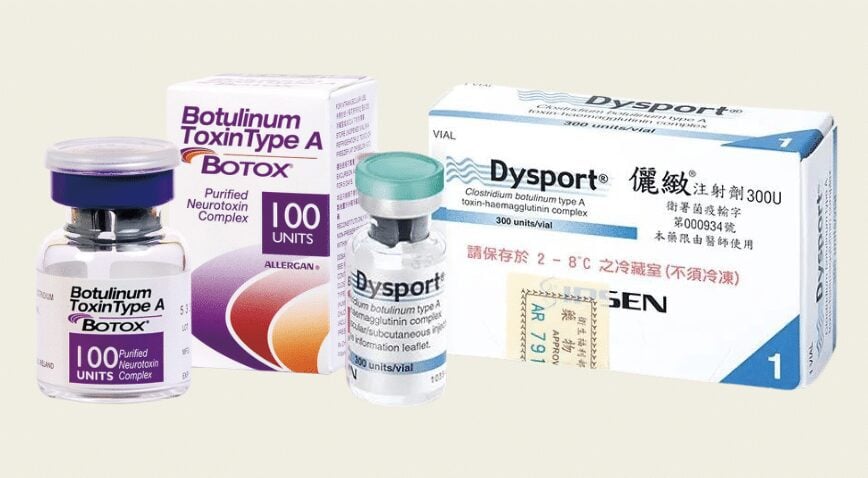
My view: botulinum toxin is more like a generic drug
Botox is the original botulinum toxin and also the most expensive brand. But with the patent expired, the toxin's structure is no longer a secret, and aesthetic manufacturers around the world have joined in production.
This is very different from hyaluronic acid. Different hyaluronic acid brands differ greatly in cross-linking technology, G′ value and support, and switching brands can give a completely different result. But botulinum toxin is more like a generic drug: the ingredient and mechanism are highly similar, and longevity differs by a month or two at most.
So I usually advise: choose the brand you are used to and can afford. There is no need to exceed your budget for a particular brand, and no need to keep switching brands just because one is cheaper.
3. How Many Units for Each Area? (with Cost Estimates)
The units you need depend on your muscle tension and muscle mass: the more developed and stronger the muscle, the more units it needs, which is why the recommended range for the same area is so wide. The figures below are average references; the actual amount is always determined at an in-person consultation.
Three dynamic lines: forehead lines, frown lines, crow's feet
| Forehead lines | Frown lines | Crow's feet | |
|---|---|---|---|
| Recommended units | 12–24U | 8–16U | 14–20U |
Treating all three areas together takes about 34–60U in total. The approximate cost is:
| Brand | Cost for all three dynamic lines (34–60U) |
|---|---|
| Botox | About NT$5,100–12,000 |
| Dysport | About NT$4,080–9,600 |
| Korean toxins | About NT$3,060–7,200 |
The techniques and risks of treating these three areas (uneven brows, brow lifting, heavy brows) are in my article on Botox for the three wrinkle areas. Here I only cover cost.
Large muscle groups: masseter, trapezius, calves
| Masseter | Trapezius (shoulders) | Gastrocnemius (calves) | |
|---|---|---|---|
| Botox U | 40–80U | 120–200U | 200–400U |
| Dysport U | 100–240U | 300–600U | 500–1,200U |
| Botox cost reference | About NT$6,000–16,000 | About NT$18,000–40,000 | About NT$30,000–80,000 |
| Further reading | Masseter Botox | Shoulder Botox | Calf Botox |
Large muscle groups need several times the units of the three dynamic lines, which is why slimming the face, shoulders and calves costs noticeably more than wrinkle treatment.
4. How Soon Does Botox Work?
| Type | Areas | When results appear |
|---|---|---|
| Three dynamic lines | Forehead lines, frown lines, crow's feet | 3–7 days after injection |
| Large muscle groups | Masseter, trapezius, calves | 3–4 weeks after injection |
They differ so much because the effect on expression muscles comes from "the muscle no longer contracting," which is visible as soon as the signal is blocked. For large muscle groups the goal is to shrink muscle volume, and the muscle only gradually atrophies after it stops working for a while.
So it is normal to feel "nothing has changed" a week after masseter Botox. Please wait until weeks three or four to assess.
5. How Long Does Botox Last? Why Does It Fade Faster for Some People?
In general it is 3–6 months. But I want to point out a factor more important than brand: constitution.
Botox works by blocking the signal from the nerve to the muscle. But the muscle doesn't accept this quietly; it tries every way to repair this "broken bridge."
- People with strong muscles repair quickly: the connection is restored soon, and forehead lines come back early.
- People with weak muscles repair slowly: results can last longer (but these people are also more prone to heavy brows).
So this often happens: a friend says brand X lasted a long time for them, you get brand X too, and your lines appear after three months. Quite likely, if you switched to another brand, the longevity would be about the same.
In my own observation, people with more developed muscles usually see their lines return after three or four months of Botox.
If you feel it is "working less and less" rather than "lasting a shorter time," that is a different issue, which I cover in my article on Botox resistance.
Whatever brand you use, I recommend topping up the three dynamic lines every six months to reduce the chance of static lines forming in the future.
6. Masseter Botox: I Quantify the Results with Ultrasound
I used to feel like a fortune teller: pinching a patient's face, feeling the thickness of the masseter, and judging the dose by touch.
Many masseter patients are my engineer friends. While chatting they asked me: is there a way to quantify the results with numbers?
So I started to record each person's masseter thickness with ultrasound.
For example: this patient's masseter thickness before treatment was about 2 cm, and the total dose was 100U on both sides. At the three-month follow-up, the masseter thickness was down to 1 cm.
For treatment planning, I usually recommend a small top-up within three months after the first dose to maintain longevity, and after that a maintenance dose about every six months.
7. What Are the Side Effects of Botox?
The one you most need to know is heavy brows.
As mentioned, Botox blocks the muscle. Some people with weaker muscles respond very well to Botox: the frontalis goes completely flat and fully blocked, making it hard even to raise the eyebrows. This is heavy brows.
If this really happens, don't worry too much. It usually recovers naturally in one to two weeks. What matters is to remember it and tell your doctor to reduce the dose at your next top-up.
This is also why I dose conservatively for first-time patients: Botox can be added, but not taken away.
8. What to Watch for When Comparing Botox Prices
- Confirm whether it is Botox U or Dysport U: this is the biggest price trap, a 2.5–3 times difference.
- Ask exactly how many U are needed: a low unit price with a high recommended number of units does not necessarily mean a lower total.
- Confirm the brand and source: ask the clinic to state the brand used and whether it is legally imported.
- Be careful with "use the whole vial": the number of units in a vial varies by brand, so confirm the units actually injected into you.
- Don't switch doctors just for a price difference: the result depends on injection placement and dose judgment, and skill is worth more than the few dollars saved per unit.
My position is simple: brand differences in Botox are small, but differences in the doctor's dose judgment are large. Saving on brand is reasonable; saving on assessment usually does not pay off.
9. Botox Price FAQ
How much is 100U of Botox?
In Botox units, Botox is about NT$150–200 per U, so 100U is roughly NT$15,000–20,000. Dysport converted is about NT$120–160 per U, so 100U is about NT$12,000–16,000. Korean toxins are about NT$90–120 per U, so 100U is about NT$9,000–12,000. But the actual cost depends on how many U you need. 100U is roughly the amount for both masseters, or for the three dynamic lines plus some fine adjustments.
How should I choose a botulinum toxin brand?
Botulinum toxin is like a generic drug. After patent expiry, each manufacturer's ingredient and mechanism are highly similar, unlike hyaluronic acid where brands differ greatly, and longevity differs by a month or two at most. I usually recommend choosing the brand you are used to and can afford, without exceeding your budget for a particular brand.
How are Dysport units converted?
Dysport defines its unit differently from Botox. The conversion is roughly 1U Botox ≈ 2.5–3U Dysport. So don't compare "Dysport at only NT$50–65 per U" directly with Botox; converted to Botox-equivalent units it is about NT$120–160. When asking for a price, ask the clinic directly whether it is calculated in Botox U or Dysport U.
Can Botox remove static lines?
Unfortunately, no. Botox only treats dynamic lines; static lines that have already formed are irreversible. Botox is more of a "defense": it reduces lines that would form in the future, which is why I recommend topping up the three dynamic lines every six months. If you already have obvious static lines, fillers or other treatments are needed.
How soon does Botox work?
It depends on the type. The three dynamic lines (forehead lines, frown lines, crow's feet) show results 3–7 days after injection. Large muscle groups (masseter, trapezius, calves) take 3–4 weeks to show, because they work by shrinking muscle volume, which takes time. No change a week after masseter Botox is normal; please wait until weeks three or four to assess.
How long does Botox last? Why does mine fade faster than others'?
Generally 3–6 months, but constitution matters more than brand. After Botox blocks the nerve signal, the muscle tries to repair the broken bridge: people with strong muscles repair quickly and their lines return early, while people with weak muscles last longer (but are also more prone to heavy brows). So if a friend's brand lasted a long time but the same brand only lasts three months for you, switching brands usually makes little difference. People with more developed muscles usually see lines return after three or four months.
Are there side effects of Botox?
The most common is heavy brows. Some people with weaker muscles respond very well to Botox, and the frontalis is fully blocked, making it hard to raise the brows. There is no need to worry too much; it usually recovers naturally in one to two weeks, and you just tell your doctor to reduce the dose at the next top-up. Because Botox can be added but not removed, I dose conservatively for first-time patients.
How many units of masseter Botox are needed? How much does it cost?
In Botox units, both sides together take about 40–80U, which costs roughly NT$6,000–16,000 with Botox. For treatment planning, I usually recommend a small top-up within three months after the first dose to maintain longevity, and a maintenance dose about every six months afterward. I now record masseter thickness with ultrasound to quantify results. In one case, thickness before treatment was about 2 cm with 100U in total on both sides, and at three months it was down to 1 cm.
Why do the units needed vary so much from person to person?
Because Botox is priced by units, and the units each person needs depend on muscle tension and muscle mass: the more developed the muscle, the more dose it takes to relax it. For the three dynamic lines, the total falls around 34–60U, quite a wide range. So the quote differs according to the dose assessed at your consultation. This is not differential pricing, just a difference in dose.
Is it fine to go to a clinic with a low unit price?
A low unit price does not mean a low total price, nor good value. When comparing, confirm three things: whether the price is in Botox U or Dysport U, how many U this area needs, and the brand and source used. Also, the result depends largely on injection placement and dose judgment. Brand differences are small, but the doctor's assessment differs a lot: saving on brand is reasonable, saving on assessment usually does not pay off.
Author and Medical Review
This article was written and reviewed by Dr. Chia-Hung Ou of Golden Apple Aesthetic Clinic. Prices in the article are reference ranges common on the market, and each clinic prices differently. Units are clinical averages, and the actual dose must be assessed at an in-person consultation and adjusted for individual muscle tension, sex and prior injection history.
- Carruthers J, Fagien S, Matarasso SL. Consensus Recommendations on the Use of Botulinum Toxin Type A in Facial Aesthetics. Plast Reconstr Surg. 2004;114(6 Suppl):1S-22S.
- Scaglione F. Conversion Ratio between Botox, Dysport, and Xeomin in Clinical Practice. Toxins (Basel). 2016;8(3):65.
- Kim NH, Chung JH, Park RH, Park JB. The Use of Botulinum Toxin Type A in Aesthetic Mandibular Contouring. Plast Reconstr Surg. 2005;115(3):919-930.
- Seo KK. Botulinum Toxin for Asians. Springer; 2017.
To find out how many U you need and what it would cost, you are welcome to book a consultation. I will first assess your muscle tension and then recommend a dose and quote.